
Expert Opinion
Vantage Point: Examining the Bifurcated Market
RVA predicts deliveries will reach nearly 900 aircraft this year
Primary Business Aircraft OEM Backlog Evolution
© Rolland Vincent Associates

As trusted advisers to business aviation leadership since 2009, we have continuously been asked to provide judgment calls to some of the industry’s most vexing questions. From the aircraft OEMs, these questions have ranged from: What should we do next? What product do we need to become the market share leader in our segment? How big is the total addressable market for my new aircraft? Why isn’t it bigger than that? How do we fill our sales pipeline? What strategy do we need to penetrate market X to achieve a market share target of YY%? Why do I need to invest in my aircraft when it is at its peak production rate today? What is your forecast for the future? Are younger customers ever going to buy an airplane, or are they just going to share them? What if we see oil sustained at $120 a barrel? Where do I find people who know which way to turn a wrench to tighten a bolt? Are we operating in a bifurcated market? Should I be worried that the Nasdaq is up by a factor of 2.5x in four years? How sustainable is the upmarket? What “black swans” keep you up at night?

Ah, the life of an aviation consultant. Many questions, fewer good answers. Don’t let me be misunderstood—I love what I do, and the questions are fascinating. Answering them—backed with as much empirical data and analytics, our own proprietary indicators, and a healthy dose of judgment by experience—can be rejuvenating, much like the feeling you get after solving a complex puzzle. 

Let’s start with a simple question we’re hearing a lot: Is business aviation a bifurcated market? If you are a manufacturer, an aircraft owner, a prospective buyer, or a lender/lessor with skin in the game, this is a very important topic. Our one-word response? Yes.

In a perfect world, transaction prices for preowned aircraft of various vintages would be a pretty good place to start to look for answers. Too bad the data are not always so straightforward, clear, or accommodating. Simply said, reliable preowned business jet pricing has long been the industry’s Holy Grail—highly valuable, closely guarded, and notoriously difficult to find. Peeling back the layers of the onion, we do see evidence that the larger and younger the aircraft, the more it retains its value. The International Aircraft Dealers Association’s (IADA) Q2 2026 Market Report makes for some interesting reading (which we recommend), especially with regard to price movements and pressures. IADA’s findings point to a firming preowned market, particularly for newer midsize and large-cabin aircraft. Asking prices are steady or rising, while price reductions have become less frequent, with buyers increasingly paying premiums for scarce, highly pedigreed aircraft. Bottom line: Analysts still seeking the Holy Grail can continue their search for the closely guarded transaction prices at which aircraft actually change hands.

Amstat’s Q2 2026 Business Aircraft Preowned Market Update highlighted some important pricing and value indicators in the current large-cabin/“heavy-jet” segment, with asking prices down 35% while transactions were up 44% year over year (YOY) through the end of June 2026. What this reflects is a situation where the high-end market segment has been continuously scraped of attractive inventory. In the meantime, median resale values—a broad-based but more accurate indicator of actual transaction prices—have increased steadily for more than a year, ending June 2026 up 13% YOY. The result: Prospective buyers at the top of the market are no doubt being frustrated by the fact that, as the song says, they can’t always get what they want.

Our proprietary mood-of-the-market indicators from RVantage surveys suggest that their wait to enter the large-jet club, while maddening, may actually be worth it one day—existing owners and operators of large business jets make up the most optimistic segment we regularly monitor regarding current and evolving market conditions. And the beat goes on—firm order backlogs at the five largest aircraft OEMs reached $67 billion at the end of the second quarter of 2026, up an impressive 13% year to date and up 24% since the beginning of 2025.

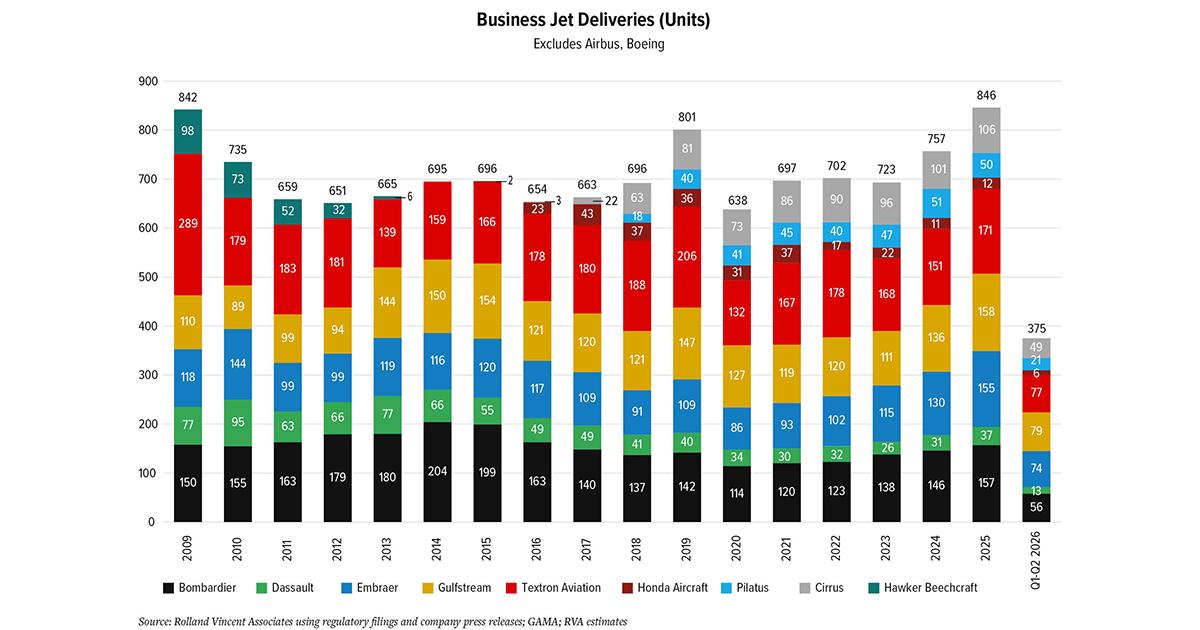
What’s our outlook for the year? From our vantage point, we’re predicting just under 900 business jet deliveries in 2026 with a combined list price value of more than $30 billion. By any measure, this will be another solid performance for an industry that, like others, was reeling in an existential crisis as recently as 6.5 years ago. If achieved, 2026 jet deliveries will come in about 5% higher YOY on a unit basis. Backlog burndown? Nah.

Depending upon the region of interest and the database provider, business jet cycles in the U.S. appear to be up about 2.5% YOY, growing at a modest but steady rate that is in line with underlying fleet and real GDP growth.  

With just over 26,000 business jets in service worldwide, the five largest business jet manufacturers are collectively managing roughly two years’ worth of firm orders, a comfortable place to be. Investments in additional production, completions, and MRO capacity can’t seem to come online fast enough. Maybe that’s a good thing—giving us all some more time to bring in fresh talent and accelerate skills training in the complexities of righty-tighty, lefty-loosey. Better yet, leading companies and technical training centers are actively engineering human error right out of aircraft assembly and maintenance processes, having wisely anticipated generations of digitally-native workers entering the labor force. The need for mechanical skills and aptitude, long the foundation of aircraft manufacturing and MRO operations, will stick around for years to come, in my humble opinion. Whether, and how well, we can transition to modern manufacturing processes given aviation’s comparatively low-rate/slow-rate production world is a strategic question for another day.

Rollie Vincent is founder and president of Rolland Vincent Associates, a strategic advisory firm that provides proprietary market intelligence, forecasting, and executive counsel to senior leaders across the global business aviation industry. The organization is hosting its inaugural RVA Summit on Feb. 15 and 16, 2027, at the Mayflower Hotel in Washington, D.C.

Business Jet Deliveries
© Rolland Vincent Associates
Rolland Vincent
About the author
See more by this author