While clean-sheet aircraft designs hit the market from time to time and draw attention, much of the improvement in aerospace engineering is applied incrementally to new models. Though not as flashy as a futuristic rendering, these progressions today often incorporate advanced materials elegantly woven into an existing type-certificated design.
Alongside these new materials, the industry has adopted new ways of manufacturing in pursuit of lowering costs, building efficiency, and reducing waste. Solutions go beyond those now-common ones involving 3D printing and its corollary, additive manufacturing, where a component is built by layering material into a given shape rather than carving it out of a block—which, if done correctly, produces much less discarded material. Indeed, many OEMs have entered a world where the life cycle of the material itself takes center stage. And, the improvements are not just in the material itself, but in how it is reused to reduce cost and impact on the planet.

French company Daher, through its aircraft business, manufactures the TBM 900 series and Kodiak 100 and 900, all single-engine turboprops built primarily from aluminum and steel, with composite components typically in non-load-bearing structures. As an industrial conglomerate, however, it has made significant investment into developing ways to use carbon fiber and thermoplastic parts in an ever-widening range of aerospace applications.
Initially among these advancements, Daher has developed a patented induction thermoplastic welding technology. This fastener-free assembly “represents a major technological breakthrough, allowing for a reduction in the weight of aerostructures by up to 15%—a gain impossible with traditional methods,” according to the company. In late 2024, this innovation was validated at its Shap'in Tech Center in Nantes, France, with a fixed horizontal tailplane demonstrator for aircraft, “confirming its industrial feasibility.”
The second pillar of this strategy focuses on upcycling scrap that is generated during the production of thermoplastic composite parts. Daher has implemented a process by which production scrap is collected on site, ground up, and then transformed into a semi-finished product. As a result, 100% of the pure carbon polyphenylene sulfide (PPS) scrap is upcycled through this process, according to Daher.
“The resulting semi-finished product is a pellet containing 56% carbon fiber. Derived from fibers that originally were continuous and reprocessed into short fibers, it offers high mechanical performance, including excellent temperature resistance and strong resistance to moisture and chemical exposure," even if it can’t be used in structural, load-bearing applications.
Daher now estimates a production capacity of four to seven tons per year of carbon PPS pellets. Recently, using the same scrap material, the Daher Group developed a filament for additive manufacturing, opening new opportunities for 3D printing of technical parts. Dominique Bailly, Daher’s R&D Director, explained the process, the details, the implementation, and the future.
Daher began targeting its first part for the use of the recycled pellets in the rudder pedals used in the flight deck of the TBM 960 and now, TBM 980. The application was chosen for several reasons, one of which was its utility function as well as its placement out of sight in the airplane. “A few years ago we were looking for an application on our aircraft that could be successful, switching from machined aluminum to injected carbon PPS parts,” Bailly told AIN. “We selected the TBM rudder pedal. We made the demonstration, we made some prototypes, and we did some tests. Finally, we were successful in the certification demonstration with EASA."
Discussing the process, he added: “We grind the waste coming from the plant, so at the end the carbon fiber is only 0.6 millimeters long, so you cannot have very high loads [translating] through the parts that are redesigned, but for simple loads it works very well; it has very nearly aluminum mechanical characteristics.”
The next part in development makes sense: the rudder pedals on Daher’s Kodiak 100 and 900 utility turboprops. First, the internal team must determine the interest in making the change, and understand if it will have the same cost- and materials-saving advantages that transpired with the TBM rudder pedal replacement. Weight savings was not a goal for the TBM pedals, said Bailly, as it would have only been a few grams and negligible on the 7,650-pound turboprop.
Also in development is the door handle on the TBM, and it presents similar advantages (saving cost through the reduced need to purchase new materials) but different challenges, since it is highly visible—and its aluminum predecessor came polished to a considerable shine. That can’t be done with carbon fiber, and Bailly is concerned about adding a layer of metal deposition.
Some future applications will involve the use of the PPS sandwiched between two fiberglass layers, with the aim of isolating the PPS from metal components and the resulting risk of corrosion. “We are actually working to demonstrate that we can mix pure C/PPS with C/PPS+ glass without any impact on mechanical characteristics, in order to double the volume of waste available,” said Bailly.
Daher’s thermoplastics division in Nantes not only creates new parts for the TBM, but also components for other manufacturers, such as Dassault and Airbus, including the high-load wing rib—for which it just won the JEC Composites Innovation Award. “In Nantes we have one of the biggest thermoplastic aeronautic plants in the world,” said Bailly. “So we manufacture a lot of parts every year for the [Airbus] A350 program and other legacy programs. Unfortunately, we have waste. Even if the plant has worked hard to reduce the waste, there is still waste. There are two solutions: We pay to remove this waste from our plant, or we transform it. So, we decided to transform it. And actually, it's something around three tons per year. But it could be up to seven tons per year.”
Part of Daher’s strategy, according to Bailly, lies not just in the reduction of waste, but also in developing the know-how to produce upcycled and more complex thermoplastic structures, as its B2B customers look at producing single-aisle Part 25 category aircraft out of a greater percentage of composite material than ever before. “They intend to put more composites, so more thermoplastics also, on their aircraft. With the high run rate of these programs of 80 aircraft per month, the volumes will be very high, so we have to prepare. That’s what we are doing today based on the A350’s low-rate program, to build that capacity and anticipation of those future designs.”

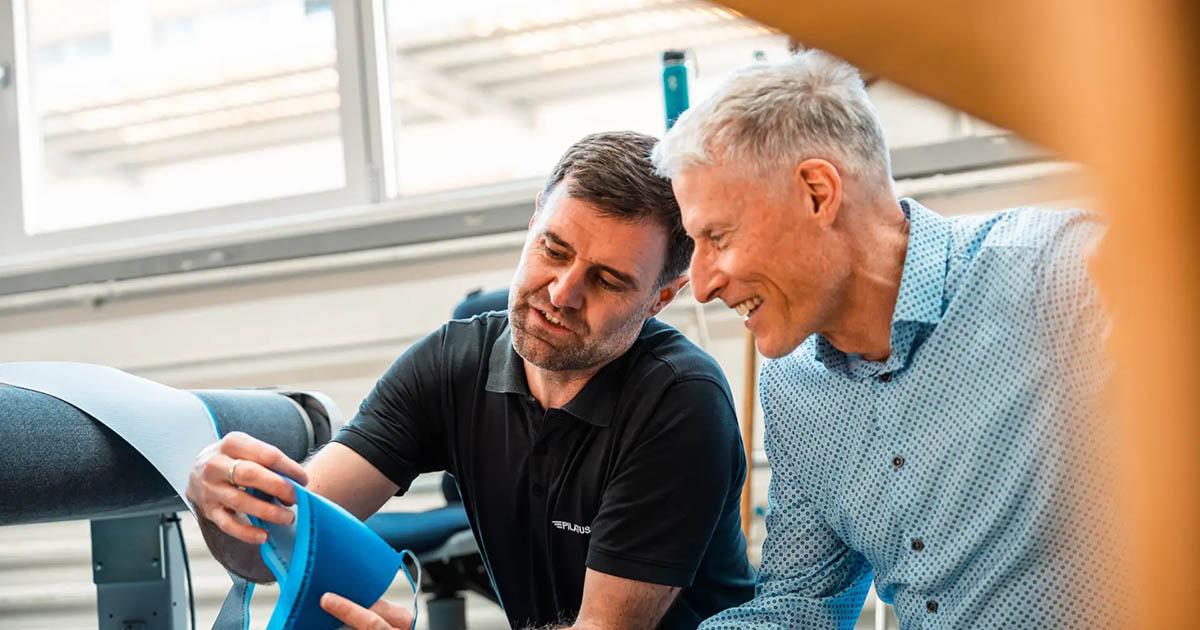
Pilatus Aircraft, based in Stans, Switzerland, has figured out that it creates more than 13,000 pounds of waste material in the process of producing components from carbon fiber web material pre-impregnated with synthetic resin, a common material used in composite manufacturing across the aviation industry—and used in both the PC-24 and PC-12. Pilatus goes through more than 90,000 sq m of prepreg material (delivered on rolls in refrigerated trucks) per year, according to supplier Zund.
In May, Pilatus kicked off a 32-month study in partnership with several Swiss institutions to investigate whether carbon fiber production waste can be recycled directly back into the aircraft construction process. Urs Thomann, director of technologies, processes, and sustainability at Pilatus, discussed its figures.
Recycling the material could significantly reduce production waste and potentially replace certain aluminum parts with carbon components, generating savings of up to 36 tonnes—nearly 80,000 pounds—of aluminum per year, Thomann told AIN.
The process that the study will investigate heats tacky prepreg scraps in a controlled setting, through which they will lose their adhesive qualities and be able to undergo further processing. Then, the material can be cut into small pieces and transformed into new components using a special pressing process before hardening and finishing. The current industrial method used in aerospace doesn’t directly transform unused prepreg waste into new components—most go through an intermediate step into pellets, which are used in injection molding tools to create new parts.
Researchers at Lucerne University of Applied Sciences and Arts and Inspire, a strategic partner of ETH Zurich, will collaborate with Pilatus on the investigation. Backing for the project comes via Swiss innovation agency Innosuisse. “Close cooperation with our research partners creates ideal conditions for exploiting the potential of high-value waste materials to even better effect, and for quickly putting new solutions into practice,” said Thomann.
Pilatus also has committed to using better materials within its cabin interiors. In particular, use of transparent F/Lab Natural Oil minimizes the release of harmful volatile organic compounds into the environment, and it’s built to last: the oil-treated surface is scratch- and stain-resistant to work well in a high-use environment with minimal maintenance.

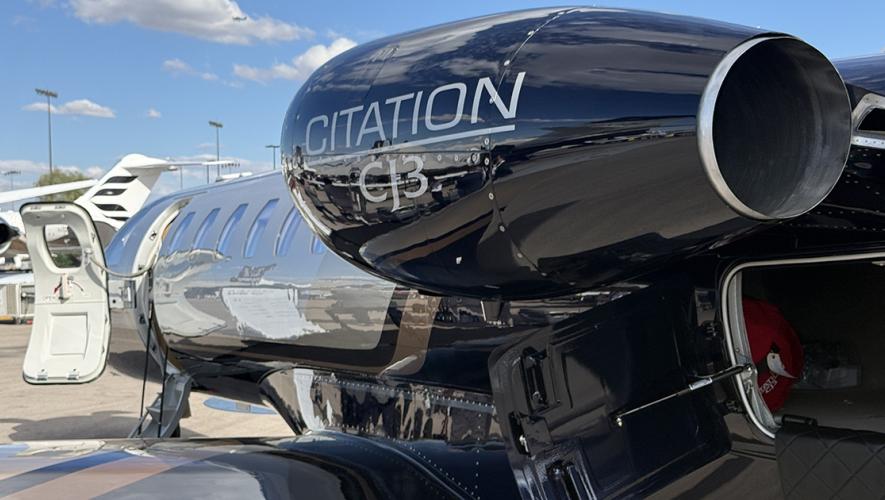
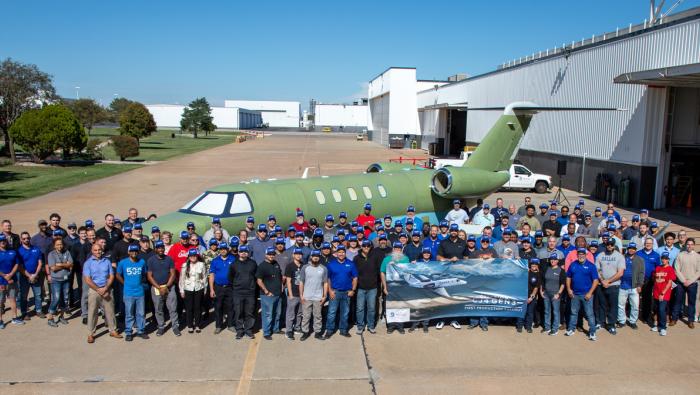
Like Pilatus, Textron Aviation has also incorporated materials into the fuselage and interiors of the Gen3 series Cessna Citations that leverage their composition and design to reduce weight and thus gain extended range and/or payload. It’s part of an overall sustainability vision that has also driven the use of Evergy and its New Green Energy program in Kansas, which involves wind energy along with other sources. In fact, in its first year using the program, Textron Aviation’s Wichita facilities used 100% renewable wind energy.
According to the company, “Many sustainable materials have inherent natural properties that make them ideal for aircraft interior design. Wool, for example, is sound-dampening and naturally flame-resistant. Cotton, linen (flax), silk, mohair, and bamboo are also naturally flame-resistant.” The OEM has strived to incorporate materials that are “cradle-to-cradle certified—meaning that at the end of their useful life, they biodegrade in a way that is safe for human health and the environment.” Typically, these natural materials cost less to manufacture as well.
Part of the Business Aviation Community Commitment on Climate Change is the drive to increase fuel efficiency by an average of 2% per year between 2020 and 2030. As Textron Aviation has reported, the OEM is most of the way there now. This is important as jet-A prices continue to rise, responding to global events.
In 2010, Chris Hearne was leading program management on the Citation CJ series for Cessna Aircraft prior to its evolution into Textron Aviation. Now, Hearne is senior v-p of engineering for the Wichita-based manufacturer. In an interview at Aero Friedrichshafen in April, Hearne talked about the progression the CJ marque has made over the past 16-plus years, and its foundation in “voice of the customer.” “Customer feedback starts with our customer advisory boards, so that it’s a formal process for us,” he said.
Because of this feedback, in part, Textron Aviation uses green materials in textiles, carpets, and wood veneers throughout the Citation product lines. “Sourcing biodegradable materials with long life spans and clean manufacturing processes, such as aviation-grade leather, contributes to mindful sustainable design,” according to the company’s mission statements on sustainability. “We are also conscious about selecting materials only from carefully managed forests, and leveraging surplus inventory to further reduce our environmental footprint.”
And like at Daher and Pilatus, recycling plays a part as well: “Textron Aviation has a robust recycling program that includes scrap metal and composite materials generated during the manufacturing process. This program reduces reliance on new natural resources. Additionally, landing gear, avionics, and electronics can be recycled and repurposed.”
The drive to improve sustainability also underpins the company’s workforce development, according to Hearne. “I’m looking for an engineer that remains curious, that remains not just curious about that system or that area that the engineer is working in, but what's around that engineer. Meaning, if I’m a systems engineer, I’m also interested in structures. From structures, I am interested in systems that attach to the structure. And [that process] leads to a better engineering function.”
As the manufacturers across the industry have driven more recycling efforts into their collective sustainability mission, specific programs targeting composite and other materials used will continue to expand, as companies realize real gains that go beyond the “feel-good” aura of reducing waste and an overall environmental footprint.
Look for components to evolve from traditional materials cut from raw blocks of metal, and for companies to leverage onsite 3D printing and other advanced fabrication methods to add even more value to the process of incorporating carbon fiber and thermoplastics.