With a growing portfolio and lengthening backlog, Gulfstream Aerospace anticipates production will reach at least 200 aircraft a year in the no-too-distant future, which would be a record rate for the Savannah, Georgia airframer. Expressing confidence that Gulfstream would reach this production level, president Mark Burns said, “That’s a number. It's not the number.”
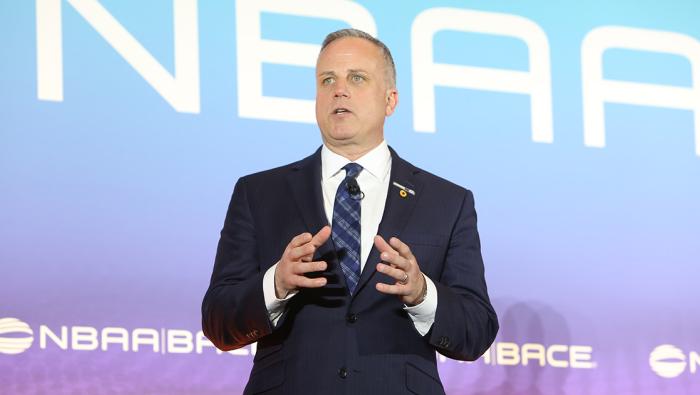
Speaking to reporters at NBAA-BACE, Burns noted that the production rate will be about 160 jets this year, but that the company has heavily invested in its facilities and designed them with scalability to accommodate growth.
Supporting these optimistic plans is a Gulfstream backlog that extends multiple years. By mid-2026, the OEM’s backlog had topped $25 billion, up $4 billion from late 2025. “Barring any unforeseen catastrophe, I think it’s inevitable,” Burns said of the production increases.
These ambitions are the fruits of a concerted plan dating back more than a decade to bring a new lineup of six business jets to market. “When we announced the G500 and G600 in 2014, we were actually working on six airplanes, not two,” Burns explained, referring to the G700 and G800 siblings, as well as the still-in-development G400 and G300. “We were just coming off a very successful entry into service for G650, and we said, ‘What can we do next?’”
Creating a new family of airplanes under the philosophy of “a Gulfstream for every mission” was the plan, he said. While the G400 and G300 are still in development, Gulfstream has brought the other four models to market, most recently the G800 in 2025.
The ultra-long-range G800 already has set speed records, including the 800th record the Gulfstream fleet has collectively set. Gulfstream has already delivered 34 of the 8,200-nm, Mach 0.935 jets in less than a year.
Meanwhile, the G700 preceded the G800, with its launch in 2019 and certification in 2024. More than 100 of these twinjets are in service, and the model has set 100 speed records.
Burns added that the G800 and G700 could set records on almost any trip. Earlier this month, Gulfstream flew three legs from Savannah to Singapore and back. “All three were world-record runs,” he said.
Meanwhile, he called the G600 “the foundation of this new family of airplanes.” With more than 200 of the 6,600-nm twinjets delivered since 2019, this aircraft has set more than 100 speed records. Since entering service in 2018, the 5,300-nm G500 fleet has grown to nearly 200 jets..
With this new family, Gulfstream built two campuses in Savannah for production—one for the G700 and G800 lines and the other for the G400, G500, and G600. “The lines in those facilities are built to be flexible based on demand, so as we see more of one particular airplane, the lines flex.”
Gulfstream continues to invest in its infrastructure as it supports the rapidly expanding fleet. This includes scaling its spare parts inventory, distribution capabilities, and its maintenance operations. Gulfstream’s inventory is now at a $3 billion investment, according to the company.
“As our fleet continues to grow around the world, we are making strategic investments in inventory, infrastructure, and expertise that further strengthen our ability to support customers wherever they operate,” Burns said. “By increasing parts availability, we’re providing customers with greater confidence that the resources they need are available when and where they need them.”
The airframer now has a dozen global distribution centers, and recently doubled its Atlanta warehouse, making it the largest in the network outside of its Savannah headquarters. The facility is housing some $190 million in spare parts, a 65% increase in inventory value this year alone. Gulfstream also has expanded its spares inventory by 25% over the past year, now housing $48 million worth of parts.
Separately, Gulfstream expanded its in-house component support at its repair and overhaul center in the Dallas-Fort Worth area, with additional capacity for wheels and brakes, structures, paint, non-destructive testing, hydraulics, and Gulfstream G650 landing gear assemblies. That site is further expanding its capabilities to include Gulfstream G500 and G600 hydraulic and landing gear components and has boosted staff by more than 50%.
Other investments have been directed toward Gulfstream Customer Support’s performance analytics program, which combines aircraft health monitoring information, operational data, and maintenance history to provide an overall picture of aircraft performance and system health and enable proactive support.
At the same time, Gulfstream is continuing its sustainability drive, achieving reaccreditation through NBAA’s Sustainable Flight Department Accreditation Program. This recognizes continued leadership in advancing sustainability across its global operations, Gulfstream said.
More In Aircraft