The National Aviation Hall of Fame (NAHF) leaders unveiled the 2027 class of inductees, naming six individuals who have made groundbreaking contributions to aviation and aerospace. These individuals have left their mark through a spectrum of accomplishments that furthered flight, space exploration, education, safety, aviation economics, and philanthropy, and sparked the interest and imagination of new generations.
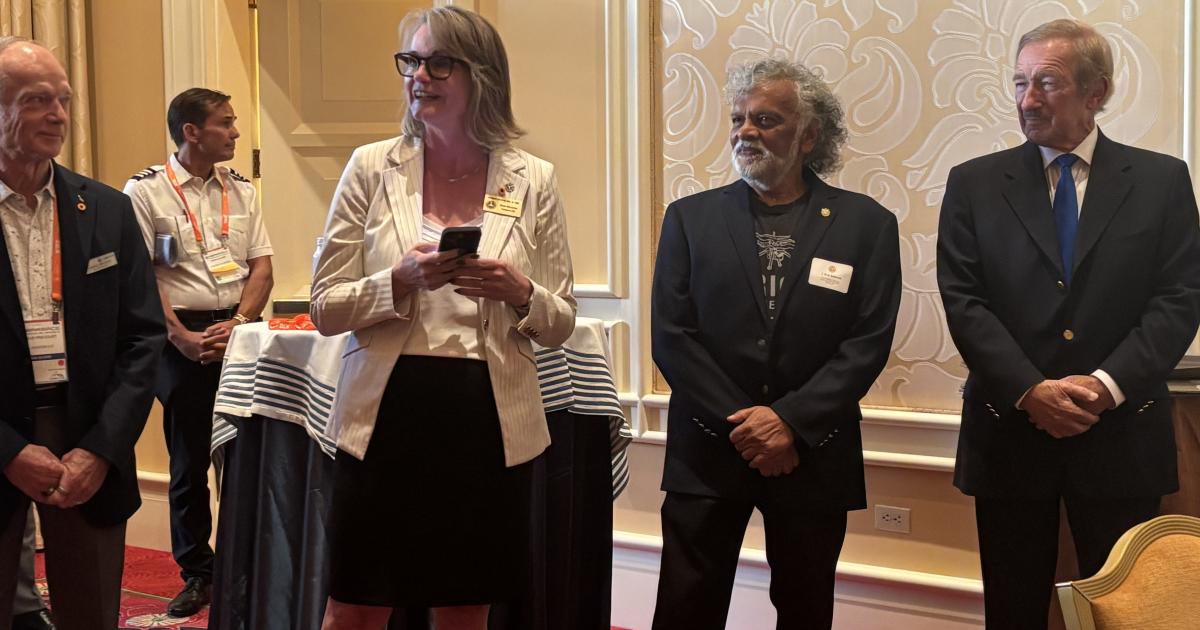
NAHF president and CEO Aimee Maruyama announced the slate during a reception on Monday during NBAA-BACE, with three of the inductees present: Mars Helicopter project originator and chief engineer J. Bob Balaram, former NASA chief astronaut and renowned aviation safety advocate Charles Precourt, and philanthropist and aviation leasing pioneer Steven Udvar-Hazy. The other members of the class include model rocketry innovator and entrepreneur Vernon Estes, the late astronaut Judith Resnik, and the late Neal Vernon Loving, who was a trailblazing aviator, aircraft designer, and aeronautical engineer.
They join 283 other individuals enshrined to date, some of whom were in attendance for the 2027 announcement. Enshrinees are selected by the NAHF Board of Nominations, composed of a panel of aviation professionals. The induction ceremony for the newest class will be held on Sept. 24, 2027, in Dayton, Ohio.
“Each year, we recognize inductees whose achievements have shaped history and continue to inspire future generations,” said Maruyama. “From the entrepreneurial vision that advanced model rocketry and commercial air travel to the engineering breakthroughs that carried us to new frontiers in aviation and space exploration, this class is extraordinary in every way.”
Balaram’s work at NASA’s Jet Propulsion Laboratory made history with Ingenuity, the first aircraft to achieve powered, controlled flight on another planet. During his nearly four-decade career, he also advanced Mars rover technology.
Estes founded Estes Industries in 1958 and invented Mabel, an automated machine that enabled mass production of safe, affordable model rocket engines. His efforts established model rocketry as a lasting educational tool and launched a hobby that continues to influence aerospace leaders.
Loving lost both legs in a 1944 glider accident but was able to return to flight and designed the midget racer Loving’s Love. He was the first African American certified to race airplanes, helped to establish an all-Black Civil Air Patrol squadron, and co-founded the Wayne School of Aeronautics.
Precourt, a decorated Air Force veteran, former NASA astronaut, test pilot, and aerospace leader, participated in four space shuttle missions, including piloting Atlantis during the first shuttle docking with Russia’s Mir space station. He later served as chief of NASA’s Astronaut Corps and led major aerospace propulsion programs at Northrop Grumman. He is currently an NBAA and EAA board member and chairman of the Citation Jet Pilots Safety and Education Foundation.
Resnik, one of the first six women chosen for the U.S. Astronaut Corps, became the second American woman to fly in space, serving as a mission specialist aboard the inaugural flight of space shuttle Discovery in 1984. An electrical engineer with a doctorate from the University of Maryland, she contributed to spacecraft systems, software, and operation of the shuttle’s robotic arm. Resnik died aboard Challenger in 1986.
Udvar-Hazy, an entrepreneur and philanthropist, helped reshape the global airline industry and commercial flight economics by co-founding International Lease Finance Corp. in 1973. This created new opportunities for airlines, which helped influence generations of airliner design and fleet development. A pilot with more than 11,000 flight hours, he also supported the annex to the National Air and Space Museum, now known as the Steven F. Udvar-Hazy Center.
In this article
More In Aircraft