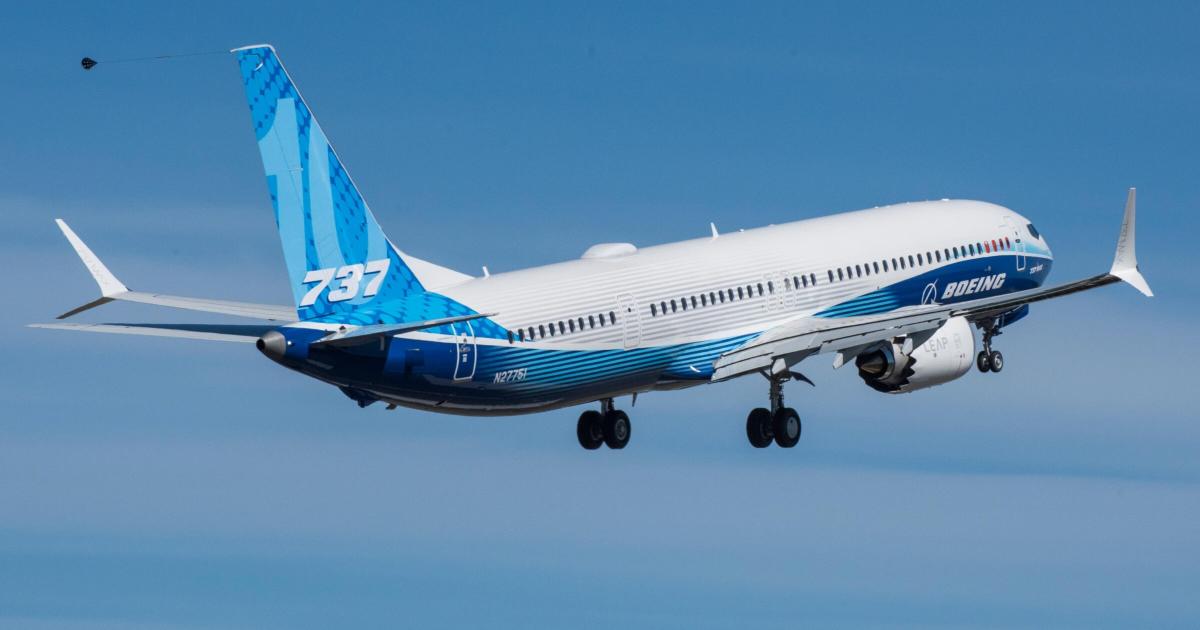
Boeing's latest commercial aircraft program delay is unwelcome news for the company less than two weeks after it said that FAA certification of the 737 Max 10, already several years behind schedule, was finally at hand. Chief executive Kelly Ortberg said on September 16 that the longest and highest-capacity Max jet would be certified "very soon."
However, Boeing has since informed airlines flying 737 Max aircraft of a previously undisclosed glitch related to a cockpit software update, The Wall Street Journal reported on September 26. The issue prompted major U.S. airlines to request Max aircraft produced before the update was introduced by GE Aerospace in November 2024. Both Southwest Airlines and United Airlines have reportedly refused to take new jets.
The WSJ and Bloomberg later reported that the Max 10's certification would be delayed as a result of the software issue, which can cause pilots to fly without some autopilot features following a missed approach. FAA administrator Bryan Bedford told reporters that the agency has yet to determine whether it is a safety risk.
The last-minute certification pause is something like tripping in front of the finish line. By some accounts, Boeing was days away from holding an amended type certificate for the Max 10, having seemingly gained momentum after securing Max 7 certification in July.
Asked by Leeham News and Analysis (LNA) to comment on the reports, Boeing said simply, "We continue to follow the lead of the FAA as we work through the certification process." Engineers are already working on a solution, and the company has formed a Corrective Action Board to assess the situation. How long that will take is unclear.
Another setback for the long-delayed Max 10 is a blow to Boeing's recovery efforts. The airframer is counting on the most-stretched Max to compete with the Airbus A321neo, provide badly needed revenue and help Boeing Commercial Airplanes return to profitability.
The variant represents about a third of Boeing's outstanding orderbook. Global airlines have ordered some 1,500 Max 10s, according to Cirium fleets data. Expectant customers include Alaska Airlines, American Airlines, Lufthansa Group, WestJet and Vueling.
Boeing has already produced about a dozen Max 10 airframes, as well as three test articles, according to Cirium. Production of the variant will be focused primarily at the newly opened North Line in Everett, Washington, where to Max 10s fuselages were loaded onto the line in July.
Max 7 and Max 10 deliveries were originally expected to begin in the early 2020s, but certification of both jets has been severely delayed. Scrutiny of the FAA's certification process and its relationship with Boeing was dialed up intensely following the dual Max crashes of 2018-19. Technical hurdles, such as an engine anti-icing issue, later help up Boeing's ability to complete its latest generation narrowbody family.
Deliveries of the Max 7, due to begin in early 2027, could also be held up as a result of the glitch.
The optics are less than ideal for Boeing, which has been working to ramp up 737 production and restore airlines' trust. Robert Stallard of Vertical Research Partners noted that Boeing was on the "last lap" before hitting its latest certification snag on the Max 10.
It is unclear how many in-service jets are impacted by the software issue. Jefferies analyst Sheila Kahyaoglu notes that 800 Max jets have been delivered since the cockpit navigation update was deployed, but not all of them are impacted.
"Importantly, not all Max deliveries since November 2024 incorporate version 14 of the software," she said in a recent investor note. "As such, the in-service Max fleet for [American Airlines, Alaska Airlines, Southwest Airlines and United Airlines] do not use the software version in question."
Some industry observers—including 737 pilots—say the glitch is a minor issue and can be resolved by technicians in a matter of hours, expressing frustration with the FAA's cautious approach. Critics, meanwhile, see it as another setback related to Boeing's long-running practice of installing modern avionics and software on the 737's ageing computer hardware, pointing to MCAS as the most famous example.
The delay in Max 10 certification is the latest headache for Boeing, which recently saw certification of the 777-9 slip into 2027, and is facing potential strike action from its engineers' and technicians' union as soon as October 6. A walk-off by SPEEA-represented employees could further hinder the company's Max 10 and 777X certification efforts.
LNA is part of the AIN Media Group, providing in-depth coverage of the commercial aerospace and airlines sectors. Subscribe here for exclusive stories.