Surf Air Mobility spent five years pitching hybrid-electric Cessna Grand Caravans to investors and other Caravan operators, built around a powertrain it planned to develop and certify itself. Now the Addison, Texas-based company is focused on pitching its SurfOS software suite, and its electrification priorities have shifted toward Beta Technologies’ all-electric Alia CX300 airplane. Meanwhile, its charter business has overtaken its shrinking commuter airline in revenue.
“These results reflect our shift from an airline-centric company to a technology-powered air mobility platform,” CEO Deanna White said in the company’s November 5 third-quarter results statement. Neither that statement nor executives’ remarks during the earnings call mentioned hybrid propulsion, Textron Aviation, or the electrified powertrain Surf Air Mobility planned to certify for the Caravan. Its third-quarter SEC filing, however, says the company “intends to continue developing fully electric and hybrid-electric powertrain technologies with commercial partners.”
Surf Air Mobility’s electrification strategy has changed partners several times. In February 2021, the company agreed to acquire Long Beach, California-based hybrid-electric propulsion developer Ampaire, but dropped the deal in April 2022. In July 2021, Surf Air Mobility said it planned to buy 150 Grand Caravans and replace their Pratt & Whitney Canada PT6 engines with hybrid-electric powertrains starting in 2024.
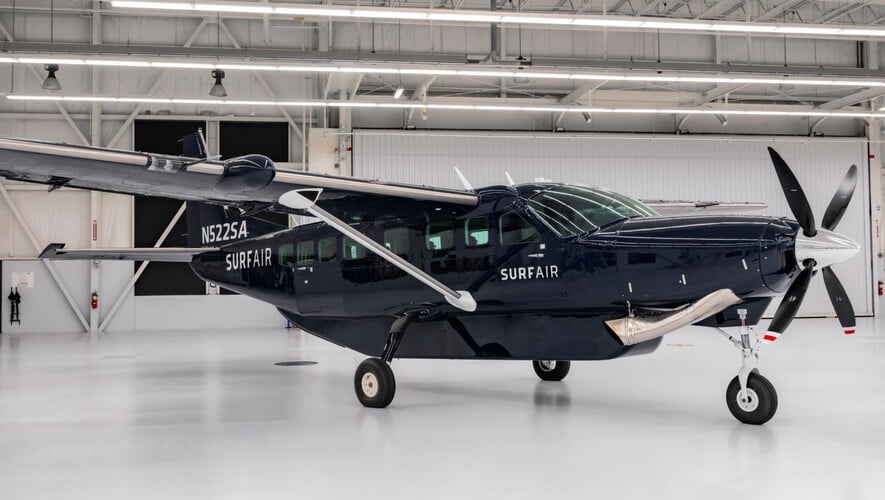
The company later signed engineering, licensing, sales and marketing, and aircraft purchase agreements with Wichita, Kansas-based Textron Aviation, which took effect when Surf Air Mobility listed its shares on the New York Stock Exchange on July 27, 2023. It said it would develop the electrified powertrain, which it called the SAM System, and certify it through a supplemental type certificate (STC). By March 2025, the company said it had signed memorandums of understanding with seven operators to upgrade about 100 Caravans.
On Sept. 26, 2023, Textron Aviation confirmed an order from Surf Air Mobility for 20 Grand Caravan EXs, part of an initial fleet order of up to 100 aircraft with options for 50 more. The company’s later SEC filings describe firm orders for 90 Caravans, worth about $297 million, plus options for 26 more.
In February 2026, Surf Air Mobility and Textron Aviation amended the purchase agreement, cutting the firm order to four airplanes and the remaining commitment from $283.8 million to $13.2 million. The company disclosed the change in its annual report filed March 12. Surf Air Mobility has taken delivery of eight Caravans under the agreement—four in December 2024 and four this year—and has no remaining purchase commitments, according to the company’s SEC filings. In its first-quarter results in May, the company said it had “eliminated up to $100 million in planned capital expenditure from its Cessna Caravan powertrain electrification program.”
The company’s third-quarter filing still describes its licensing and exclusivity agreements with Textron Aviation. It owes $9.5 million in initial license fees and would owe $35 million more once it receives the STC, which it says it intends to pursue “with commercial partners.” The last certification target it gave was 2027, in its fourth-quarter 2024 results.
Surf Air Mobility has a second hybrid-electric partnership with Manassas, Virginia-based Electra. In February 2024, the company secured early delivery positions for 90 of Electra’s nine-passenger EL9 hybrid-electric ultra-short takeoff and landing airplanes, and the company took part in Electra’s demonstration flights at Virginia Tech in August 2025. Meanwhile, the company has not mentioned Electra in its 2026 earnings releases, its last two quarterly filings, or its November 5 earnings call
An Electra spokesman told AIN that Surf Air Mobility still holds the 90 delivery slots, and that “the companies continue to work together under this relationship as Electra advances the development and certification of its EL9 Ultra Short aircraft.” Asked whether Surf Air Mobility has paid deposits or converted any positions into firm orders, he said only that the companies “continue to evaluate opportunities to advance their relationship.” He did not name any joint work since the Virginia Tech flights.

Hybrid propulsion has also dropped out of the risk language in Surf Air Mobility’s earnings releases. Its fourth-quarter 2025 financial results statement cited the “development of hybrid-electric and fully-electric powertrains” as a risk, while its last three quarterly earnings releases did not. The company’s third-quarter SEC filing still cites reliance on third parties to develop “fully-electric and hybrid-electric powertrains.”
Betting on Beta in Hawaii
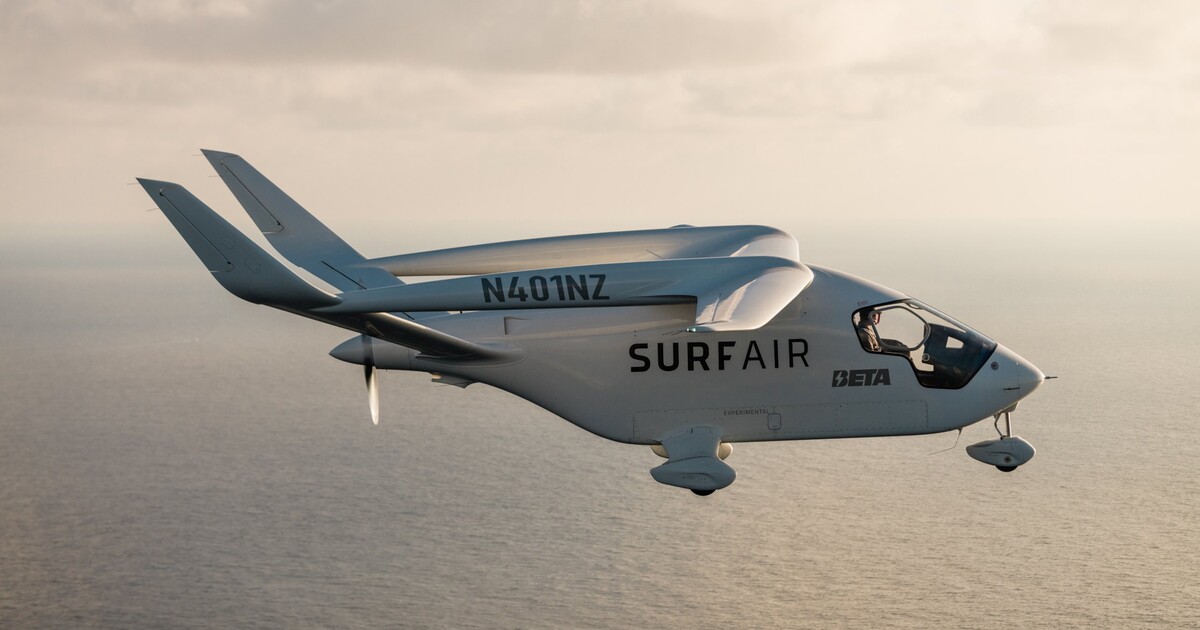
In March, Surf Air Mobility signed an agreement with South Burlington, Vermont-based Beta Technologies for 25 Alia CX300 all-electric airplanes, with options for up to 75 more through 2030. The firm order is worth more than $90 million, and deliveries are scheduled to begin in 2028, according to its third-quarter filing.
Beta’s CX300, the conventional takeoff and landing version of its Alia 250 eVTOL design, seats a single pilot and up to five passengers. Beta lists a maximum demonstrated range of 336 nm and a top speed of 153 knots.
Under the agreement, Surf Air Mobility plans to fly the Alia for cargo first, through its Mokulele Airlines subsidiary in Hawaii, and then serve as launch operator for the passenger version, aiming to start Hawaii’s first commercial electric passenger flights. It also plans to open a maintenance, repair, and overhaul center in Hawaii that, once certified, would be the only factory-authorized service center for Beta aircraft in the state.
Beta and Surf Air Mobility launched what they described as a six-to-eight-week demonstration campaign in Hawaii on June 26, with support from Hawaiian Airlines. The partners said the flights, made with a cargo-configured Alia CX300, would show how the aircraft performs on interisland routes and what it costs to operate, maintain, and charge.
On October 7, Surf Air Mobility announced the test campaign’s completion, following 64 all-electric flights across four islands. The company said its priorities for the rest of this year and into 2027 include positioning Hawaii as “the launch market for electric aviation” and using what it learned from the flights to start cargo and passenger service with the Alia CX300 once Beta certifies the aircraft.

“Hawaii’s short interisland hops make it the ideal launch market for electric aircraft, which we expect will further lower our costs and strengthen profitability,” Louis Saint-Cyr, Surf Air Mobility’s president of airline operations, said in a company statement. On the November 5 call, he named two airline priorities for the fourth quarter and into 2027: growing profitability and finishing its digitization.
Surf Air Mobility, the Hawaii Department of Transportation, and Beta applied in January for a slot in the FAA’s eVTOL Integration Pilot Program. Hawaii was not among the eight projects the FAA selected in March, but the demonstration campaign went ahead outside the program.
SurfOS and Palantir
While efforts to develop a hybrid-electric powertrain have stalled, Surf Air Mobility’s software business has started landing commercial contracts. The company developed the software with Palantir Technologies, a Miami-based maker of data analytics and artificial intelligence software, and introduced the SurfOS product suite in June 2025.
This June, Wheels Up signed on as the launch customer for the company’s enterprise charter brokerage software, BrokerOS, in a contract worth up to $12 million over two years plus an optional third. Surf Air Mobility said on the earnings call that Wheels Up has started using the first phase of the software, and that the full rollout will take longer because the project’s scope has grown.
In August, the FAA authorized OperatorOS, Surf Air Mobility’s flight operations software, to replace paper signatures, records, and manuals at the company’s two airlines, Southern Airways Express and Mokulele, the company said. Surf Air Mobility also says the software has cut its direct operating costs by 6% per hour of operation so far this year.
Five Part 135 operators have signed OperatorOS contracts since mid-September, according to Surf Air Mobility: Sprintbach Aviation of Caldwell, Idaho, which operates nine Pilatus PC-12s; SkyDance Air of Orlando, Florida, with three Cirrus Vision Jets; Air Fuga of Jacksonville, Florida, with one PC-12 and two Dassault Falcon 50EXs; Clipper Aviation of Van Nuys, California, with four King Air 350s; and Flying Zebra of White Plains, New York, with four PC-12s.
Surf Air Mobility will earn a percentage of revenue on trips managed through OperatorOS, and the company said on October 29 that it was still working to implement the software at all five operators. Its stated goal was to have five operators live by the end of the year. SurfOS president Barrett Brown said on the earnings call that onboarding the five is his top priority for the fourth quarter, that SurfOS revenue was not material in the third quarter, and that the company expects 2027 to be its first year of meaningful software revenue. The company also said it has built a pipeline of large operators, brokerages, and aircraft manufacturers that it believes could be worth tens of millions of dollars in annual revenue.
Palantir alumni now lead both Surf Air Mobility’s board and its software business. Shawn Pelsinger, who spent a decade at Palantir and helped originate Palantir’s partnership with Surf Air Mobility in 2021, became chairman on July 24, succeeding Carl Albert. Brown, Palantir’s former head of Asia, became president of SurfOS on September 30. Surf Air Mobility said on October 29 that it had expanded the partnership, adding dedicated Palantir engineering and sales resources, and that Palantir co-sells SurfOS to enterprise prospects under an exclusive teaming agreement. In September, the company also issued Palantir about 2 million shares of its stock, worth $2.3 million, in payment for services.

Airline Operations
Surf Air Mobility’s airline business predates its electric aviation ambitions. The Surf Air brand, now carried by its Los Angeles-based namesake subsidiary, began selling subscription flights in 2013. In 2023, when Surf Air Mobility went public, it acquired commuter carrier Southern Airways Express, which had bought Hawaii’s Mokulele Airlines in 2019. Southern and Mokulele fly scheduled routes, many of them subsidized under the federal Essential Air Service program for small communities, using unmodified Cessna Caravans, which made up 39 of the company’s 41 aircraft at the end of 2025, according to its annual report.
That airline business is shrinking as the company exits what it describes as unprofitable routes. The cuts began last year: scheduled departures fell 13% in 2025, to 60,117, and scheduled passengers fell 15%, to about 300,000, according to the company’s annual report. Companywide headcount fell from 703 to 573 in 2025, and to 481 by Sept. 30, 2026.
In the first nine months of this year, scheduled departures fell another 14%, to 39,746 (from 45,958 in the same period of 2025), and scheduled flight hours fell 20%. Scheduled revenue dropped 15% in the third quarter, to $17.5 million, which the company attributed primarily to leaving certain Essential Air Service routes. Charter revenue more than doubled, to $19 million, surpassing scheduled revenue, a shift the company’s finance chief called “an important milestone” on the earnings call. In an August 3 letter to shareholders, Pelsinger said investors would “see the airline become a smaller share of the business.” The airline generated $1.2 million in adjusted EBITDA, a measure of earnings before interest, taxes, depreciation, amortization, and certain other costs, in the third quarter.
Hawaii has been the exception. Mokulele’s third-quarter revenue rose 9% year over year, according to Surf Air Mobility, and in September the U.S. Department of Transportation awarded Mokulele a four-year Essential Air Service contract worth $19.4 million in subsidies to serve Lanai Airport (PHNY) through August 2030. Mokulele also restarted service between Ellison Onizuka Kona International Airport at Keāhole (PHKO) and Kahului Airport (PHOG), its first scheduled flights on the route since 2023.
Finances
Surf Air Mobility is making the shift on a strained balance sheet and with a new finance chief. Jason Secore, previously chief financial officer of drone delivery company Matternet, replaced Oliver Reeves as Surf Air Mobility’s CFO on September 30.
Third-quarter revenue reached $36.5 million, the highest in the company’s history and 25% more than a year earlier, according to Surf Air Mobility. Its net loss narrowed to $20.4 million from $27.2 million. Surf Air Mobility now forecasts a full-year adjusted EBITDA loss of $32 million to $35 million, compared with its previous forecast of $25 million to $30 million, citing higher fuel prices and “extended implementation periods for SurfOS.” It kept its revenue forecast of $128 million to $138 million. Secore said the company is not giving a date for reaching adjusted EBITDA or cash flow break-even.
The company held $10.7 million in cash at the end of September, and its liabilities exceeded its assets by $45.5 million. Operations used $34.6 million in cash over the first nine months. Its third-quarter filing says there is substantial doubt about its ability to continue operating and that it is in default on certain taxes and debt. If it cannot raise enough money, the company may have to scale back plans to develop its software and to equip its airlines with fully electric or hybrid-electric aircraft, the filing says.
In July, Surf Air Mobility restructured its biggest debt, exchanging the $46.9 million left on a $74 million convertible note held by investment firm High Trail Capital for a $16.9 million convertible note due in 2027 and a $30 million term note due in 2028. Separately, it borrowed $21.6 million from affiliates of investment firm JGB Partners in an asset-backed loan.
The New York Stock Exchange warned Surf Air Mobility in July that its shares had averaged less than $1 over 30 trading days, the second such notice since 2024. The company has until about Jan. 24, 2027, to bring its share price back to at least $1 or risk delisting. At the July 24 annual meeting, shareholders approved a reverse stock split, which would combine existing shares into fewer, higher-priced ones, though Surf Air Mobility says it plans to regain compliance without one if it can.
More In Aircraft