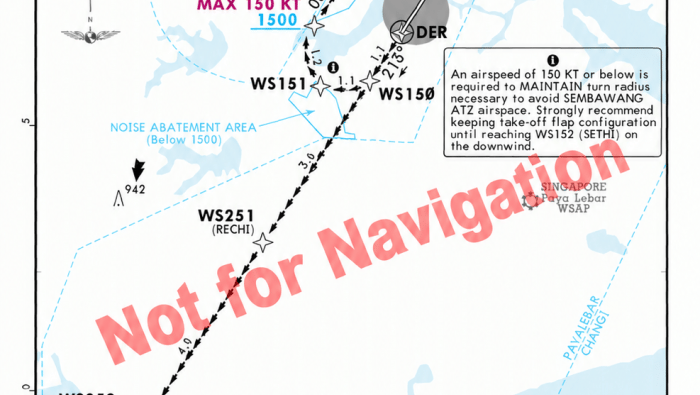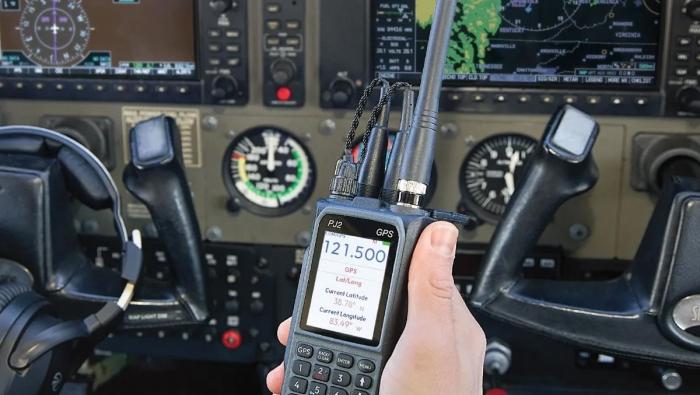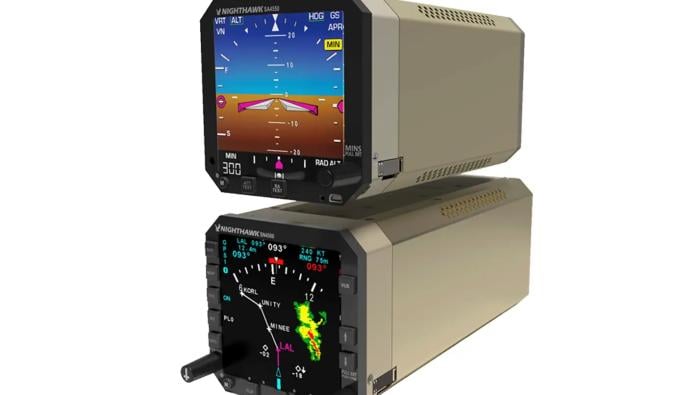

Skyband Systems is seeking an FAA supplemental type certificate (STC) for a GPS jamming- and spoofing-resistant system that uses signals from the Iridium satellite network to provide an alternative navigation solution when global navigation satellite systems (GNSS) are compromised. The Skyband M100 consists of an Iridium receiver coupled with an inertial sensor, and together the system could provide a backup navigation solution for the vulnerable and weak signals associated with GNSS.
“We’re getting the raw Iridium positioning,” said Skyband co-founder and president Robert Wiggenhorn, “and we’re fusing that with a high-quality IMU [inertial measurement unit]. What it’s doing is developing its own GPS-independent position solution.” At the same time, the M100 is looking at GNSS data on the aircraft’s Arinc 429 bus. “We’re comparing what the aircraft’s primary [nav system] now thinks its location is to our independent location, and if it sees a divergence, it flags that in two ways.”
First, the M100 will send an alert to a cockpit annunciator to let the crew know that there is a GNSS issue. Second, a tablet app will send a notification about the issue and provide an alternative accurate navigation solution on a moving map, including information about hazards such as terrain. Eventually, Skyband could share that data with third-party electronic flight bag app providers. “But we didn’t want to have to wait on them to have that functionality,” he said, “which is why we’re going to have an app that has basic functionality that is tied to how it integrates with our product. I think there’s a lot of value to have our visualization and positioning data extended into other platforms.”
The M100 system that Skyband has submitted for an STC includes the cockpit annunciator, an electronics box, and connection to the Arinc 429 bus. Skyband is targeting Embraer’s 600 for the first STC, which is expected in November. AeroMech is working with Skyband to develop the upgrade. The STC won’t include integration with the aircraft’s flight management system, but the system will connect to the aircraft’s Arinc 429 bus. Production of the M100 has begun, according to Skyband, and “end-to-end system performance has been validated across 17 test flights.”
The benefits of using Iridium’s 66-satellite, low-Earth-orbit network for position, navigation, and timing (PNT) information have to do with relative signal strength compared to GNSS networks such as GPS. Iridium signals are 30 decibels or 1,000 times stronger than GPS signals, according to Wiggenhorn, “which makes it much more difficult to jam.”
While any signal can be jammed, he explained, “as you need more and more power to jam a thing, it just means the area [that] can be jammed starts shrinking, like massively smaller. Even if Iridium could be jammed, if somebody took a jammer and targeted Iridium specifically, instead of it being, say, a 100-kilometer radius area that would be jammed, it might be a 3-kilometer radius. That’s [small] enough where an aircraft could just fly through that region.”
Wiggenhorn also pointed out that Iridium uses encryption while GPS and other GNSS constellations “are kind of like open architecture. It’s much easier to do spoofing on those because you can basically receive GPS signals…and most unsophisticated GPS receivers will just honor those playback and spoofed signals. Iridium…has additional measures in place that make it much more challenging to spoof. And because it’s not an open network that’s been around for decades, there’s not been the same kind of art in terms of how to go spoof their signal. Nothing is impossible, but it is an order of magnitude-type harder challenge to do that.”
An alternative PNT solution such as that provided by Iridium is helpful, but Skyband aims to supplement that with its tactical-grade IMU. “You want to be able to ingest inertial measurement data as well as blend in with the solution that you’re getting from Iridium to provide a much more resilient and accurate solution,” he said. The benefit of the combined system is that if either is compromised, the other can handle the navigation needs of the aircraft during a GNSS jamming or spoofing event. “It’s that one-two punch combining both an IMU with Iridium that we think is going to give us this both resilient and accurate solution.”
Skyband won’t use an aircraft’s onboard IMU or GNSS sensor because its solution needs to be independent of aircraft systems. Some aircraft use GPS timing, for example, for internal calculations, and a GNSS failure can cause some systems to fail, including autopilots and flight management systems. “We wanted to make sure that our box was able to be fully independent of GPS or any other GNSS system,” Wiggenhorn said. “So we get our clock and timing measurements from Iridium, not from the aircraft bus. That allows us to be fully independent of the aircraft, so we can strongly say we will know if you are getting spoofed. Our plan is to be able to integrate other aircraft data off that 429 bus. But we don’t want our core product to have to rely on anything on the 429 bus because, fundamentally, we want to be able to treat that bus as ‘we don’t trust you because you could have been spoofed’ because the purpose of our product is to let you know if that occurred.”
To make installing the Skyband M100 easier, it will be a single LRU with no added external antennas needed if there is an Iridium antenna already mounted. More than 70,000 aircraft already carry an Iridium antenna, according to Skyband, so this shouldn’t be a problem.
“Iridium has served aviation for more than two decades, and our network was built to be relied upon when nothing else is available,” said Iridium CEO Matt Desch. “As GPS interference has grown into a daily concern for flight crews, Iridium PNT offers a signal that is resilient against jamming and spoofing. Skyband’s M100 brings that capability into the cockpit, and we are excited to see it reach production.”
There is no technical standard order covering what the M100 is designed to do, but Skyband will make sure it meets DO-160 environmental qualifications. A possible future version could provide a certifiable navigation solution to the aircraft’s flight management system.
Skyband Systems produces the GPS Threat Map jamming and spoofing interference monitor website.
In this article
More In Avionics