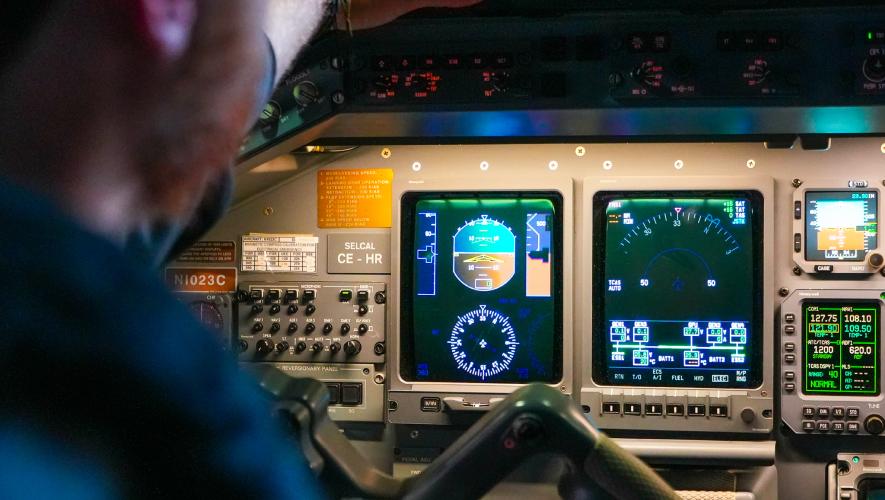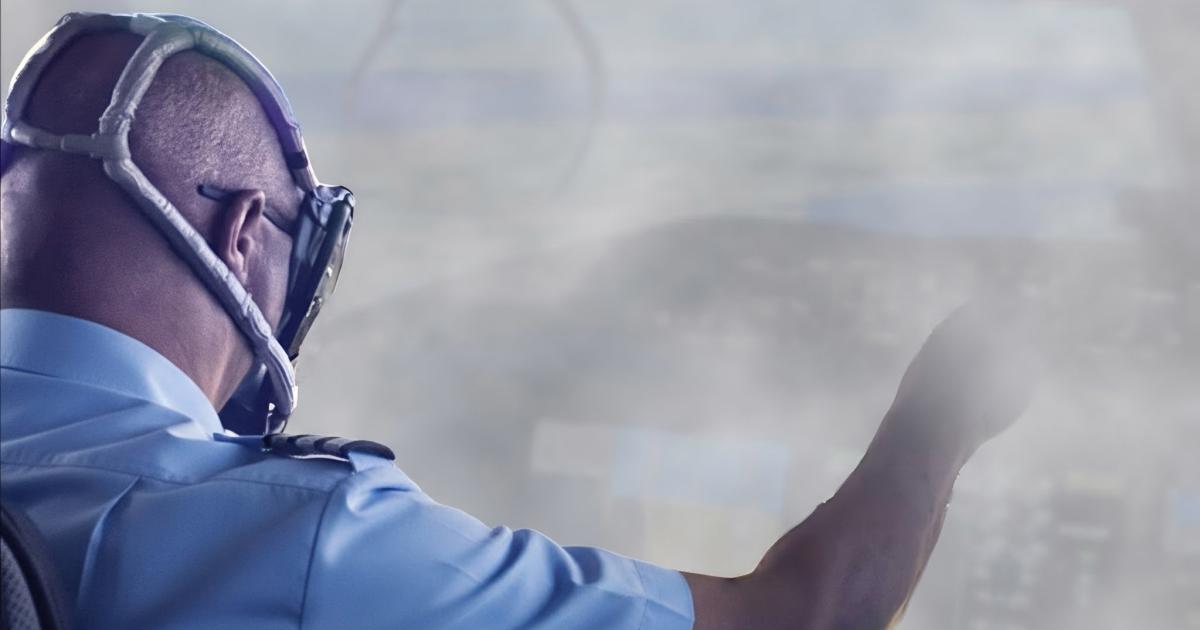
Klatt Works has installed its Smoke Assured Vision Enhanced Display (SAVED), a head-up display built into an oxygen mask, in Gulfstream simulators at pilot training centers, giving crews a chance to practice landing with a cockpit full of smoke. The company also announced that FedEx has agreed to become the launch fleet customer for the SAVED system for its Boeing 767s.
SAVED masks are now FAA supplemental type certificate (STC) approved in the Boeing 777F and 767, as well as the Gulfstream G550. B757 and G650 STCs are underway, followed by additional Gulfstreams and other business jet models. Installations are available from Klatt Works dealers such as Altus Aerospace, Duncan Aviation, Gulfstream, and West Star Aviation.
The move to add SAVED to simulators follows an NTSB recommendation that the FAA develop standardized, realistic smoke-in-the-cockpit simulator training after an incident on Dec. 20, 2023, when a bird was ingested by the left engine of a Southwest Airlines B737. Within five seconds, the cockpit filled with smoke.
According to Klatt Works, which interviewed the pilots, “[They] described relying primarily on the cockpit-mounted head-up display, leaning forward in their seats with their emergency oxygen masks on to see it, with vision extremely limited throughout the flight deck.”
Typical training scenarios don’t include actual loss of visibility inside the cockpit, although some training centers have the ability to add artificial smoke. According to the NTSB report on the Southwest incident, smoke training often involves the instructor just announcing that the cockpit is filling with smoke.
“In practice, artificial smoke is used only occasionally,” Klatt Works explained. “Building and fire code restrictions limit where it can be released, the simulator’s fire alarm must be bypassed, and operators are concerned about long-term damage to simulator equipment from repeated exposure.
“Even when artificial smoke is used, pilots report that they can still make out their instruments and controls through it. Real dense smoke is very different. In the 2010 UPS Flight 6 accident, the crew of a Boeing 747 freighter reported they could not see their instruments through the smoke. Training that leaves the instruments visible does not prepare a crew for that.”
The company highlighted FAA Advisory Circular 120-80B, which notes, “A fire that reaches the overhead area may become uncontrollable in as few as eight to 10 minutes, and an uncontained fire can destroy an aircraft in as few as 20 minutes. A flight crew may have only 15 to 20 minutes to get the aircraft on the ground.”
When training with the SAVED mask, Klatt Works recommends its own standard of touching down on the ground within eight minutes of smoke onset, “with the crew managing its own energy and airspeed to minimize time of flight. A time-based target gives instructors a clear measure of performance and gives crews a realistic sense of how little margin an onboard fire allows.”
Klatt Works is working with training providers to help improve their smoke-in-cockpit training curriculum, using smoke lenses that fit over the SAVED mask to simulate cockpit smoke without using artificial smoke. The lenses come in light, medium, and dense smoke configurations, with the medium and dense filters blocking pilots’ view of instruments, requiring use of the SAVED system to regain visual reference.
With the SAVED mask on, pilots can declare an emergency, communicate with ATC, and receive vectors, then manipulate the throttles, flaps, and landing gear by touch and land using the head-up display symbology, even with the cockpit filled with smoke.
“The NTSB has described the gap clearly,” said Klatt Works CEO Nathan Klatt. “Crews are told the cockpit is filling with smoke, but they are not trained in what that actually looks like. SAVED lets a pilot see the head-up display in the densest smoke, and training with it at leading pilot training centers lets crews experience that before they ever need it.”
In this article
More In Avionics