As Bose, a manufacturer of high-fidelity audio products, celebrates the 40th anniversary of its active noise-reduction (ANR) headsets, AIN caught up with retired distinguished engineer Dan Gauger to learn more about the company’s history and technology.
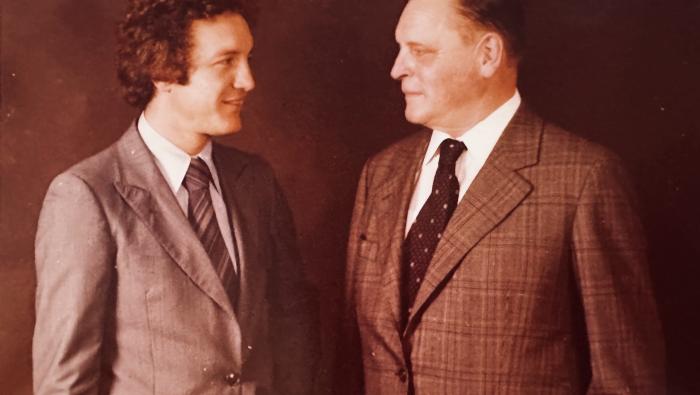
In 1978, Amar Bose, founder of Bose Corp. and then-professor at his alma mater (Massachusetts Institute of Technology), was on a Swissair jet flying to Boston from Switzerland. “He was excited” to try out the new electrodynamic headphones that airlines were implementing, Gauger said. “He thought, ‘Oh, it’ll sound good. I’ll be able to enjoy music for the first time on a plane.’”
As it turned out, these headphones did nothing to block external noise, and airliners were much louder then. “So he was frustrated,” Gauger said. “He started thinking about the problem.”
“Sound is very, very tiny variations in air pressure from atmospheric pressure,” Gauger said. “It alternates between a little slightly higher pressure, and I’m talking about tiny—millionths of an atmosphere in pressure—and so you get slight increases and slight decreases, alternating around whatever the local atmospheric pressure is.”
Bose had already developed feedback control as a core technology, he explained. In considering the problem of outside noise, Amar Bose “imagined on his own the idea of using feedback control to regulate [and] control the sound pressure to be what you wanted to hear—the music or communication—and try to cancel a lot of the noise.”
Although the Bose team wasn’t aware of it at the time, there were patents from the 1930s describing something similar to noise-canceling, followed by some Air Force research in the 1950s, according to Gauger. “We independently invented it.”
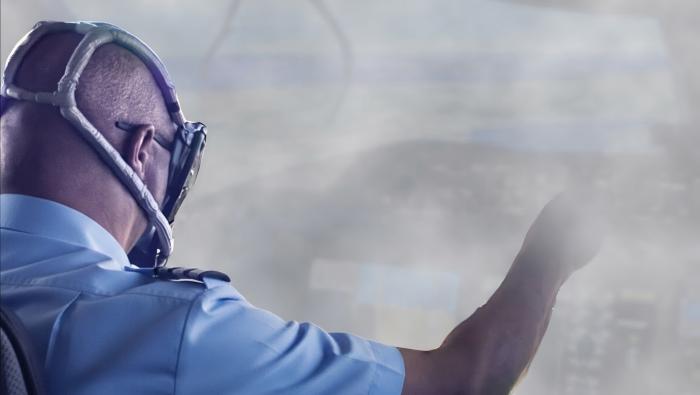
Essentially, active noise canceling or noise reduction uses a microphone inside the ear cup, near the ear canal, that senses noise or sound pressure going into the ear. Then it compares that noise to the audio that the user wants to hear—for example, a voice on the intercom or a call from ATC. “The difference is the noise you don’t want to hear, and also maybe some distortion effects and things like that,” Gauger said. “We take that difference, we process it, we amplify it, we shape it in frequency, and play it back through a speaker to provide a correction.”
To put that description into a visual analogy, he explained, “When the microphone realizes that the sound pressure is a little bit too high, it moves the speaker back to make more room for the air, lowering the pressure.” It does this several thousand times per second, at the speed of—naturally—sound.
While some might question whether an ANR headset actually lowers the noise a pilot’s ears experience, Gauger explained that this is indeed the case. The way that Bose tests this, in accordance with Acoustical Society of America standards, is to put a tiny microphone in the subject’s ear canal and measure the sound it picks up in a room with a lot of noise, without the headset on. Then the subject puts on the headset or earbuds, and the measurement is done again. “So objectively, that microphone is measuring the reduction in the sound pressure in your ear canal,” he said.
By the early 1980s, Gauger and his colleague Roman Sapiejewski had developed prototypes of an ANR headset, and they were trying to figure out the market opportunity. To start with, they brought the technology to Air Force and Navy test pilots at Edwards Air Force Base in California and Naval Air Station Patuxent River in Maryland, and debriefed the pilots after they flew with the prototypes.
“It won some increasingly significant contracts that we thought were going to be our path to creating our first product,” Gauger said. “It was part of a larger digital audio intercom program that all three services were looking at for aviation, and that program got canceled in early ’86 because of some issues with the cost of the overall program. Digital audio was a bleeding-edge thing in those days, and Roman and I were left with trying to figure out what we do with this.”
Casting about for another potential market, the pair looked outside of Bose’s primary market back then: the automotive sound system business. “Bose had no prior experience developing headsets, so we were left on our own to try to figure out a path,” Gauger said. Because of the work they had done with military pilots, “General aviation obviously seemed like a good fit. We’d flown in small aircraft, and we were trying to figure out how to make a go of it. We needed something to jump-start it.”
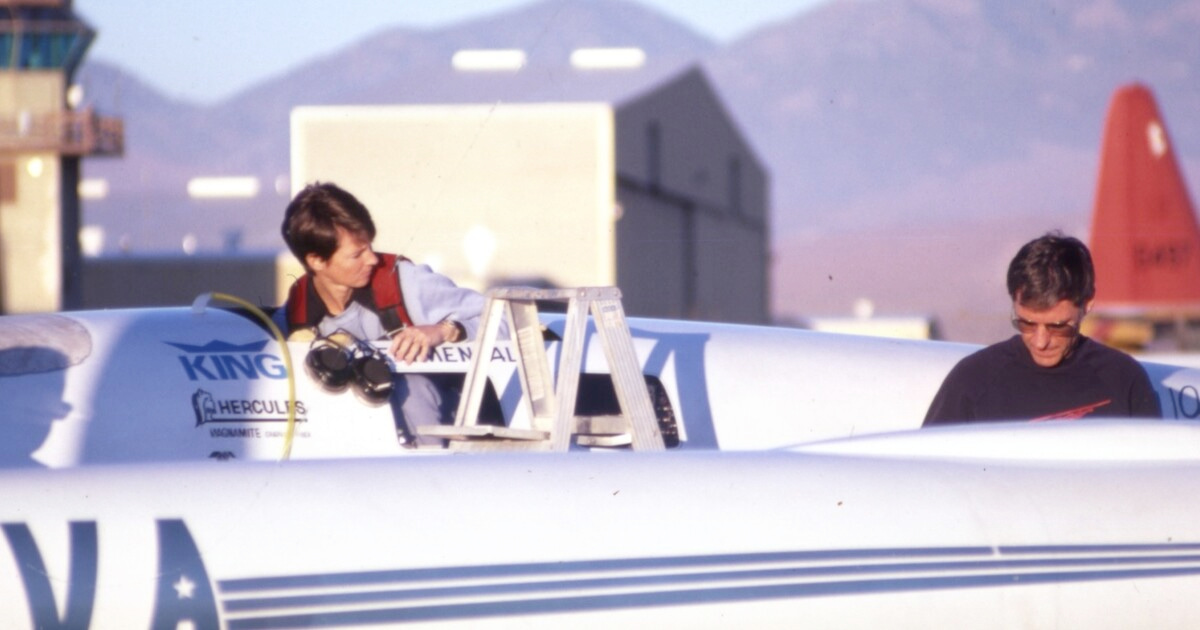
That something turned out to be the biggest story of the mid-1980s—the ambitious attempt by Jeana Yeager and Dick Rutan to fly around the world nonstop without refueling. Their aircraft was the ungainly yet quintessential Burt Rutan design, called Voyager. Burt and Dick are brothers (Dick passed away in 2024).
A cover story published in a magazine in July 1986 was what caught their attention. The article described a four-day test flight north and south along the West Coast, and it mentioned that when Yeager climbed out of the diminutive cockpit, she had bruises around both ears from wearing traditional passive headsets. These headsets cut noise by clamping the ear cups to the head, and the higher the clamping pressure, the greater the passive noise reduction.
“Roman and I looked at each other and said we think we can help,” Gauger recalled. In August 1986, they paid a cold-call visit to the Voyager hangar at Mojave Airport (KMHV) in California’s Mojave Desert. It was just months before the planned takeoff, and they carried with them the latest Bose ANR headset technology from the military testing.
As it turned out, Yeager and Rutan were most interested in the new headset. At that point, Gauger said, “The level of performance, the noise cancelation, was pretty comparable to what we were shipping with the first-generation product in ’89.”
What the Bose engineers showed the two pilots was the latest version, which not only focused on active noise cancelation but incorporated a more comfortable passive blocking fit. This was a direct result of the military pilot feedback. “It was that more comfortable headset that Dick and Jeana wanted. They’re going to be wearing this headset conceivably for nine days straight, and so that’s what we had to build. The units that they flew were only the third and fourth copies of that new generation…we ever made.”
However, these were still prototypes, and there were challenges. “We initially had lots of problems with RF interference from the radios,” Gauger recalled. “I spent about five weeks in Mojave trying to debug that. Once I figured out how to get the RF performance in line with what they needed, I begged Dick to let me bring the prototypes back to Bose to…have a proper electronics technician rebuild them with the modifications they’d come up with, so that they’d have clean headsets for use in their flight.
“I am a lousy electronics technician. I can design circuits, but I’m not good at building. But once they were working well enough…he wouldn’t let them out of his hands. He kept them under his desk when they weren’t flying, and so that’s what they took on the flight when they departed Edwards.
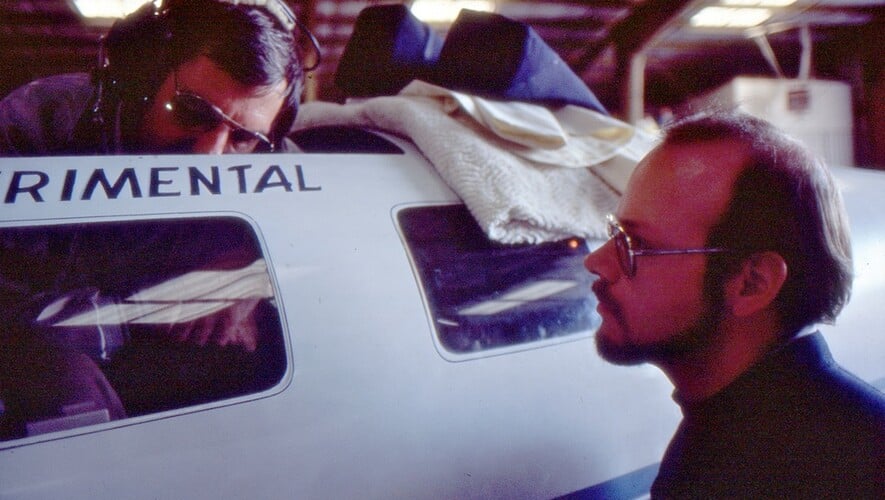
“The reality is that about two or three days into the flight, they started hearing this continuous sort of staticy sound from the headsets. My understanding is that they could shut the cancellation off and still get communication and passive blocking, and so they intermittently used the cancellation for the rest of the flight.
“That static problem happened because they’d been wearing these headsets nonstop for a couple of days, and the humidity inside the ear cups from their perspiration had corroded some of my bad solder joints. We proved that when we got our hands back on the headsets. So the headsets did not actually perform as well as they should have during the flight. We had done a lot of work on the comfort of the headsets, and they still had good passive attenuation.”
Nevertheless, the successful Voyager flight—which took 9 days, 3 minutes, and 44 seconds and averaged about 116 mph—generated a lot of interest among pilots. Gauger said, “The subsequent attention we got created the impetus for the company to say, ‘Well, I guess we found a market here.’ The number of pilots who contacted us asking when they could buy what Dick and Jeana had used on the flight was a little overwhelming, so the company said, ‘I guess we have to do this.’”
That turned out to be a fairly heavy lift for Bose, which had never made a headset. “There’s a special art in knowing how to engineer these things mechanically to fit heads, fit ears, and so on,” he said. “We had to figure that all out from scratch for production in the span of a couple of years.”
This included figuring out how to manufacture the cables that connect the ear cups to the microphone and plugs. “We did what anybody does as an engineer working on a design,” he said. “You look at well-designed products from competing companies, and you try to learn from them.”
What this meant was Gauger needed to see inside a competitor’s cable, but taking it apart wasn’t possible because it would destroy the mechanism and not provide any useful information. So he went to a local medical facility and said, “I have something that needs to be X-rayed.” The nurse asked if he had broken something, and he showed her the cable and said, “I’m just trying to figure out what’s inside.” After joking that she might be contributing to industrial espionage, she ran the cable through the X-ray machine in exchange for $100, and Gauger got the information he needed.
The week before the 1989 EAA International Fly-In Convention (now EAA AirVenture Oshkosh) that started on July 28, Bose held a press conference at its Framingham, Massachusetts headquarters, hiring a helicopter to give reporters a firsthand experience of the new ANR headset. A few days later, the Bose team packed up the nearly 200 headsets that the company had manufactured thus far and brought them to Oshkosh, selling out before the end of the show. The introductory price was $795, which went to $995 after the show.
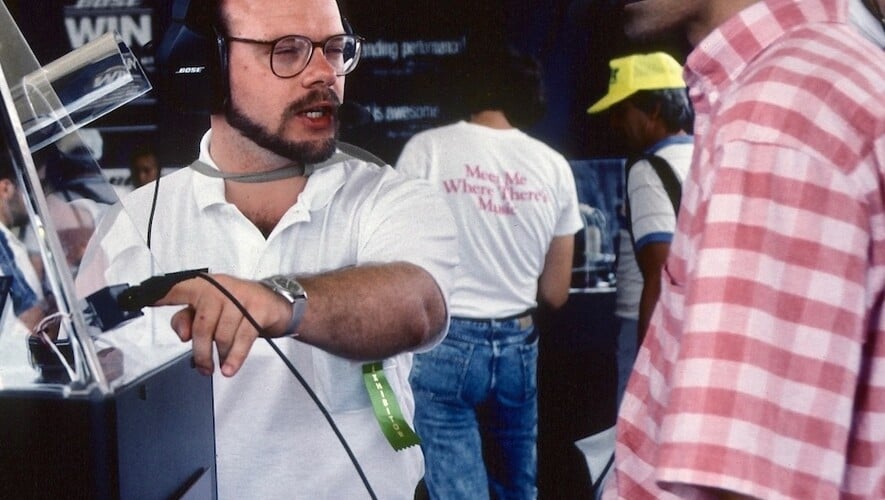
Before the public reveal, Bose had been approached by major headset manufacturers looking for a partnership. “We chose to go on our own,” Gauger said, “much to their disappointment and anger. One of those conversations ended with somebody saying that they would bury us. I won’t say who. And it wasn’t long after we started selling headsets before…others had product on the market.”
Since then, Bose has continuously iterated the design of the original headset, with the latest generations being the A30 ear cup version and the ProFlight Series 2 with earbuds (for quieter cockpits). Major upgrades come on a roughly 10-year cycle, which seems slow but fits with Bose’s efforts to make unique products that, in the words of Amar Bose, “are different and better.”
While noise-canceling technology is pushing the limits of technology and major breakthroughs aren’t likely, there are pathways that will be useful to pursue.
“This is not something where you throw in this year’s hot new chip, and you get much more performance,” Gauger said. “We’re up against physics here, and we are at about the physical limits. There are things we could do to eke out a little bit more improvement…for using noise cancellation in a more effective way to make the experience of operating the aircraft better. So there are still interesting opportunities for improvement.”
In this article
More In Avionics