Jeppesen is stepping up introduction of its artificial intelligence-based Airflow operations planning and management system with the activation of 150 AI agents. At the company’s Commercial Aviation User Conference in Paris today, the Texas-based group said it is now supporting several airlines that are early adopters of the technology, and plans to roll out other AI agents for business aviation and military customers in the coming months.
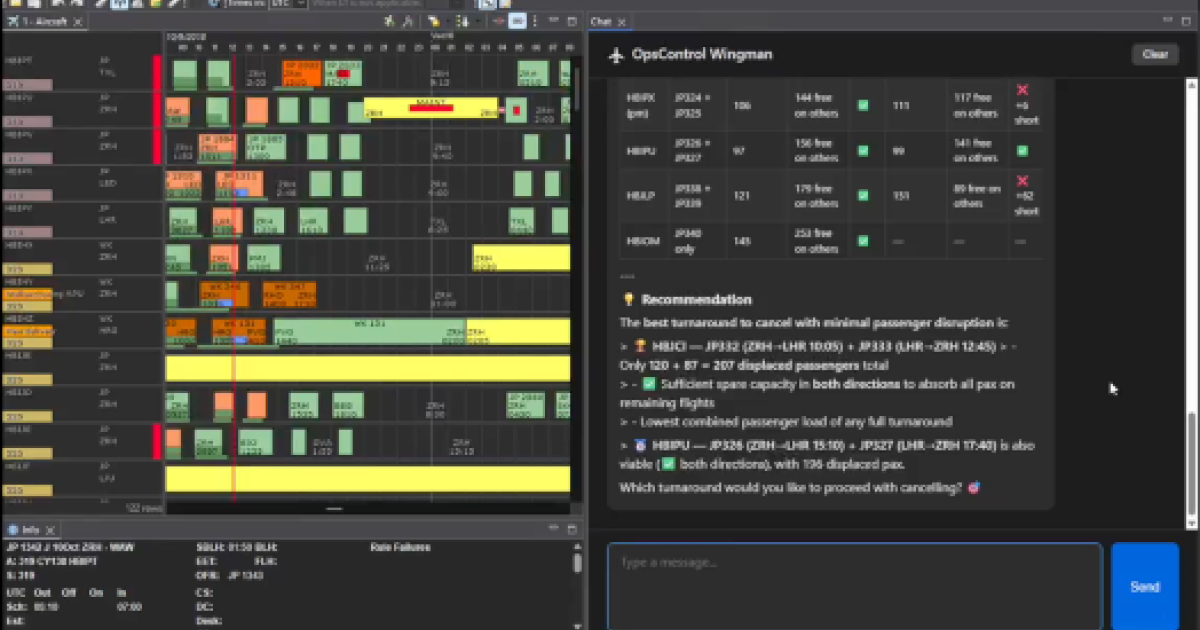
The initial batch of AI agents is intended to support more effective use of Airflow’s Trip Trading and Trip Mastery tools, which help pilots and schedulers to organize crew rosters. They are also being deployed with the platform’s Augmented Ops Control function, which helps operators deal with flight disruptions, proposing, for example, recovery options for displaced aircraft and crews.
Jeppesen introduced Airflow in July as the foundation for its agentic AI strategy, which it said is initially focused on growing revenues, reducing costs, and protecting assets for operators. The initial rollout included the AI-driven ClearNotams feature intended to make the notices easier for pilots to interpret.
According to the company, operators can choose how much automation they want to use with the platform and the pace at which they want to adopt AI. In addition to the ForeFlight platform, the Airflow technology can be applied to operators’ existing third-party systems and tools—in all cases using only “certified” aviation data and adhering to each operator’s policies.
“We believe this technology will provide value to users by giving people cognitive leverage to augment judgment and capability,” Jeppesen CEO Brad Surak told AIN. “It should give everyone [at an operator] more situational awareness so that they don’t have to keep bothering each other as much [to get information].”
Guardrails Included
Acknowledging concerns over the safe limits of AI use, Surak said Jeppesen applied a “skeptical lens” to develop five “principles of trust” for Airflow. He described the first principle—reason and context—as “the need to make sure you are not getting provably wrong answers.” The other principles are reason from certified inputs, involving absolute user control over the information source; maintaining a visible trail for AI-generated data; ensuring the AI agents operate as part of the operator’s existing safety management system; and “keeping the human in the loop.”
Once these principles were established and related guardrails developed, Jeppesen’s Airflow team focused on more than 2,000 processes for operators that they believed would benefit from the AI agents. They developed what they call an airline value map to establish how to include operational settings that boost income and the profit-and-loss statement.
A prime example of how Airflow applies AI agents is in the process of recovering an airline schedule that has been disrupted by, for example, a serious weather event or an air traffic control shutdown. The AI can be trained to remember the “intent” of efforts to recover operations to avoid losing sight of priorities, while also “learning” from incidents to make the process more readily repeatable.
“Jeppesen ForeFlight Airflow is not a single feature we bolted on to our products,” Surak stated. “It is the foundation we build everything on from here, and it is built so every operator can adopt AI at their own pace, with their own mix of tools. Every recovery option, weighed in seconds, with the reasoning attached. This is what operators have told us they need most.”
The navigation and flight information company has been testing the deployment of the AI agents on its own operation since January. It is now working with a select group of operators to refine the platform over the rest of this year.
“We have found it easier to integrate the AI than we expected when we applied it to the systems in our back office in a month,” Surak said. “It just means modifying existing tools so they can start working with the agents. It’s less about technology and more about the business areas you want to start focusing on.”
More In Operations