Beta Technologies flew more than 16 medical and disaster-response missions across North Carolina this month under the FAA’s eVTOL Integration Pilot Program (eIPP), connecting hospitals in the Raleigh-Durham area, known as the Research Triangle, with the state’s rural and coastal communities.
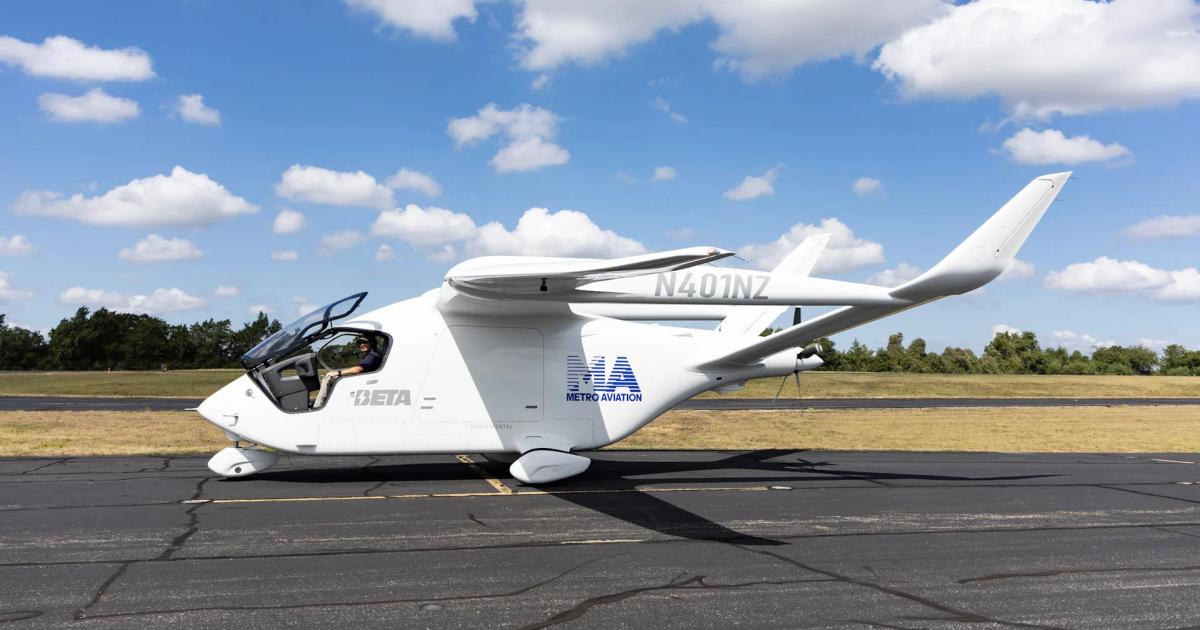
The South Burlington, Vermont-based company started flying in eLIFT-NC, North Carolina’s eIPP project, on September 17 with its all-electric Alia CX300 conventional takeoff and landing (CTOL) airplane
Routes ran between Raleigh Executive Jetport (KTTA), Pitt-Greenville Airport (KPGV), and Dare County Regional Airport (KMQI) on the Outer Banks, covering more than 1,300 nm with a field medical station and supplies aboard. Shreveport, Louisiana-based air medical operator Metro Aviation—a Beta customer and partner—flew every mission. Beta said its airplane also passed over the Wright Brothers National Memorial.
“We carried a field medical station and supplies along a route that connects the Research Triangle to North Carolina’s coast, overcoming the distance that often prevents the movement of critical supplies, specialists, and care in the times they are needed most,” said Beta founder and CEO Kyle Clark.
North Carolina’s transportation department leads eLIFT-NC. Two hospitals helped Beta shape the routes and missions flown: Raleigh-based WakeMed and ECU Health, which serves the rural east. A WakeMed physician chairs the program’s health advisory subcommittee.
Joby Aviation, the only other aircraft developer participating in eLIFT-NC, has also conducted autonomous missions for the project. Last week, it flew an autonomous J208 Cessna Grand Caravan from KMQI to Raleigh-Durham International Airport (KRDU).
Beta is also developing an eVTOL counterpart to the CX300, the Alia 250, which shares most of its design. That model has yet to fly an eIPP mission, though prototypes fly regularly in testing from New York’s Plattsburgh International Airport (KPBG). The company has described its eIPP rollout as stepwise, running eCTOL operations first and eVTOL later. Likewise, Beta expects to certify the CX300 with the FAA first, with the eVTOL approval following about a year later.
North Carolina flights draw on Beta’s electric aircraft charging infrastructure at KTTA, online since 2024, and the company said it has more than 15 charging sites in development elsewhere in the state. Beta also develops and tests flight control computers at a facility in Morrisville, outside Raleigh, that has created nearly 70 jobs since opening in 2023. The company flies those computers in its own airplanes and sells them to other aircraft manufacturers.

Beta holds a place in seven of the eIPP’s eight state-led projects—more than any other electric aircraft developer—spanning at least 10 states. It flew the eIPP’s first operational missions in July, carrying United Therapeutics organ products across Virginia and Maryland, and lists Louisiana among the states where it has supported program missions. More test flights are planned in North Carolina through the rest of the year.
Earlier this month, Beta and Metro also flew the Alia with Washington County Emergency Medical Services in Brenham, northwest of Houston, in Beta’s first Texas flight under the eIPP. The two companies tested how the airplane could move disaster-response equipment for an agency that answers more than 7,000 calls a year across about 700 square miles, working alongside the county’s ground ambulances and the EC145 helicopter Metro has flown for Washington County EMS since 2022.
Those flights fall under Project Nexus, the eIPP project the Texas Department of Transportation leads, and follow a route linking Galveston, Sugar Land, and Brenham.