Operations
More Than a Bizjet: The Heroes Who Bring Patients Home
When a toddler became critically ill overseas, it was the flight and medical crew who got her home
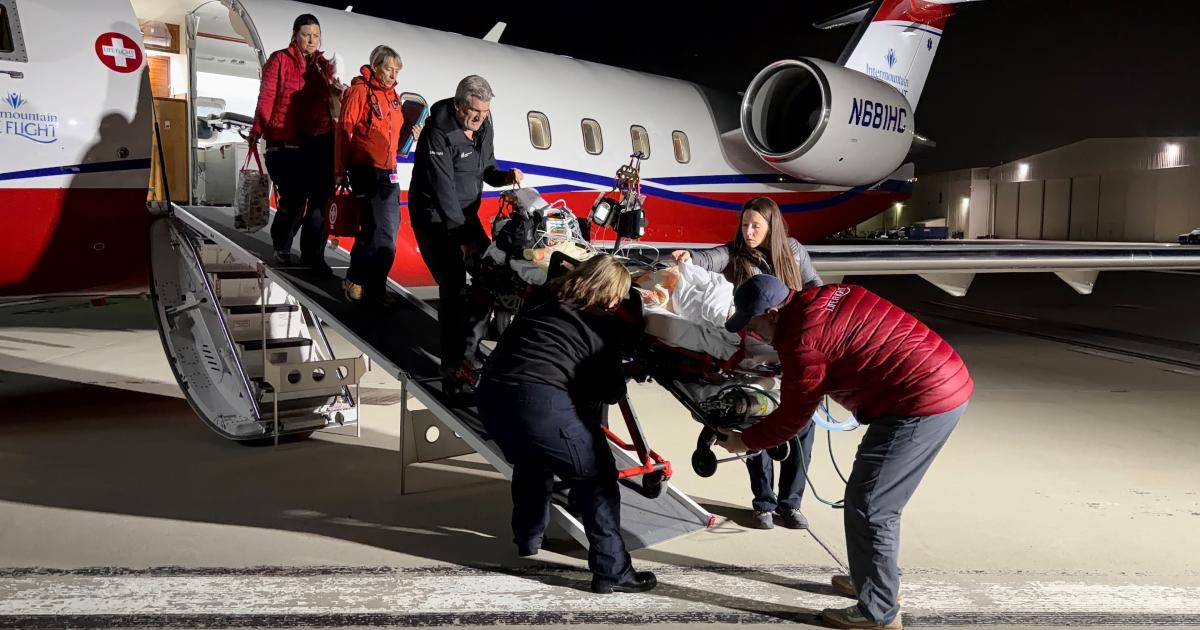
medevac mission by Intermountain Health
When a toddler became critically ill overseas, it was the flight and medical crew who got her home. © Intermountain Health

Estelle Santiago blew out her birthday candles surrounded by people most children never meet twice: the flight nurse who had monitored her vitals for 18 hours over ocean and land, the physicians who consulted on her case across two continents by phone, and the pilots who flew an air ambulance to South America and back to bring her home.

Months earlier, nobody in that room was sure this birthday would happen.

The Bombardier Challenger 604 that carried Estelle out of Uruguay is, by most measures, the star of a rescue story like this one: a long-range jet built to function as an airborne intensive care unit, capable of keeping critically ill patients alive for thousands of miles. But the aircraft is really only the vehicle. The mission belongs to the flight and medical crew. 

For an industry that spends most of its time proving the value of business aviation to boardrooms and shareholders, Estelle’s case is a reminder of a different kind of value proposition: what a well-run flight department, paired with the right medical expertise, can do when a child’s life is the return on investment.

Estelle’s family had traveled to visit grandparents who were serving a church mission. What should have been a routine trip turned into a crisis when the toddler suddenly fell ill. Doctors in Montevideo, Uruguay, diagnosed her with hemolytic uremic syndrome, a condition that attacks small blood vessels, can lead to organ failure, and is often triggered by a bacterial infection. By the time she reached the hospital, Estelle was having seizures. Her kidneys had failed. Then her heart and lungs began to fail too.

Her parents, thousands of miles from home, watched their daughter’s condition spiral with no way to get her the specialized care she needed. They contacted Intermountain Health’s Transfer Center in Salt Lake City, Utah, hoping someone could bring her home.

That call set off a chain of paperwork. Health insurance approval came through within hours, but international landing permits can take a week to 10 days to process—time the critically ill toddler didn’t have. 

The permit came through in 24 hours instead, fast enough to change the mission from a question of whether they could get her home to a question of how quickly.

A pediatric critical care physician with University of Utah Health and Intermountain Primary Children’s Hospital stepped in as medical control for the mission, consulting directly with physicians at British Hospital of Montevideo on a question more vital than the logistics: could Estelle physically survive the flight home? The Uruguayan team wasn’t sure. The U.S. team would need to coordinate in-flight care from thousands of miles away, carried out over international airspace.

Intermountain had added the Challenger 604 to its fleet in 2022 specifically for long-range international transports and organ retrievals. With a range of almost 4,000 nm, the aircraft has a cabin large enough to accommodate two patients and the equipment required for complex mid-flight procedures. For shorter, North American missions, the organization flies a Textron Aviation Cessna Citation CJ4; internationally, the Challenger does the heavy lifting.

But ask anyone who has flown one of these missions what actually got Estelle home, and the aircraft is almost an afterthought. On January 9, a three-person medical team and four pilots launched for South America, spending the night in Peru before continuing to Montevideo. When they reached Estelle, she was intubated, sedated, and dependent on multiple IV drips. Her continuous dialysis would have to stop for the length of the journey home.

Two days later, the team began the trek north: back to Peru to refuel and swap out pilots, on to Brownsville, Texas, for U.S. customs, and finally to Salt Lake City. Flight nurse Rose Linsler stayed at Estelle’s side for the full 18 hours in the air.

“The speed and efficiency necessary to make the transport safe, rapid, and successful were extraordinary,” Linsler said. “On Wednesday night, we first heard about our patient. By early Friday morning, we were departing for Uruguay, and by that Sunday night, Estelle was in her ICU bed at Primary Children’s Hospital getting the care she needed.”


Estelle Santiago
On track toward a full recovery, Estelle Santiago made a life-saving journey on a business jet. © Intermountain Health

For Estelle’s father, Michael, the arrival of the Challenger and its crew was the moment the crisis started to turn. “The moment the Intermountain team landed there, we felt relief and gratitude beyond words, like the cavalry had arrived,” he said. 

That relief didn’t fully set in until the family was back on U.S. soil. He described watching his daughter wheeled into her room at Primary Children’s Hospital as the first moment he and his wife, Ellie, felt they could breathe, although they knew there was a long road ahead.

Estelle’s flight is one version of a mission Intermountain runs routinely, if not always at this level of urgency. The air ambulance program pairs adult, pediatric, neonatal, and high-risk OB nurses and paramedics with aircraft equipped for a variety of specialized needs. 

A 24/7 TeleCritical Care service lets flight crews connect instantly with board-certified critical care physicians, including secure video consultation, so clinical decisions get made in real time rather than after landing.

None of that shows up in a passenger’s view of a business jet. Since the program began, Intermountain crews have brought patients home from Canada, Mexico, Japan, Guam, Tahiti, Samoa, Chile, Brazil, Puerto Rico, Ireland, Qatar, Thailand, Micronesia, Jordan, Ecuador, South Korea, and Uruguay, among other places. 

This reach depends as much on relationships and clearances as on aircraft specs. The program holds independent accreditation from the Commission on Accreditation of Medical Transport Systems, the European Aero-Medical Institute, and the Business Aviation Safety Consortium.

Business aviation spends a great deal of energy defending its value against critics who see private jets as a luxury. Missions like Estelle’s are a case study in the other side of that ledger: a flight department, an aircraft, and a highly trained crew, deployed because nothing else could have gotten a mortally ill child home in time. 

At Primary Children’s Hospital, Estelle spent several weeks moving from critical care toward rehabilitation before finally going home. Partway through her recovery, her parents sent the flight crew a video update. Linsler still remembers watching it.

“No ventilator. No continuous EEG. No dialysis,” the nurse said. “Just a toddler taking tiny sips from a spoon. It was wonderful.”

By mid-year, Estelle was closing in on a full recovery. “She has a few lingering problems, but nothing that will hold her back,” Ellie said. “Estelle is on track to make a full recovery, and we’re so grateful.”