Everything about Radia’s plan to build the world’s largest commercial freighter is hugely ambitious, from the sheer size of the WindRunner airframe to the U.S. start-up’s vision for a robust market for highly specialized, high-volume cargo. Radia is going it alone at a time when no other airframer is working on a new heavy lift aircraft, which begs the question as to how it assesses the market potential.
While the aerospace industry benefits from companies advancing big concepts, skepticism comes with the territory. The aviation industry's back catalog is littered with defunct aircraft development programs, with many business cases dragged down by operational realities and merciless market dynamics.
As with any conceptual aircraft, questions surround whether enough WindRunners will be produced and sold to break even on the program's sky-high development and production costs.
Recent history provides some guidance. Former Boeing employees with direct knowledge of the U.S. airframer’s research into the business case for a purpose-built freighter offer a cautionary tale as Radia seeks FAA Part 25 certification and market introduction of WindRunner in the early 2030s.
Leeham News and Analysis (LNA) recently interviewed two employees with insight into Boeing's exploration of niche cargo markets. Both flagged challenges WindRunner must overcome to realize Radia's vision.
More than two decades ago, Boeing explored development of a purpose-built freighter with no passenger equivalent, LNA learned. Historically, the company has served the cargo market with freighter variants and conversions of passenger jets. Both sources, who were granted anonymity to speak candidly, confirmed that Boeing—despite devoting significant engineering and market-research resources to the project—could not make the business case work for a bespoke freighter.
One of the sources described the never-built aircraft's design as “brilliant” in its simplicity, as Boeing engineers imagined an airframe with very low empty weight.
“Boeing tried scoping an airplane that was all purpose-built for the freighter aircraft industry that had no analog in the passenger world," one of the sources said, "and basically the airlines said ‘We’re not interested; it just doesn’t make any sense.'”
Demand did not justify the jet. And that is the biggest question for the WindRunner program to answer, both sources said: Would the existing market support a clean-sheet cargo jet designed for moving very-large-but-not-extremely-heavy cargo? Would demand for what would be a niche aircraft justify the huge investment necessary to develop, certify and produce enough units to break even on the program? Both shared doubts.
One source estimated that nonrecurring costs of the WindRunner program could total $15- to $20 billion, adding: “No investor in their right mind, except the U.S. government—read: the Pentagon and the U.S. Air Force Air Mobility Command—are going to write that kind of check.”
Radia CEO Mark Lundstrom has been candid that, while the program has been funded privately to date, WindRunner's future success hinges on government support. Whereas the concept was unveiled during the 2024 Farnborough International Airshow as a transport platform for the world's largest wind tubrine structures, Radia has since expanded its business case to include military transport missions, such as transporting fighters and helicopters.
During LNA's conversation with Lundstrom at the 2026 Farnborough International Airshow in July, he declined to specify how many WindRunner units must be sold for the program to turn a profit. But he suggested that the number is dozens rather than hundreds of aircraft, and that the program’s break-even point “goes down significantly as the amount of government funding goes up, and we are at the point where large amounts of government capital are at the MoU stage with us now.”
The program has received "a lot of interest" from the U.S. military, according to Lundstrom.
“We intend to be the neo-prime contractor for strategic airlift, and there’s funding available for companies like us to bring things into market in a quicker way compared with traditional prime contractor methodologies,” he explained. “Most of the money for the project will come from government sources. It will be a combination of economic development assistance from some of the European countries of supply; that comes in the form of grants and loans. There will be some military assistance as well.
“There are things like export credit agencies that can support certain portions of the financing stack from different countries around the world where we’re procuring products,” he said.
The U.S. Air Force is likely Radia's most-preferred customer. Without a major government contract, WindRunner will not be produced and sold in quantities that will justify the program's huge costs. However, the military's certification requirements are less demanding, leaving the possibility open for a smaller production run.
In terms of what the market could support, some analysts point to the production runs of the Antonov An-225 and An-124. Fewer than 100 of those airframes have been assembled.
There is simply not much precedent for long production runs of transport aircraft with performance characteristics like WindRunner's. It would be a slow-moving transport jet with a relatively low maximum payload, at least compared with large freighters in operation. The Pentagon historically has favored utility—range, payload, and speed—along with operational flexibility. And the large, lumbering aircraft would be a poor fit for contested airspace.
The company envisions moving "six packs of Chinooks" and four Lockheed Martin F-16s lined up nose-to-tail without disassembling the aircraft. At an empty weight of 25,000 pounds apiece, six Chinook helicopters would come close to WindRunner's targeted maximum payload of 160,000 pounds.
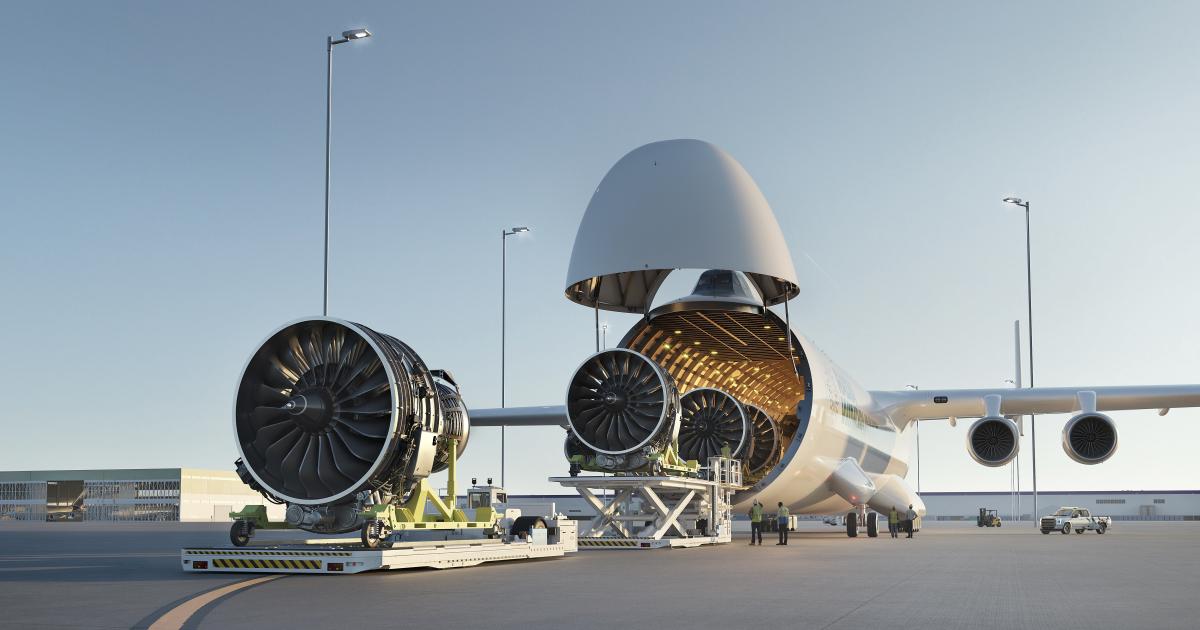
Moving very large turbofan engines without disassembling them is another potential application, according to Lundstrom.
He pointed to the Boeing C-17 Globemaster and Lockheed C-5 Galaxy as examples of large transport aircraft produced in the low hundreds. Those jets are designed to move far heavier payloads, however—and aren't nearly as large.
Radia’s designers obviously took cues from the Boeing 747-8F, including the signature nose door for loading ungainly items, as inspiration for WindRunner's design. At 242,000 cubic feet, WindRunner has roughly 10 times the cargo volume of a Boeing 747-8F, yet it carries less than 60% of the 747-8F's maximum payload weight, according to LNA aerospace analyst Bjorn Fehrm.
The aircraft's market, therefore, is not the "normal cargo market," Fehrm said. "It's the outsized cargo market with very large items that are not that heavy. This market is served by the few remaining [Antonov] AN-124s today and was served by the now-destroyed AN-225 Mriya, which had a volume of 46,000 cubic feet at a max payload weight of 250 tons."
Cirium data show 23 An-124s in service globally.
WindRunner's main selling point is its cavernous cargo bay, with volume sufficient for most of the world's largest rockets. The design calls for an outsized cargo aircraft targeting very specific missions moving large single items.
In a telling anecdote, one of the former Boeing employees who spoke with LNA tracked how often the 747-8F's nose door was required for outsized shipments–or the side cargo door was used for extra-tall objects—for a major cargo carrier. Those missions amounted to “at best 2% of their daily freighter operations,” the source said, adding that specialized cargo is a “very, very niche” corner of the overall freight market.
Boeing also explored a demilitarized C-17 variant for commercial cargo missions. That, too, was determined to be a prohibitively small market, as the C-17 has “about the same payload-range capability as an MD-11, but its economics are...worse than the MD-11 in terms of cost basis.”
In Radia's favor is a wide-open market in which no strategic airlift is being actively developed in the Western world. Lundstrom has noted that Radia essentially has a 10-year jump on any competitors looking to fill a similar niche.
"In order to make a large military aircraft, traditionally the Pentagon would pay for it," he said. "It would be a multi-year procurement process and then a multi-year delivery process, and the interaction between the Pentagon and the prime contractors just takes a lot of time, to go through that competition and then deliver the airplane.
"We haven't taken any government money yet," Lundstrom added. "We've been doing all of this on investor dollars, and so we've had a chance to get a decade ahead of the industry in terms of being able to deliver a giant cargo aircraft. Now, what I think has happened is that the military has started to realize they're kind of behind the game to deliver the next generation large aircraft."
According to Lundstrom demand for the aircraft will increase as manufacturers see they can move very large equipment with WindRunner, possibly even expanding what is possible to build thanks to its high-volume freight-hauling capability.
Whether the U.S. military proves strongly interested in a new heavy-lift platform, or whether the existing market can support such a jet, will determine the still-conceptual aircraft's success.
Leeham News and Analysis, which is part of the AIN Media Group, provides expert, independent coverage of key topics in the commercial aerospace sector. Subscribe here for exclusive access.