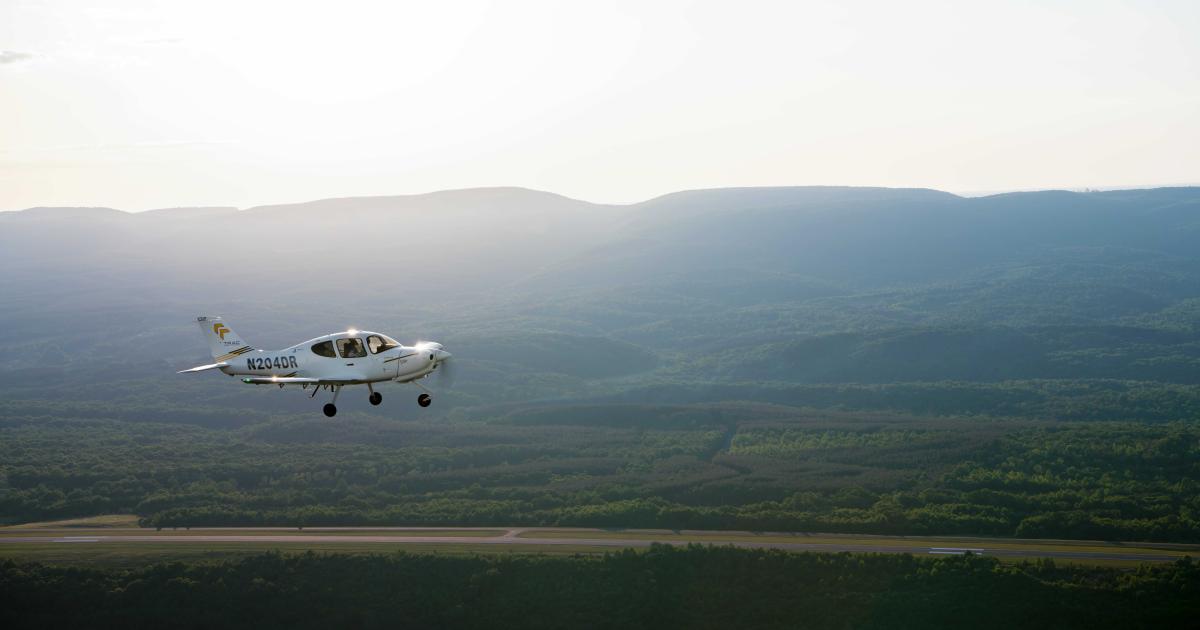
At the EAA AirVenture Oshkosh show in July, Cirrus unveiled its newest model, the TRAC10 dedicated trainer. Designed in concert with Cirrus’ Chinese partners at parent company AVIC, the TRAC10 is similar to the AG100 trainer that was certified in China. In the U.S., Cirrus received FAA certification for its version, the SR10, in 2023, but didn’t bring it to market until recently.
When it was certified, said Ivy McIver, executive director of the SR product line, “We put it on the shelf because it didn’t make sense for us to commercialize it at the time. We continued to evaluate the training market, and now was the right time for us to bring it to market. There’s a tremendous need for a flight-training-specific, purpose-built aircraft.”
Cirrus is not offering the $499,000 TRAC10 for retail sale; it is only available for Part 141 training providers and with a minimum purchase of five. “We designed the TRAC10 to be a clean-sheet, purpose-built aircraft specifically targeted at flight training,” she said. “We also wanted to make sure that it was quintessentially Cirrus, and that it felt like a Cirrus when you flew it. So the transition from a TRAC10 to a TRAC20 or 22 [trainer versions of the SR20 and SR22] was seamless.”
While the TRAC10 is a typical Cirrus all-composite airframe with a ballistic parachute, it differs from the other models, with three seats and power by Rotax. The two seats up front are for an instructor and one student, and the third seat in the rear is for another student. The idea is to shorten the downtime between lessons at the busy airports where flight academy fleets often operate.
“If you’ve got two students in the airplane, you can get two lessons done in a 1.5-hour equivalent,” McIver explained. “You put two students in the airplane…get out to the training environment…do your lesson…and land at a remote airport. You swap students, and then you do your [other] lesson in the training environment, and then fly back to the airport.”
The TRAC10 is the first Cirrus model to be equipped with Garmin’s new Axis touchscreen display avionics along with a Garmin GFC 500 autopilot. In the rear-seat position, an optional third display with a push-to-talk transmit button is available. This allows training organizations to incorporate the rear-seat student as an active participant in flights—for example, handling radio communications and navigation tasks. This is helpful, McIver said, “if you want to incorporate crew resource management into the lesson.
“If you think about an airline environment where you’ve got one pilot flying and one pilot not flying, typically that not-flying pilot is doing the radios, picking up the clearances, changing your altimeter setting, picking up ATIS, loading approaches, entering the flight plan, or plugging in the different frequencies, that sort of thing. All that can be done from the back seat.”
A switch in the front allows the instructor to enable or disable the rear-seat avionics. “It gives you a lot of flexibility in terms of how you’re going to manage your flight training,” she said.
Other TRAC10 features make it more efficient for flight schools, including a Cirrus Airframe Parachute System that is deployed by an airbag instead of a rocket, which should make maintaining the system more cost-effective. The 160-hp Rotax 916 engine can run on 100LL avgas, unleaded avgas, or mogas, giving schools flexibility as well as lower maintenance costs when using unleaded fuel.
Maximum cruise speed of the TRAC10 is 139 knots, and fuel burn at 65% power is 5.9 gph. Useful load is 750 pounds, and maximum fuel capacity is 33.5 gallons. The engine uses a single power control, which is more representative of the turbine-powered airplanes that students will later fly as professional pilots. “There’s a bit of a hint of, if you’re going to fly a turbine airplane, you’re not messing around with the mixture [control],” she said.
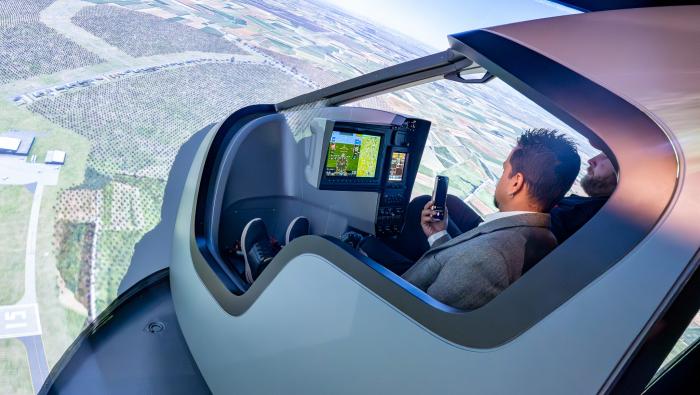
Cirrus is also developing structured training for the TRAC series, including training videos and interactive courses as well as simulators, she said, “which are pretty common throughout the professional airline space. That structure of learn [in the] classroom, simulator integration, and flying, that’s exactly what they’re seeing at the airlines.
“We not only design that airplane around the needs of the student; we design [it] around the needs of the whole training ecosystem,” McIver concluded.
In this article
More In Aircraft