For two years, Heart Aerospace promoted one hybrid-electric airliner concept while working toward another. The ES-30, with two turboprop engines and two electric motors spread across four nacelles, remained the start-up's public design through August, when the company flew an all-electric demonstrator it called representative of that airplane. But Heart had quietly settled on a different production design long before that flight, CEO Anders Forslund told AIN.
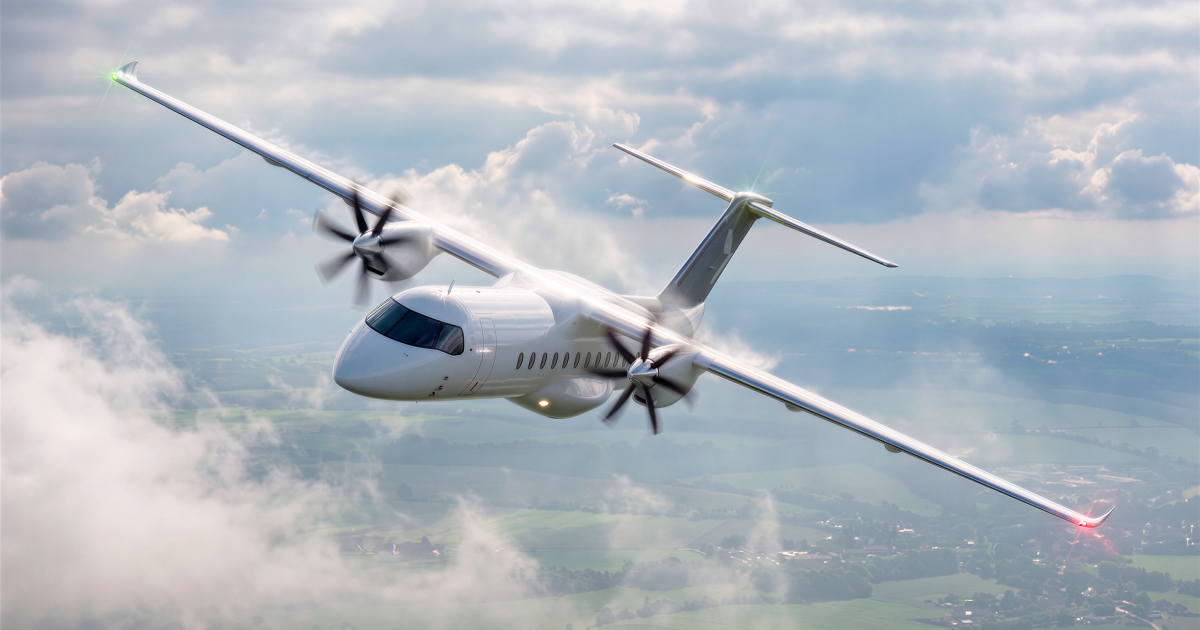
Heart unveiled the updated airplane, called the ES-36, on September 23 alongside a deposit-backed purchase agreement from charter carrier JSX. The 36-seat “series hybrid” propulsion system returns to an architecture Heart had dropped in May 2024 in favor of the four-nacelle “independent hybrid” configuration. It marks Heart’s fourth design iteration in six years.
Forslund said the decision to go back to the series hybrid was made about two years ago, which would place it close to the September 2024 rollout of the X1 demonstrator aircraft. Through that period, Heart described the X1 as representative of the ES-30, most recently in its August 13 announcement of the demonstrator’s first flight. Airline customers, suppliers, and investors knew about the change, co-founder Forslund said.
According to Forslund, Heart publicly “kept it under wraps” because the company “wanted to make sure that we were not acting prematurely in announcing it.” He explained that they did not want to reveal a two-nacelle production design while preparing to fly a four-nacelle demonstrator. “We didn’t think it was time to go public with the new design that has a two-nacelle configuration until after we flew, because then the aircraft that we flew and the aircraft that we’re building would be different,” he said. “From a narrative perspective, it made sense to wait on that and keep that news until after flight.”
Heart launched its program in 2018 with the 19-seat ES-19, an all-electric design with four propellers. In September 2022, it replaced that airplane with the ES-30 after prospective airline customers said they needed more range and payload. That initial ES-30 design was a series hybrid: four battery-powered electric motors, with two turbogenerators in the rear fuselage to supply reserve energy without draining the batteries. It also had a strut-braced wing and a large battery bay under the fuselage.
However, in May 2024, Heart dropped the turbogenerators. It also removed the wing struts and winglets and moved the batteries out of the lower fuselage.
The redesigned ES-30 became what the company called an independent hybrid, with two conventional turboprops on the outer wing and two electric motors inboard. Simon Newitt, who was then Heart’s president and chief commercial officer, told AIN at the time that the arrangement would allow for more missions to be flown in all-electric mode. He said the turboprops could remain shut down with their propellers feathered while the airplane took off and flew up to about 125 miles on the two inboard electric motors alone. On longer trips, the turboprops would start up to extend the range to about 500 miles.

The updated ES-36 reverses that decision. Instead, it reintroduced the series hybrid. Each of its two nacelles holds a 1.65-megawatt electric motor, and each motor has its own dedicated turbogenerator. Those turbogenerators never drive a propeller; rather, they produce electricity in flight to supplement the batteries. Heart says the ES-36’s turbogenerators are based on a commercially available gas turbine, though the company has not specified which one.
According to Heart, the ES-36 will be able to carry six more passengers and 1,415 pounds more payload than the ES-30 with the same battery capacity and the same maximum takeoff weight, which the company put at about 40,000 pounds. The wingspan is 95 feet, about 11 feet shorter than the ES-30’s. Heart is targeting operating costs at least 40% below those of legacy regional airplanes, which is the same goal it set for the ES-30.
Forslund called the hybrid system “the most challenging part of building the aircraft.” Specifically, its hardest piece is the turbogenerator, he said. No such unit is certified to power an airliner, so there was none to buy. Heart would have had to develop one and then convince the FAA that a turbine, generator, and power electronics working together could reliably keep a passenger airplane flying, with no precedent to follow.
The independent hybrid sidestepped that problem with off-the-shelf turboprops, making it a design Heart was confident it could build, Forslund said. However, it had “weird operating points,” he revealed, adding that the company was “never really fully satisfied” with it.
After the X1’s rollout in September 2024, Forslund said, Heart executed some tests and studies of the hybrid system and worked through its supply chain, and it now believes it has “found a way forward” to build a turbogenerator that meets its requirements on schedule. The company said it has tested “the underlying hybrid technology” at its propulsion test site in Oxnard, California, but did not say whether a turbogenerator has run or at what power.
The reason the airplane needs a hybrid system at all, Forslund said, is energy reserves. Regulations require an airplane to carry enough energy to divert to another airport, and carrying that reserve on batteries means most of the pack goes unused on a typical flight. “One in every 1,000 flights is diverted,” Forslund said. With fuel covering the reserve, the airplane can use its full battery on the planned flight instead of holding most of it back for an unlikely diversion.
Heart claims the same 125 miles of all-electric range for the ES-36 as for the independent-hybrid ES-30, and the figure has held steady since the company unveiled the first ES-30 in 2022. Hybrid range is what has grown. When Heart unveiled the ES-30 in 2022, it said the airplane could fly about 500 miles in hybrid mode with 25 of its 30 seats filled, or about 250 miles with a full load, including reserves. The 2024 independent hybrid kept the 500-mile figure.
For the ES-36, Heart quotes 745 miles, plus the fuel reserves required for flying under instrument flight rules. But that figure does not assume a full cabin. Heart said operators would have to give up some payload to carry enough fuel for a flight that long, but it did not say how much.

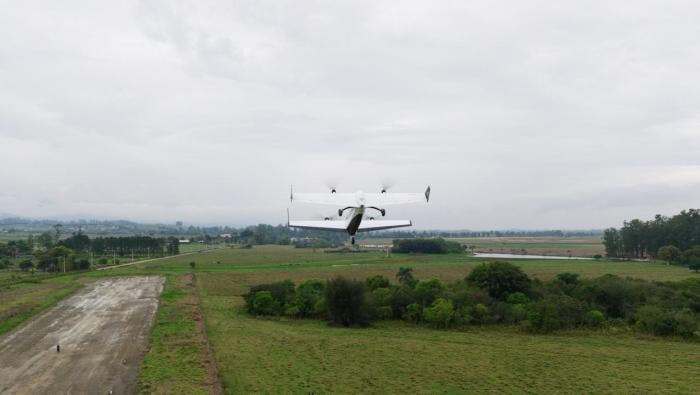
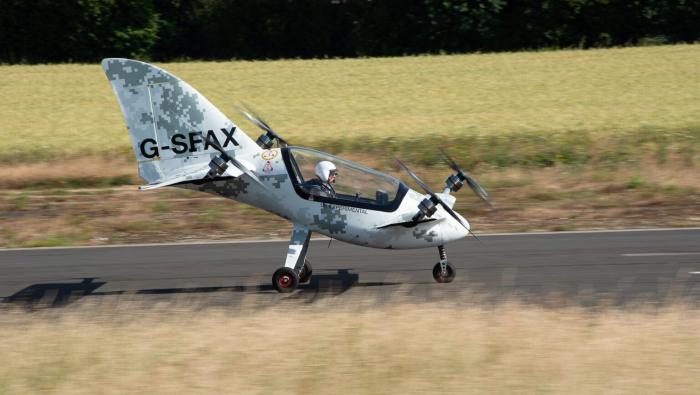
The X1 showed that Heart could design, build, and fly a full-scale electric airplane, which it did for 27 minutes on August 12 at Plattsburgh International Airport (KPBG) in New York. That remains its only flight. But the demonstrator hardly reflects the airplane Heart now plans to certify. It has four propellers instead of the ES-36’s two, and it has a takeoff weight of more than 25,000 pounds, compared with the ES-36’s 40,000 pounds.
Most importantly, the X1 is all-electric and carries no turbogenerator, so it has not tested the hybrid system Forslund called the most challenging part of the aircraft.
According to Forslund, that was the point. “Why put the hybrid system on the first aircraft that you’re flying?” he said. A sound flight-test campaign starts with the minimum and expands from there, he argued. “You don’t want to try to do a bunch of things at once.”
The demonstrator validated the airframe, the batteries, and Heart’s ability to run a flight-test program, he said, adding that “90% of what you learn from a flight test you learn before the first flight.” The X1 “was not meant to do any weather testing or pushing the envelopes in any way,” he said. “It was just meant to prove the technology.”
Chief technology officer Ben Stabler said in Heart’s September 23 announcement that the ES-36 design “is a direct result of what Heart learned designing, building, testing and flying our X1 demonstrator aircraft.” By Forslund’s account, the decision predates the flight by about two years.
Asked whether the X1 would be retired or keep flying with modifications, Forslund said Heart is “still evaluating what to do with it.” The airplane remains at Plattsburgh, and he said “the brunt” of the company’s work has moved on to the X2, a pre-production ES-36. The X2 is now under construction at the company’s pilot plant in Los Angeles. “We want to fly it by 2028, so ideally by the Los Angeles Olympics,” Forslund said.
JSX’s agreement converts a December 2023 letter of intent into a purchase commitment for 50 ES-36s, backed by deposits, with rights to buy 50 more. Neither company has disclosed the deposit amount, the value of the agreement, or delivery dates. Forslund said Heart’s other customers, among them United Airlines and Air Canada, are all on board with the ES-36. Including the JSX agreement, Heart’s order book now stands at more than 550 aircraft worth nearly $10 billion, the company said.
Heart expects to hold the ES-36’s preliminary design review next year. First flight is targeted for the second half of 2028, with FAA Part 25 certification and entry into service in 2031. Earlier targets were 2026 for the ES-19 and 2028 for the ES-30.
The company itself has changed along with the airplane. Stabler joined as chief technology officer in May 2024, the month Heart announced the independent hybrid and opened a research and development center in Los Angeles. Chief operating officer Sofia Graflund left the next month. Heart moved its headquarters from Gothenburg, Sweden, to the Los Angeles area in April 2025 and brought its pilot plant online there that October. Newitt, a proponent of the independent hybrid, left Heart to join Beta Technologies in August 2025.
Forslund made no apology for the repeated redesigns. “Change is part of our DNA,” he said. “Change is not a bug in our development. It’s a feature.” He said Heart has reached a major milestone every two years since it rolled out a propulsion demonstrator in 2020. “This company is not moving sideways,” he said. “It’s moving forward.”