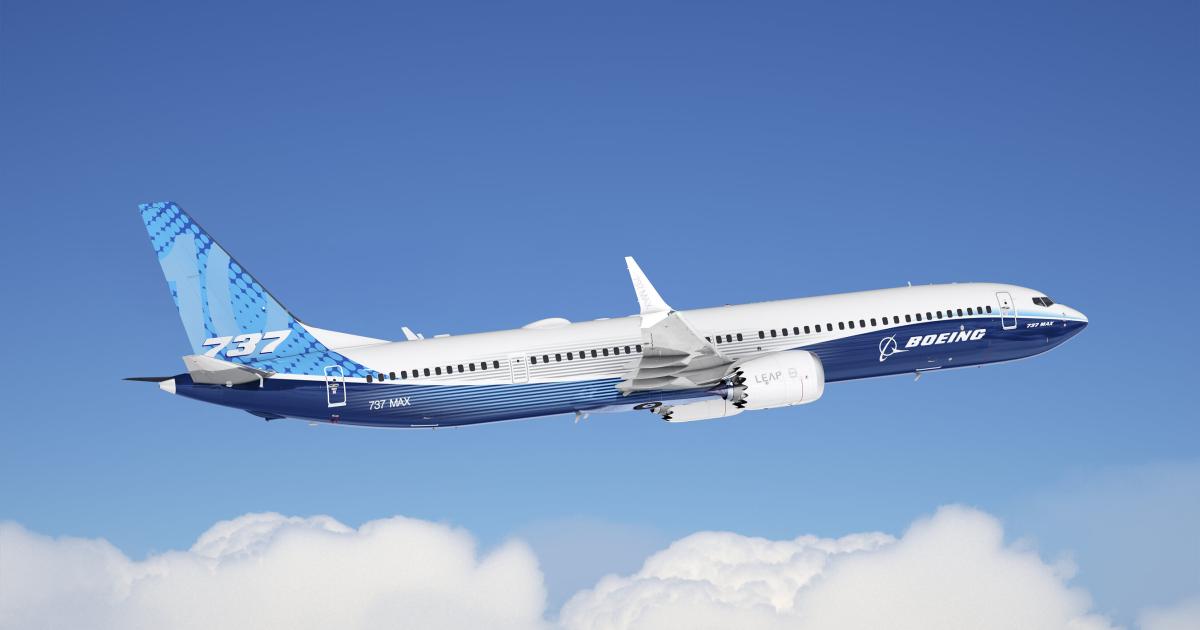
After years of delays, Boeing this week finally secured an amended type certificate for the much-anticipated 737 Max 10, the most-stretched and highest-capacity variant in the airframer's latest-generation family of single-aisle jets. The approval marks the end of a years-long saga that has seen Boeing's the Max program placed under intense scrutiny, with certification efforts held up by a series of technical issues and more-complex certifcation requirements.
The FAA certified the aircraft on October 20, confirming earlier reporting by Leeham News and Analysis (LNA). The milestone represents a massive win for Boeing Commercial Airplanes (BCA) and company CEO Kelly Ortberg, who had identified the Max 10's certification as a mission-critical goal when he took the job in August 2024.
Certification of the Max 10 also finally completes the full Max lineup, following the Max 7's certification earlier this year. The variant "builds on the family's architecture while taking capabilities to a new level," Boeing said, pointing to its 230-seat capacity in a "maximum seating configuration," and the "lowest seat costs of any single-aisle in service."
The aircraft's sweet spot is 185-210 passengers, however, with a range of about 3,100 nm.
"Completing the certification program clears the path for us to deliver a Boeing airplane that will set a new standard in commercial aviation," said Stephanie Pope, CEO of BCA. "The 737-10 offers greater capacity, longer range and the best seat economics in its class, a platform that will create more value and opportunities for airlines around the world.
"We are also delighted to complete the 737 Max family and provide our customers the most-efficient and flexible single-aisle airplane portfolio in the industry."
Years of Delays
Clearing certification likely allows Boeing's C-suite to breathe a collective sigh of relief. The company seemed poised to clear the milestone last month, but the FAA grew concerned with a flight-management software glitch that threatened to add another setback to an already severely delayed program.
More pessimistic observers believed the Max 10's certification and eventual delivery would be held up for several more months. Ultimately, the FAA decided to move forward despite a known bug—albeit one it has deemed not safety-critical.
In a press release, the FAA noted that certification of the 737 Max 10 comes after "years of extensive review." Indeed, it and the smaller Max 7 were held up in the aftermath of the Max crashes of 2018-19, which placed a white-hot focus on Boeing's relationship with the FAA and how the parties work together to certify commercial aircraft.
“The FAA’s decision follows a thorough review of the aircraft’s design and safety requirements,” said FAA Administrator Bryan Bedford. “We will continue to hold Boeing to the highest safety standards as the company begins production of the 737 Max 10."
In addition to an amended type certificate, Boeing secured an updated Production Limitation Record, authorizing the variant's production.
Notably, the Max 10 will come with new safety features, including an Enhanced Angle of Attack System (AoA). That system was developed in response concerns from U.S. lawmakers that the sensor system that contributed to both Max crashes was not sufficiently redundant. Now that the Max 10 has achieved certification, the new AoA system will be equipped on all new Max jets, and retrofits will begin on aircraft already in service.
Finally Countering the A321neo
In a secondary position relative to Airbus' dominance in the narrowbody aircraft market, Boeing now has a deliverable answer to the massively successful A321neo. Regaining some market share is possible, though Airbus maintains a likely insurmountable lead in the space.
Boeing said it would start delivering Max 10 aircraft, which will mostly be produced on the North Line in Everett, Washington, in "coming months." Deliveries are expected to begin early next year, with more than 30 airlines waiting for Max 10s and Canada's WestJet positioned as the launch customer.
Boeing is counting on the Max 10 as a major revenue driver, as it accounts for roughly a third of the airframer's backlog. It holds more than 1,500 orders for the variant.
Boeing's next big milestone—certification of the 777-9 widebody—will not follow in short order. The large twin-aisle jet is still working through a flight-test program and has yet to secure ETOPS authority for transoceanic flights. It will likely be several quarters before the updated 777 is cleared to enter service.
This story was first published by Leeham News and Analysis, which is part of the AIN Media Group. Subscribe here for exclusive coverage of the commercial aerospace sector.
More In Aircraft