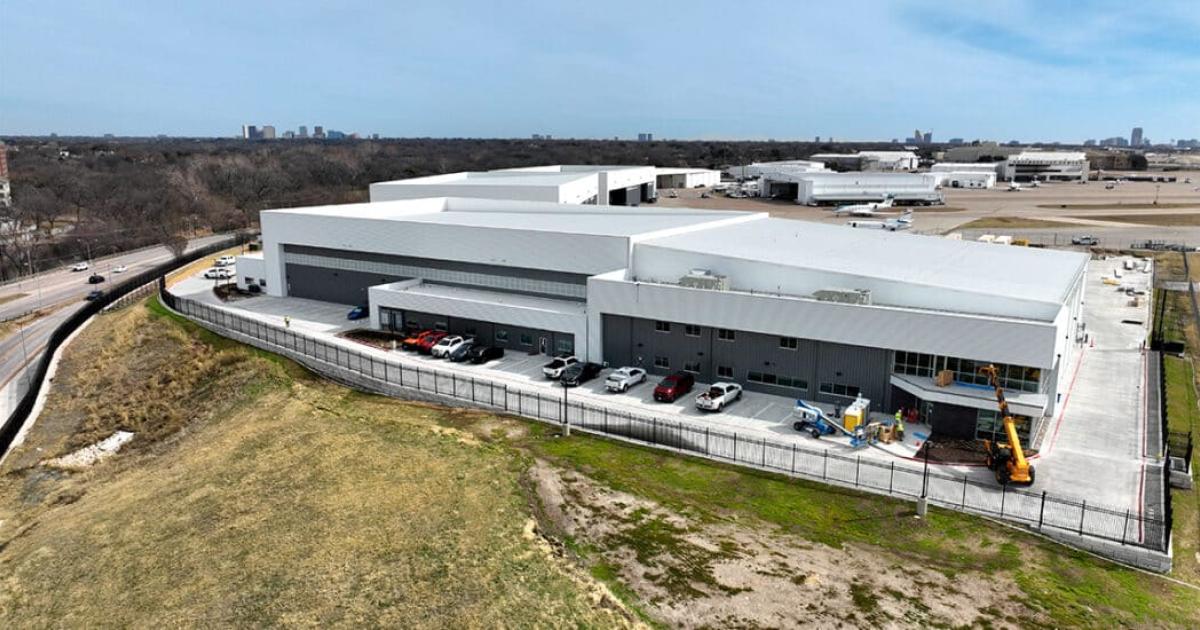
Dallas Love Field (KDAL) has been busy with construction in recent years, much of it ongoing as the aviation services company Business Jet has updated and expanded its facilities on both the east and west sides of the airport. With its latest construction projects, the FBO and aircraft maintenance, management, and charter company’s combined building footprint spans almost the size of nine football fields.
Founded in 1993 by Bob Wright, Business Jet remains a family-run business and the only independent FBO on the field. Bob’s grandson, Chris Wright, now runs the FBO as CEO and partner, along with granddaughter Hannah Vincent as director of FBO operations. Meanwhile, Bob’s son Mike remains as managing partner even as the third generation has taken over operational responsibility.
The Wrights have kept a watchful eye over the development, which most recently involved opening the company’s 18th and 19th hangars, as well as renovation of its flagship FBO terminal—all completed this year.
“We’ve had a lot of changes in the last year,” said company director of marketing Alette Cook. “It was a lot of construction for a little bit, but it’s so rewarding now to see it all together.” Hangars 18 and 19, recently completed, round out the edge of Business Jet’s expansive property, adding 70,000 sq ft and boosting the total space to some 475,000 sq ft at campuses on the east and west sides of KDAL.
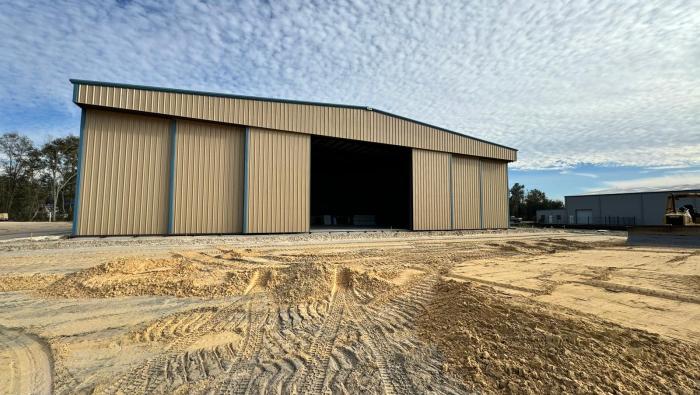
Located on Business Jet’s east campus, the hangars have different purposes—one housing seven clients and the other a single client. As clients lined up for space before the hangars were even built, Business Jet customized them for the upcoming tenants with kitchens, office space, and other requirements. Notably, the hangars each have 28-foot-high doors to accommodate the largest purpose-built business jets.
Opened in February, these hangars have come as Business Jet has continued to pour more concrete for ramp space as its clientele continues to grow. Love Field decommissioned a crosswind runway (18/36), providing an opportunity to expand ramp space. In fact, its ramp now covers about 25 acres, including 55,000 sq ft recently added on the west side.
The anchor is Business Jet’s main FBO terminal, which opened in 2000 on the east side and was recently renovated. The three-floor building, with its triangle-shaped canopy to welcome visitors and large windows overlooking runways, was reconfigured to provide a more open lobby, a new desk, flooring, and furniture—a project completed in March.
However, the one thing that did not change was the large, modern chandelier, selected by the Wrights when they originally decorated the lobby. It serves as the centerpiece of the terminal, along with artwork, to provide an abstract look.
The lobby includes a refreshment center stocked with complimentary ice cream and a Bevi machine, where customers can create their own drinks. Also on the first floor is a pilot’s lounge with a workstation, as well as a flight-planning room.
On the upper two floors are conference rooms and office space. Other amenities include a “crash pad,” with three crew sleep rooms and shower/restroom facilities that are “pretty widely used”—even by visitors from another FBO on the field that does not offer the same.
Separate lounges include one with a television and massage chairs and another known as the game room, sporting a Golden Tee arcade game that has become a favorite among some transient pilots. For those who prefer quiet time, Business Jet has a “tranquility room” that provides a more peaceful stay, with a fish tank adding to the serenity.
In addition, the FBO offers a large dining space that can be rented out, as well as a full kitchen. Diners can view the runway from the dining space, or they can move out to the balcony just off the dining room to watch arrivals and departures.
The east side houses the executive offices and most of the FBO operations, while the west side is mainly for charter operations, the managed fleet, and the Part 145 repair station. The different operations previously carried separate names, but the company rebranded in 2024 to Business Jet across all operations.
Cook credited long-held relationships, not only with the clientele but also around the airport and in the greater Dallas community, for the FBO’s successful expansion. “This gave us these opportunities to expand and have this land,” she said, noting how hard it can be to find space around Love Field.
Bob Wright was a developer who had long been deeply involved in the Dallas community and drove development of Medical City Dallas. But he decided to open his own FBO because he believed that services on the ground should match those found aboard the business jets in the air. So, he founded Business Jet Center with his son Mike in the early 1990s.
After starting the FBO on the east side, Business Jet was able to begin a lease on the west side around 2010. That’s where Business Jet began its management business and operates its charter and brokerage services—another area where the company is expanding.
But recognizing that Love Field will have limits on how much property it can secure, “a natural growth for us is to grow off the field. And so we’ve been looking at management opportunities off of Love Field,” Cook said.
In tandem, Business Jet has built up a maintenance facility on the west side. The FAA Part 145-approved station does everything from scheduled maintenance to heavy checks, modifications, and AOG.
“It shifted from mostly maintaining our fleet to a lot of outside maintenance, too, and it’s a real player on the field here,” she said. In addition, the MRO continues to add to its maintenance capabilities as its clientele expands.
Business Jet has continued to evolve since its founding, but its original goal—to provide a “great FBO experience” with reasonable prices—has remained, she stressed.
Cook noted that this service can be anything from helping change a flat car tire for a late-arriving customer who just wanted to go home to helping clients through other obstacles: “Let us help you and fix whatever you need to fix and just take care of you.”
As for its expansion, Business Jet is not done, she said. “We haven’t stopped growing. We don’t have any plans to stop, either. We’re hoping to add two more 30,000- to 35,000-sq-ft hangars in the future,” Cook said.
Those long-held relationships in the Dallas community continue to deepen. As such, Business Jet places an emphasis on giving back to the community. In 2013, it formed the Business Jet Cares nonprofit. This was employee-driven, Cook said.
Business Jet Cares focuses on “kids, pets, and vets,” supporting local elementary schools, helping children go on field trips, and partnering with two charities: Folds of Honor, which provides scholarships to family members of fallen or disabled members of the military or first responders, and Patriot Paws, which provides service dogs for veterans and first responders in need. “To date, for those two organizations alone, we’ve raised over $700,000,” Cook said.
In this article
More In FBOs