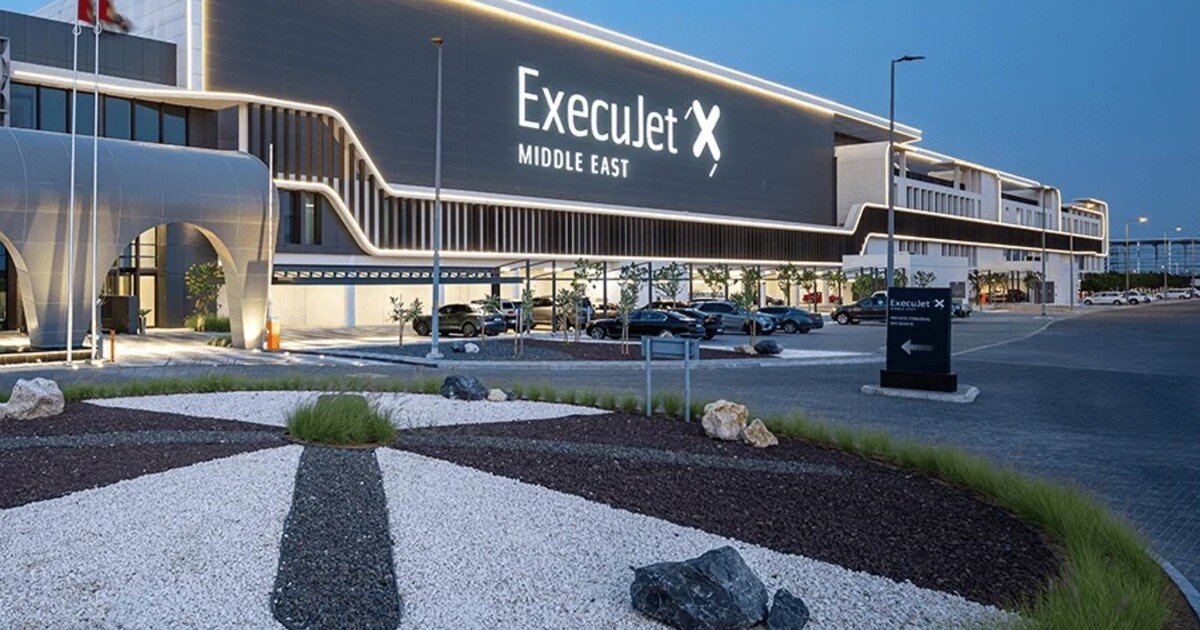
When it officially opened at the end of 2024, ExecuJet’s FBO at Al Maktoum International Airport (OMDW) in Dubai was intended by the global chain to make a “be-all and end-all” statement, unrivaled by regional—and possibly even global—standards for sheer size and luxury.
At a total of 15,000 sq m (161,500 sq ft), including the 7,000-sq-m (75,000-sq-ft) hangar, the three-story complex dwarfs those of its regional rivals. It is equipped with a full slate of amenities and services, including VIP, diplomatic, and corporate flight coordination, passenger lounges, a network of elevators, a crew lounge with an upstairs rest area, and premium shower facilities, plus a bar and restaurant.
The ExecuSpa offers massage treatments, sauna, and wellness facilities, while a cocktail and cigar lounge complements the signature Majlis Lounge and the Al Samaa Suite.
“We’ve got different types of profiles of flights from head-of-state and VIP to larger groups, football teams, to very small—two or three people on a flight,” Dumani Ndebele, regional FBO director, Dubai, told AIN. “A facility has to be able to accommodate all of those profiles. During COP28, we had four heads of state traveling at the same time. There is no other FBO [in Dubai] able to accommodate that with each of them feeling that they have private space.”
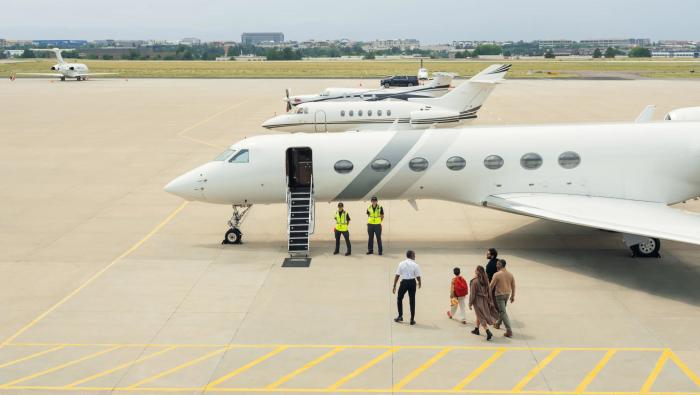
On the day AIN visited, a Gulfstream G550, two G650s, a G700, a Bombardier Global 6000, a Challenger 605, and a Dassault Falcon 8X were parked in the hangar, evoking a complex game of Tetris.
Over the past several years, the Jetex FBO has seen the lion’s share of movements at OMDW, claiming a share of almost 75% in 2022, but ExecuJet claims its new facility offers gravitas and opulence that its rivals on the field—which include DC Aviation Al Futtaim and Falcon Aviation—cannot match.
“While there are other very good FBOs on the airport, we offer something unique, and I don’t see in that sense that we do have a competitor,” Ndebele said.
Migration Accelerating
Ndebele believes the migration from Dubai International (OMDB), where ExecuJet has had operations since 2007, has quickened in the past two years, from a 60-40 split to approaching 80-20 today, reflecting slot competition at the old location.
After operating a temporary facility at OMDW from 2016, ExecuJet had a soft opening of its FBO in late 2023—ahead of its formal opening a year later. Ndebele said initial market share of around 12% to 15% “wasn’t great.”
“At OMDW, we’ve had an over-150% increase in market share since November 2023,” he said. “Since we built this facility, we have had significant growth. Given the fact that we now have aircraft that are based here, a lot of our managed fleet is now [operating] out of here.”
ExecuJet handles some 70% of the flights into OMDB. It also has an expanding fleet under management that is based at OMDW, but this reflects only 10% of the total flights it handles there.
“We’ve seen a significant increase to now just over 35% [market share] for OMDW,” Ndebele explained. “If you look at the picture covering both airports, we have 40% of the total movements into Dubai.”
Generally speaking, the Middle East and Asia have been ExecuJet’s big markets.
“The Gulf has always been strong, and we’ve obviously had a lot of traffic from India and Russia also, in the past,” Ndebele noted. “The UAE has done an incredible job of creating an environment in which the owners of aircraft, operators, and companies such as ours can operate. I feel that it would be very difficult to top the ecosystem that’s now in place at this airport.”
ExecuJet serves UAE owners, but many clients either based at OMDW or within the region have chosen it to manage aircraft on their behalf. “We’ve got aircraft owners in Africa, but their fleet is managed from here,” he said.
ExecuJet’s FBO joint venture with NasJet Private Aviation lasted about a decade through 2022, but Ndebele is confident of a relaunch soon in Saudi Arabia. He notes the volume of internal Saudi traffic is likely higher than that coming in from outside. “I can see that Saudi is well positioned to grow that,” he said.
ExecuJet’s reentry to that market would prioritize high-volume locations.
“We were in Riyadh; we understand how Riyadh works and the kind of traffic that comes in there,” he said. “Obviously, Jeddah is another very important location. It’ll eventually become clearer, but returning to Riyadh is our primary focus right now.”
Construction on a sizeable new King Salman International facilities there is expected to be completed by 2030.
“There will be a new general aviation area and some chalets, as they’re called, for FBOs,” Ndebele said. “The layout that I saw recently was that FBOs would have their own processing areas, not necessarily in the same space, [their] own driveways, and then there’ll be a separate terminal for handling the Hajj, [and] big passenger flights.”
ExecuJet is engaged in a Saudi tender that Ndebele hopes will “wrap up” soon. The results have yet to be announced.
No Hindrances
But he is hard-pressed to detect challenges to Dubai’s status as the natural regional business aviation hub.
“I don’t see it right now, given the scale of the ecosystem within Al Maktoum International, in particular. I don’t see anything in the next 10 years that will come close to what exists in Dubai.”
He is unfazed by the threat of ongoing regional conflict. “As of now, I feel everything is moving in the direction of growth, and I don’t see any type of hindrances to that continuing.”
The OMDW evolution has been spurred by Dassault-owned ExecuJet MRO Services Middle East’s co-location at the site. That facility complements the FBO, but, irrespective of Dassault’s plans, the decision to build the permanent terminal was already part of ExecuJet’s long-term OMDW strategy.
“There were a lot of ideas, a lot of revisions, but I think centrally it was more about understanding our clients and the requirements that we’ve faced over the last couple of years,” he said.
“The idea of this facility was to be able to frankly say yes to whatever clients need.”
More In FBOs