
AIN 2018 Pilot Report - Hélicoptères Guimbal Cabri G2
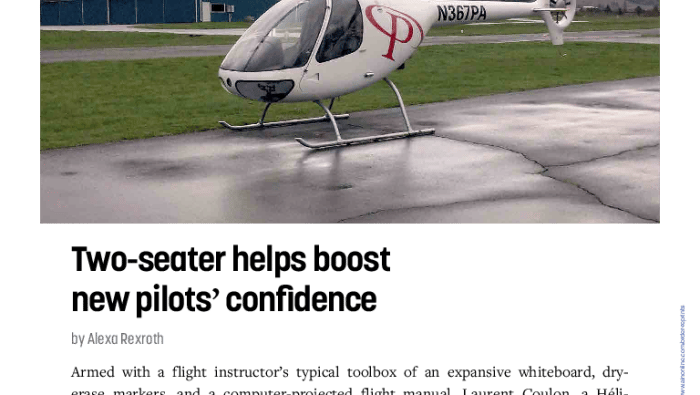
Armed with a flight instructor’s typical toolbox of an expansive whiteboard, dry erase markers, and a computer projected flight manual, Laurent Coulon, a Hélicoptères Guimbal Cabri G2 factory pilot, held court over a captivated audience at Precision Helicopters in Oregon. Precision hosted Coulon along with Cabri instructors and pilots for a multi-day advanced training course designed to provide the first factory equivalent training session in the United States. Seated among a group of pilots with Coulon at the helm, I listened with an ear typically tuned to a frequency of Robinson-related understanding when discussing piston helicopters. As discussed in depth by Coulon, however, the Cabri G2 differs from the Robinson R22 in multiple capacities. I would come to immediately recognize these differences later in the day when I had the opportunity to fly the Cabri.
With a fully articulated three-blade main rotor system, fenestron tail rotor, and composite airframe, the Cabri certainly stands out from other piston training helicopters. A Lycoming O360-J2A serves as the aircraft’s powerplant, and pricing for the helicopter sits around $400,000. While that price tag may induce sticker shock for a buyer who could purchase a Robinson R22 for something in the ballpark of $250,000, Coulon explained the value of the aircraft is apparent when it comes to safety and associated maintenance costs.
In this article
More In Rotorcraft