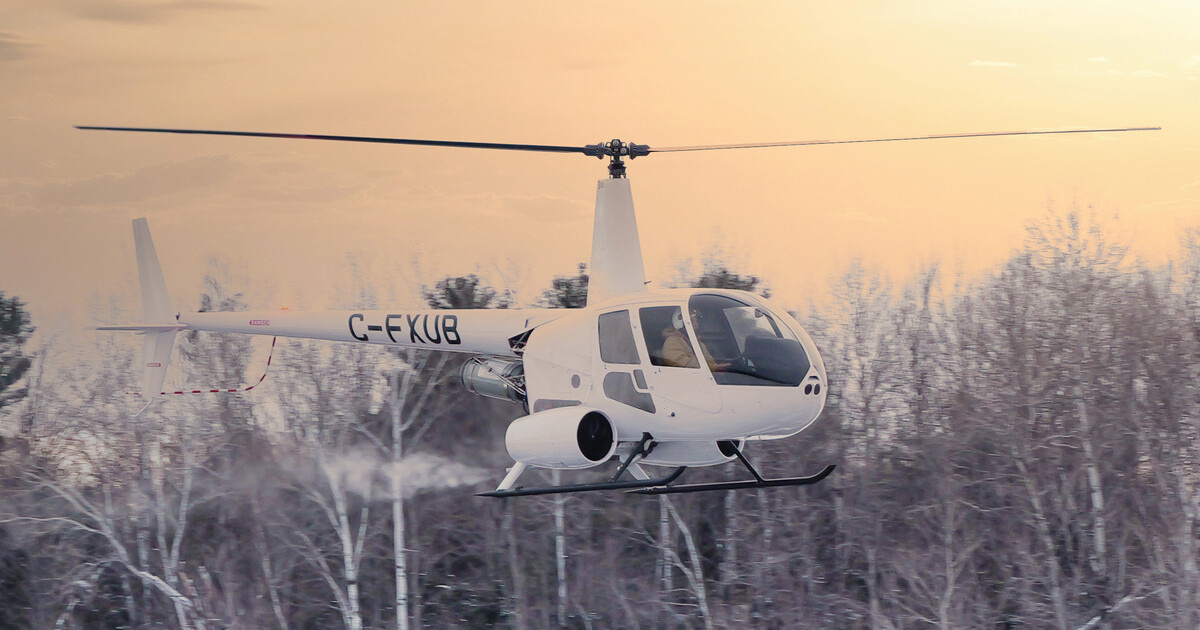
Unither Bioelectronics is moving its hydrogen-electric helicopters from gaseous to liquid hydrogen with Transport Canada’s agreement that a converted Robinson R66 can be certified under a supplemental type certificate (STC), a company executive said at HySky Society’s Flying Hy 2026 symposium.
Mikaël Cardinal, Unither’s v-p of program management and business development for organ delivery systems, said in his November 4 keynote at the virtual event that the R66 conversion is intended to fly 300 nm with a 600-pound payload and no reserves, a mission that requires about 30 kilograms of liquid hydrogen.
Unither plans to replace the R66’s Rolls-Royce RR300 turboshaft with two fuel cell stacks and a companion battery pack to handle power peaks, the architecture it already flies on an R44 demonstrator. Everett, Washington-based MagniX, which built the R44’s electric motor and is partnered with Unither on the fuel cell propulsion system, would supply a Helistorm electric motor that connects directly to the R66’s main transmission instead of the belt drive the R44 uses.
Cardinal said R44 flight results, published at the Vertical Flight Society’s 82nd annual forum, feed a computer model, or digital twin, that predicts the R66 will fly more than 200 nm with a 500- to 600-pound payload. He expects a fuel system now in design to extend that to 300 nm. The hydrogen R66 “will be unveiled in the near future,” he said.
The R44 made Unither’s first piloted hydrogen-powered flight on March 27, 2025, at Bromont Roland-Désourdy Airport (CZBM) in Quebec and has since progressed to airport traffic circuits. Across more than 150 ground and flight tests, it has reached 800 feet and 80 knots, while engineers injected faults such as a degraded fuel cell to see how the power management software copes.
Unither, a Bromont-based subsidiary of Silver Spring, Maryland-based United Therapeutics, is developing the aircraft with Torrance, California-based Robinson Helicopter to deliver manufactured organs from a few production sites to about 100 transplant centers, starting on the U.S. East Coast. It also sponsored Flying Hy 2026.
Moving to Liquid Hydrogen
Tullahoma, Tennessee-based Gloyer-Taylor Laboratories is building Unither’s liquid hydrogen tank. Company president Paul Gloyer said in a later Flying Hy session that the tank holds 19 kilograms of liquid hydrogen, compared with the “couple” kilograms of compressed hydrogen gas that limit the R44 to flights around the airport. A 30-kilogram version for the larger helicopter will follow, he said.
Gloyer said hydrogen accounts for 58% of the filled tank’s total weight. The tank is awaiting a final liquid hydrogen test at Gloyer-Taylor before delivery, and Gloyer hopes to fly it on a helicopter in 2027.
Unither is also commissioning a liquid hydrogen refueling station at a small Class G airport in Quebec’s Eastern Townships, with completion expected in the first quarter of 2027.
Transport Canada is the lead regulator for the STC. Last year, the agency agreed the conversion is “a significant change and not a substantial change,” Cardinal said, which validated the STC route. A substantial change would have required a new type certificate for the aircraft, while an STC lets Unither certify the hydrogen conversion as a modification to the existing R66 design.
Removing jet fuel eliminates some hazards, Cardinal explained, while cryogenic hydrogen introduces others. He cited Part 27 fuel system crash resistance rules, which call for a 50-foot drop test of a filled tank assembly to show that the system doesn’t leak. “With hydrogen, and more specifically with a cryogenic system, we really have to consider the original safety intent of the regulation and adapt it to a liquid hydrogen fuel system,” he said.
His team and consultants are drafting white papers on those hazards that will lead to issue papers and, eventually, proposed special conditions, the custom requirements regulators write for novel designs. Unither also wants regulators to agree on where the technology fits on the FAA’s safety continuum for normal-category rotorcraft, which ties an aircraft’s safety requirements to the consequences of a failure.
Cardinal called the Eastern Townships station a sandbox for developing safety and refueling protocols, not a model for commercial service. He expects commercial operations to rely on small-scale local production of hydrogen, with each mission leg on predefined low-level IFR routes needing about 30 kilograms.
In this article
More In Rotorcraft