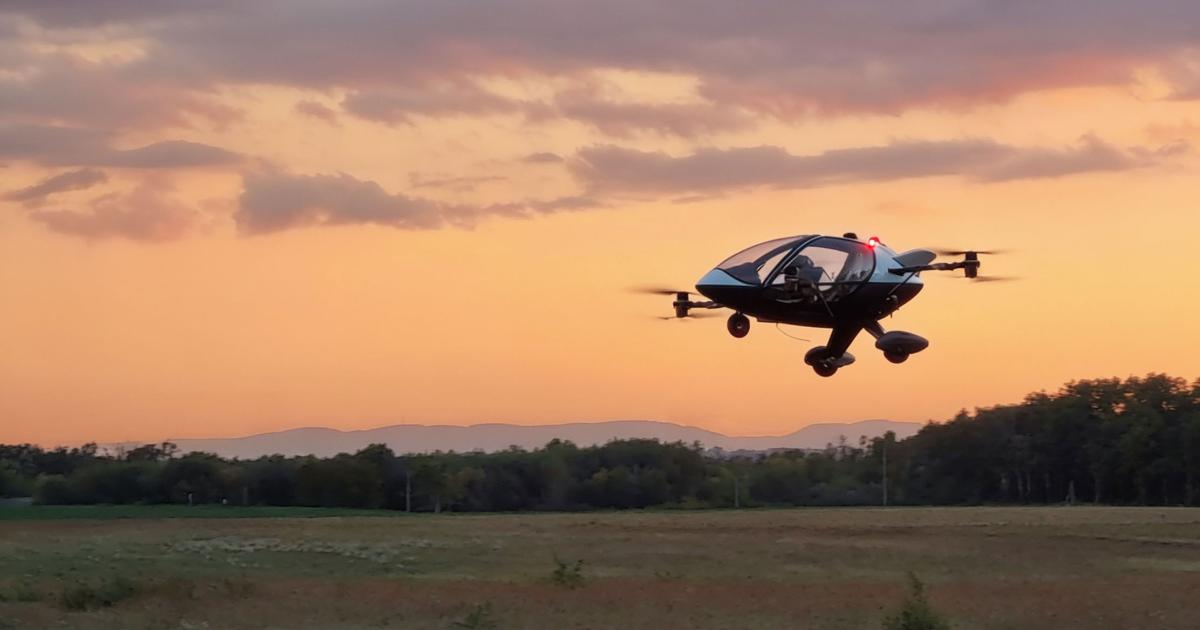
DTA Aircraft is bringing its JP1 two-seat hybrid-electric multicopter to NBAA-BACE with a pitch to business jet owners: fly yourself from home to the airport where your jet is based, skipping the traffic. The French maker of gyroplanes and ultralight trikes says some business jet owners have already placed pre-orders, and it is using the show to find more buyers as well as U.S. dealers, flight schools, and maintenance partners. DTA plans to assemble the aircraft in Arizona.
Based in Montélimar, France, DTA Aircraft, a subsidiary of French company Vichar SAS, has built aircraft since 1990 and claims that more than 595 of its machines fly in at least 33 countries. Its new U.S. arm, DTA Americas—a Delaware corporation based at Jet Aviation’s facility at Scottsdale Airport (KSDL) in Arizona—opened U.S. pre-orders for the JP1 at $385,000 during EAA AirVenture in July.
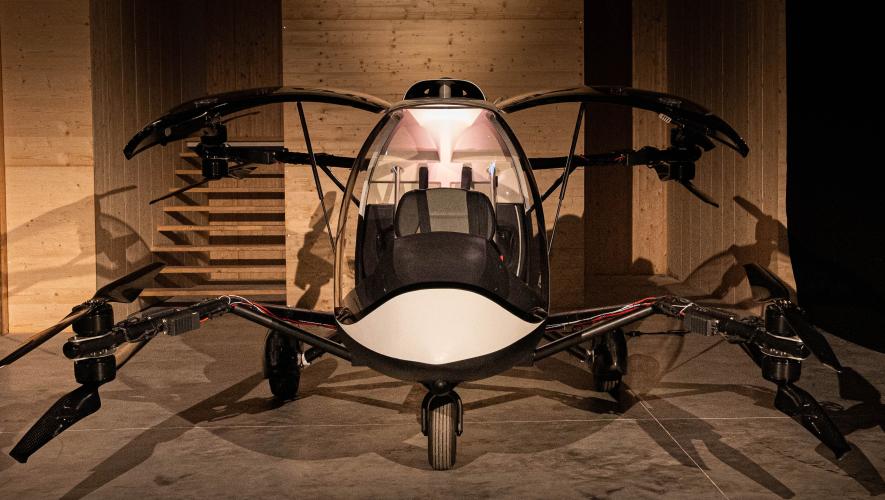
Eight electric motors on four carbon-fiber booms lift the JP1, which has a tandem cockpit and a whole-airframe ballistic parachute. A single-rotor rotary engine that burns jet fuel or SAF drives a generator to recharge four battery packs in flight.
DTA claims the JP1 will have two hours of endurance, allowing it to fly 156 nm with two people on board or 235 nm solo at a cruise speed of 90 mph. The 1,146-pound mtow aircraft is expected to be able to keep flying after losing up to four propellers. An autopilot handles stabilization while the pilot sets the flight path.
The JP1 has logged more than 200 hours of flight testing in France, all uncrewed and remote-controlled, with a 160-pound dummy in the pilot’s seat, DTA Americas co-founder and CEO Théo Parant told AIN. With no regulatory category for such an aircraft in France, DTA registered the JP1 there as a heavy drone. “We did find a loophole in the French regulation so that we could fly it,” he said. “It’s just that the French regulation wouldn’t allow us to put someone in the aircraft.”
That test aircraft is now in Scottsdale, where it remains on the ground while DTA seeks an FAA experimental airworthiness certificate for research and development so it can resume flight testing, this time with a pilot on board.
DTA positions the JP1 as an alternative to a two-seat helicopter in the same price range. It said owners can fold the aircraft’s width from 10 feet to 8 feet to tow it on a road trailer and can taxi it into a garage on motorized rear wheels with the propellers stopped.
From Gyroplanes to eVTOLs
Former crop-dusting pilot Jean-Michel Dizier founded the company as Delta Trikes Aviation in 1990 after building a weight-shift trike for his own use. DTA built its business on ultralight trikes such as the Voyageur and Evolution and later added the J-RO, a two-seat gyroplane with a carbon-fiber fuselage and removable gull-wing doors.
In 2016, Dizier sold DTA to Chinese owners, who moved its gyroplane molds and technology to China, Parant said. A former DTA gyroplane owner bought the company in 2022 and recovered its intellectual property.
According to Parant, the new owner wanted a safer, easier-to-fly aircraft for his weekly Tuesday lunch with his mother, about 30 minutes away by air. He funded the JP1’s development himself for several years, until the FAA’s Modernization of Special Airworthiness Certification (MOSAIC) rule opened a potential path to the U.S. market. Parant, now a shareholder alongside him, joined the company at that point.
Last month, DTA announced a partnership with Embry-Riddle Aeronautical University that will give students capstone projects on the JP1’s aerodynamics, airframe structure, and hybrid-electric propulsion. According to the company, this work will support its U.S. manufacturing plans.
The MOSAIC rule, which the FAA published in July 2025, expanded the light-sport category to cover larger and more capable aircraft, such as helicopters and powered-lift aircraft. Its pilot certification changes took effect in October 2025, and the aircraft approval provisions took effect on July 24.
Parant told AIN that under MOSAIC, pilots will need only a sport pilot certificate, which requires 20 hours of training and no FAA medical certificate, to fly the JP1. He called the rule an enabler for DTA, which until then had been “stuck in France with products we couldn’t sell.”
The FAA has yet to decide which aircraft category the JP1 will fall under. That decision will ultimately determine pilot certification and training. MOSAIC extends sport pilot privileges to helicopters with a simplified flight controls designation but not to powered-lift aircraft. Parant said simplified flight controls will come to DTA’s multicopter “further down the road.”
To get the JP1 approved as a light-sport aircraft, DTA must show compliance with an FAA-accepted ASTM consensus standard. In July, the FAA accepted the ASTM standard covering powered-lift aircraft and multicopters, but for now it applies the standard only to powered-lift aircraft. Parant does not expect DTA to complete aircraft approval for at least another year.
Personal eVTOL Competition
The JP1 enters a growing field of eVTOLs aimed at private owners rather than air-taxi operators. Several of the most visible, such as Pivotal’s Helix, Ryse Aero Technologies’ Recon, and the Jetson One, are single-seat, battery-powered eVTOLs designed to FAA Part 103 ultralight rules, which require no pilot certificate but limit the aircraft to one occupant and keep them away from congested areas.
Palo Alto, California-based Pivotal lists the Helix starting at $190,000 and has already begun delivering pre-production prototypes to customers. Mason, Ohio-based Ryse has marketed the Recon at about $150,000. Irvine, California-based Jetson prices the Jetson One at $148,000 and is now taking orders for 2028 delivery.
Two-seat competitors aiming for light-sport certification under MOSAIC face the same pilot-certification questions as DTA. Israel-based Air claims more than 4,000 people on the waitlist for its all-electric Air One, which it plans to approve under the powered-lift standard the FAA accepted in July.
Pompano Beach, Florida-based Doroni Aerospace expects to price its two-seat H1-X at about $400,000 and begin deliveries by 2028. Both companies asked the FAA during the MOSAIC rulemaking to let sport pilots fly powered-lift aircraft, and the agency declined, citing a lack of data and experience.
DTA’s sales pitch rests on endurance: the company said pure-electric aircraft in its class can fly for less than an hour, while the JP1’s range extender lets it stay aloft for two hours with two people on board.
More In Rotorcraft