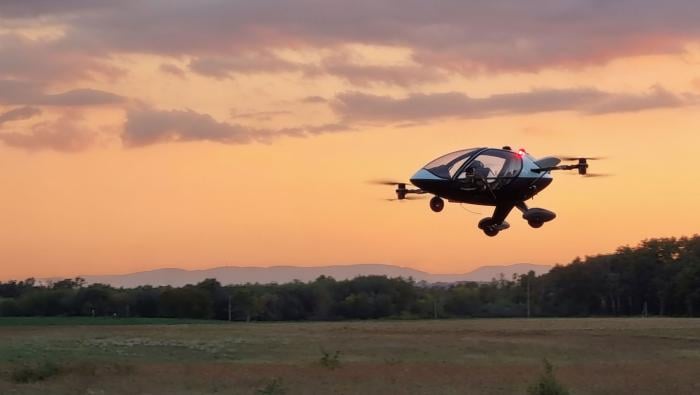
DTA Aircraft has collected 30 reservations for its two-seat JP1 hybrid-electric multicopter, four of them during NBAA-BACE in Las Vegas last week, according to DTA Americas co-founder and CEO Théo Parant. The company aims to begin crewed flight testing at Scottsdale Airport (KSDL) in Arizona next year.
Each reservation requires a $12,000 deposit, $10,000 of which is refundable, toward the JP1’s $385,000 list price. The deposits hold places in the production queue but do not count as firm orders; DTA plans to send each buyer a binding purchase agreement once it is ready to schedule production of that aircraft.
The company expects to deliver the first 50 aircraft, which it calls the Launch Edition, in 2028. For buyers who reserve after those 50 positions fill, deliveries would begin in 2029. DTA is offering Launch Edition buyers perks such as an engraved chassis-number plate, an invitation to the JP1’s first U.S. flight, and priority access to its next aircraft.
Beyond buyers, DTA courted potential U.S. partners for the JP1 program while exhibiting at NBAA-BACE. “We opened quite a few serious conversations with dealers, distributors, and flight schools,” Parant told AIN, adding that DTA has follow-up meetings scheduled.
JP1 Prototype Awaits U.S. Flight Tests
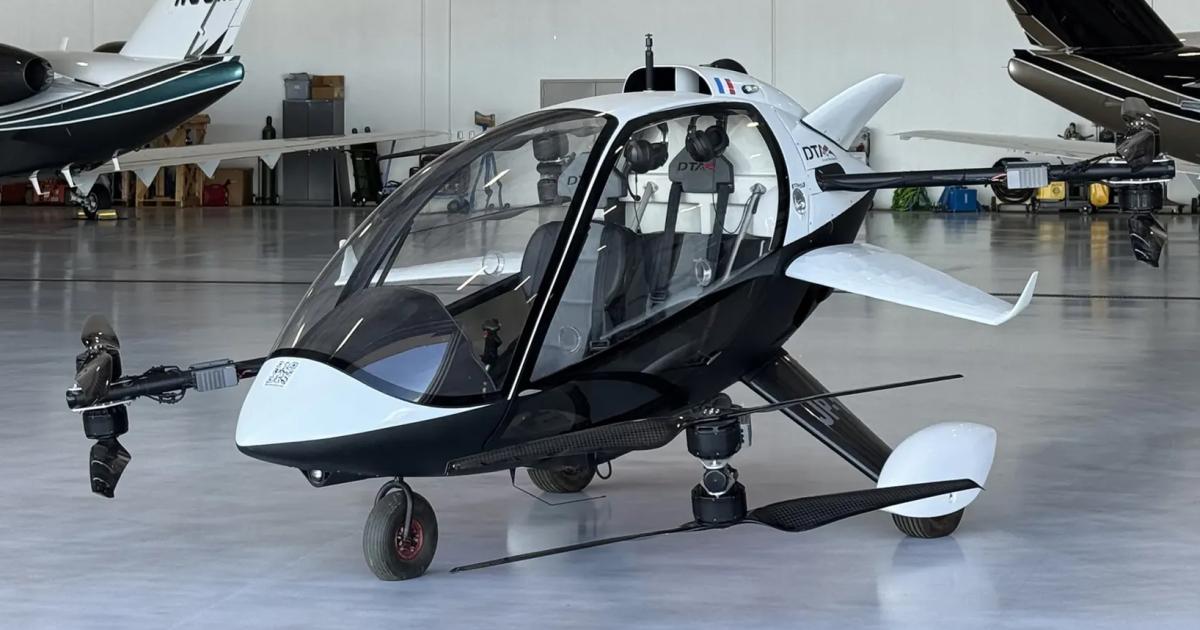
DTA Americas, the U.S. arm of Montélimar, France-based DTA Aircraft, keeps its JP1 prototype at Jet Aviation’s facility at KSDL. That aircraft, which has already accrued more than 200 flight-test hours in France, will stay grounded until DTA obtains an FAA experimental airworthiness certificate. When U.S. testing begins, the aircraft will have a pilot on board, Parant said, whereas earlier flights in France were remotely piloted within visual line of sight.
The U.S. flight tests will also mark the first time DTA measures the JP1’s endurance and range. DTA advertises two hours of endurance and 156 nm of range with two people on board. “That campaign was about handling, the autopilot, and speed, not distance,” Parant said. “Endurance and range are what the U.S. campaign in Arizona will put on record in 2027.”
Eight propellers, arranged in coaxial pairs on four booms, lift the JP1, which measures 10 feet long, 10 feet wide, and 5 feet 10 inches tall. The company is adding telescoping booms that would narrow the aircraft to 8 feet wide, allowing owners to tow it on a road trailer.
An 80-kilowatt single-rotor rotary engine that burns jet fuel or SAF serves as a range extender for the series-hybrid powertrain, which also has four battery packs. DTA said the aircraft has a maximum takeoff weight of 1,146 pounds and a 396-pound payload when fully fueled. The aircraft also carries a whole-airframe ballistic parachute and a triple-redundant autopilot, according to the company.
Certification under Mosaic
DTA is pursuing light-sport certification for the JP1 under the FAA’s Modernization of Special Airworthiness Certification (Mosaic) rule. Light-sport manufacturers do not earn type certificates under Mosaic. Instead, they must show that their designs meet the FAA’s light-sport requirements, which lean on industry consensus standards developed by ASTM International. The FAA then issues each aircraft a special airworthiness certificate based on the manufacturer’s statement of compliance.
According to DTA, the FAA has not yet decided which aircraft category the JP1 falls under. DTA describes the JP1 as a multicopter, not a powered-lift aircraft. However, multicopter is not an aircraft category under FAA regulations, which group aircraft into categories such as airplane, rotorcraft, and powered-lift. The FAA’s classification will determine which pilot certificate and training owners will need to fly the JP1, the company said. It will also determine which ASTM standards apply, since the FAA accepts separate standards for each aircraft category.
In an interview earlier this month, Parant estimated that DTA needs at least another year to show that the JP1 meets the ASTM consensus standards for its aircraft category and earn light-sport certification. Production and customer deliveries can begin only after that, he said.
In this article
More In Rotorcraft