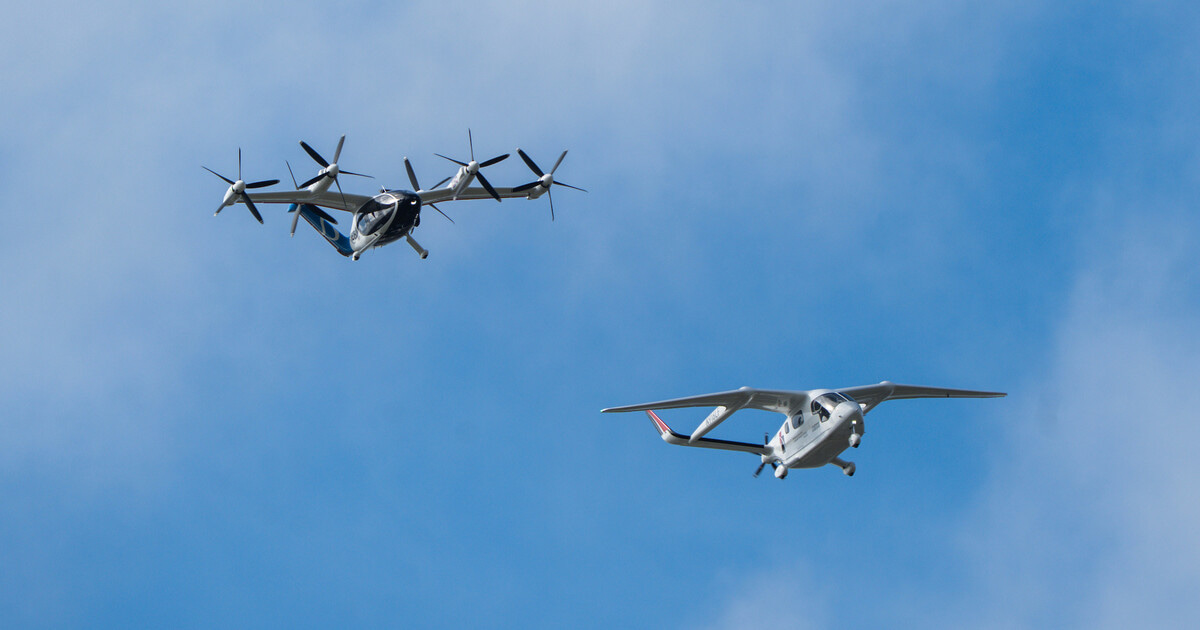
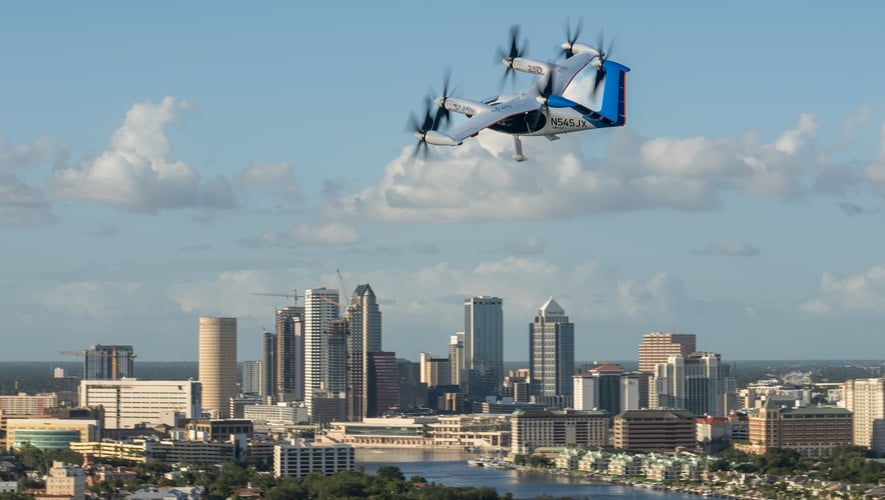
Joby Aviation and Beta Technologies opened Florida’s eVTOL Integration Pilot Program (eIPP) operations on Friday with side-by-side flights across Tampa Bay, retracing the St. Petersburg-to-Tampa route of the world’s first scheduled airline flight.
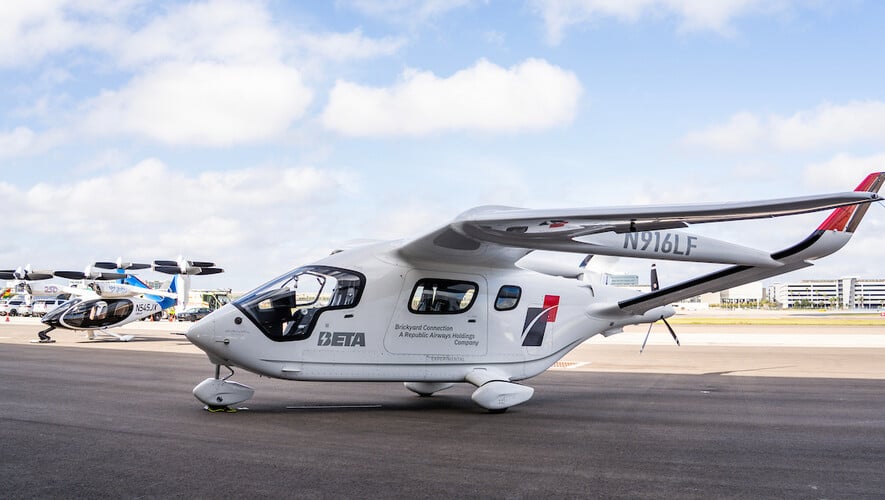
Beta’s first production-conforming Alia CX300 electric airplane, registered as N916LF, and Joby’s S4 electric vertical takeoff and landing (eVTOL) aircraft, a conforming prototype registered as N545JX, took off from Albert Whitted Airport (KSPG) in downtown St. Petersburg at about 10 a.m. Both landed together at Tampa International Airport (KTPA) about 20 minutes later.
The route has deep roots in commercial aviation. On Jan. 1, 1914, pilot Tony Jannus flew a Benoist XIV flying boat about 22 miles from St. Petersburg to Tampa with a single paying passenger, former St. Petersburg mayor Abram Pheil. That 23-minute crossing opened the St. Petersburg–Tampa Airboat Line, which flew more than 1,200 passengers across the bay before its city contract ran out three months later.
Vermont-based Beta builds electric aircraft chargers as well as the Alia family, which includes the CX300 and an eVTOL variant, the A250. The company said its CX300s have completed 14 flights covering nearly 700 nautical miles in the Tampa and Orlando regions under the Florida eIPP project. A second CX300, registered as N214BT, flew to KTPA from St. Pete–Clearwater International Airport (KPIE) earlier Friday morning. The same aircraft flew eIPP missions in North Carolina with Metro Aviation and in Louisiana earlier this year. It also wore Loganair livery at the Farnborough Airshow in July.
On to Orlando and the Space Coast
For California-based Joby, Friday’s flight opened a statewide campaign that will take its aircraft to the first planned hubs of the Florida Department of Transportation’s (FDOT) Aerial Highway Network, a proposed intercity air taxi system.
The S4 will land on November 2 at a vertiport near Orlando International Airport’s (KMCO) Terminal C and train station, which Joby claims is the country’s first eVTOL vertiport at an international airport. Joby said it developed the routes and procedures for that flight over two years of simulations with the FAA, NASA, the Greater Orlando Aviation Authority, and Orlando air traffic controllers.
Joby’s Electric Skies Tour, which visited the San Francisco Bay Area, New York, and Dallas-Fort Worth this year, will wrap up at Kennedy Space Center on November 7 and 8. There, Joby will bring its aircraft to the UP.Summit and take part in Max Power, a two-day event NASA is hosting for the first time.
This isn’t Joby’s first eIPP campaign. Transportation Secretary Sean Duffy and Sen. Ted Cruz (R-Texas) kicked off the Texas eIPP project on September 10 at Perot Field Fort Worth Alliance Airport (KAFW), where Joby flew its piloted eVTOL prototype alongside Beta’s CX300.
“From Tampa Bay to Orlando and the Space Coast, we’re giving Floridians a glimpse of a future where quiet, all-electric aircraft make it easier and faster to connect the places people live, work, and visit,” Joby founder and CEO JoeBen Bevirt said in a statement.
From Demos to Revenue
Beta’s Florida flights would start as noncommercial operations, founder and CEO Kyle Clark told AIN on October 21 at the NBAA-BACE business aviation trade show. Revenue-generating flights under Part 135 charter rules would follow “probably late this year, early next year,” he said, noting that Beta was still negotiating terms and reviewing insurance requirements.
The company’s partners in the state include Republic Airways, Metro Aviation, and Brickyard Connection, a Republic Airways Holdings Part 135 operator that flies parts and technicians to Republic jets grounded for repairs. Beta trained three Brickyard pilots to fly the CX300 for demonstration flights in Florida in May.
“Earlier this year, the aircraft and the network together supported high-cadence operations with Republic Airways along the I-4 corridor, up to nine flights a day at under $17 in energy per flight,” Clark said in a statement. Those flights, based at Kissimmee Gateway Airport (KISM), averaged 105 kWh per flight, according to FBO group Signature Aviation, which commissioned a Beta charger there.
On October 21, the FAA issued Beta the first special airworthiness market survey certificate for an eVTOL, allowing it to fly prospective customers in its A250. “We’re not flying the VTOL in Florida right now,” Clark said. “Stay tuned for other news on where we’re flying the VTOL.” He expects the A250 to join eIPP “realistically, just under a year from now.”
Beta says it is participating in seven of the eight eIPP projects. In early October, it tested the CX300 as a medical courier in Utah with Provo-based cargo airline Alpine Air Express in a five-day campaign under that state’s uFLY project to show how electric airplanes could carry time-sensitive radiopharmaceuticals.
Building the Aerial Highway
Florida was among eight projects the U.S. Department of Transportation (DOT) and the FAA selected for eIPP in March, with Archer Aviation, Beta, Electra, and Joby as named partners. Its three-phase plan covers cargo delivery, passenger transport, automation, and medical response. The eight projects span 28 states, and Florida is the seventh to start flying, according to the DOT, which said FDOT and Electra plan flight tests at several Central Florida sites in November.
FDOT’s Aerial Highway Network business plan, published in November 2025, makes the Interstate 4 corridor between Tampa and Orlando the first phase of a statewide network. Initial routes would link Orlando with Tampa, the Space Coast, and FDOT’s SunTrax test campus in Auburndale.
SunTrax sits at the center of that plan. FDOT is building an aerial test track there, and Joby flew at the site, according to the DOT. The campus will also support Eve Air Mobility’s air taxi plans in the state. Israeli eVTOL developer Air moved its U.S. headquarters and production to SunTrax in August. Four miles away in Lakeland, Florida Polytechnic University’s police department unveiled a single-seat Jetson One eVTOL on October 20. Once it receives FAA approval, the department said it plans to use the aircraft for campus patrols and post-storm recovery.
Florida lawmakers have also made state money available for vertiports. A law Florida Gov. Ron DeSantis signed in April, which took effect July 1, lets FDOT cover up to 100% of a vertiport’s costs when no federal money is involved and up to 80% of the nonfederal share when it is. It also made vertiports and charging systems eligible for public-private partnerships.
Beta signed an agreement with FDOT earlier this year to supply 34 chargers and thermal management systems, and it says Florida now hosts its largest U.S. charging network, with nine sites online. The company installed a charger at Eglin Air Force Base in 2023, shortly before delivering its all-electric Alia airplane prototype to the U.S. Air Force there. It added chargers in 2024 at Tallahassee International Airport (KTLH), Gainesville Regional Airport (KGNV), and Bob Sikes Airport (KCEW) in Crestview.
Miami on the Radar
Other eVTOL manufacturers are also eyeing the Miami market. Archer plans to fly its Midnight under eIPP in Florida and has mapped out a South Florida vertiport network linking Miami, Fort Lauderdale, Boca Raton, and West Palm Beach. Miami-based start-up UrbanLink Air Mobility plans to lease up to 10 Beta Alia CX300s and base them at a Signature Aviation FBO in the region. British eVTOL manufacturer Vertical Aerospace has also pitched Valo air taxi routes between Miami and Palm Beach. None of these aircraft has earned FAA type certification yet.
Joby already has a foothold in the region through its Blade subsidiary, which has flown passengers between the New York area and South Florida since 2015. Blade plans to relaunch its BladeOne jet service to Miami and Palm Beach in November with private jet airline Aero. As it works through what it calls the final stages of FAA type certification, Joby said the eIPP flights would give the FAA and state partners data on airport integration, acoustics, and vertiport procedures ahead of commercial launch.
“Each flight provides crucial data and lessons learned that will help establish safety standards for everyday operations,” FAA Administrator Bryan Bedford said in a statement.
The St. Petersburg–Tampa Airboat Line, the 1914 service that Jannus flew across the bay, lasted three months. FDOT is betting on a longer run: its business plan projects 220,000 to 1.4 million eVTOL passenger trips in a 2027 opening year.
In this article
More In Aircraft