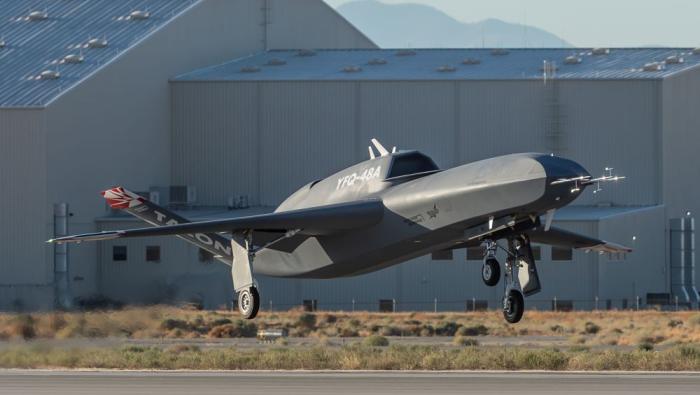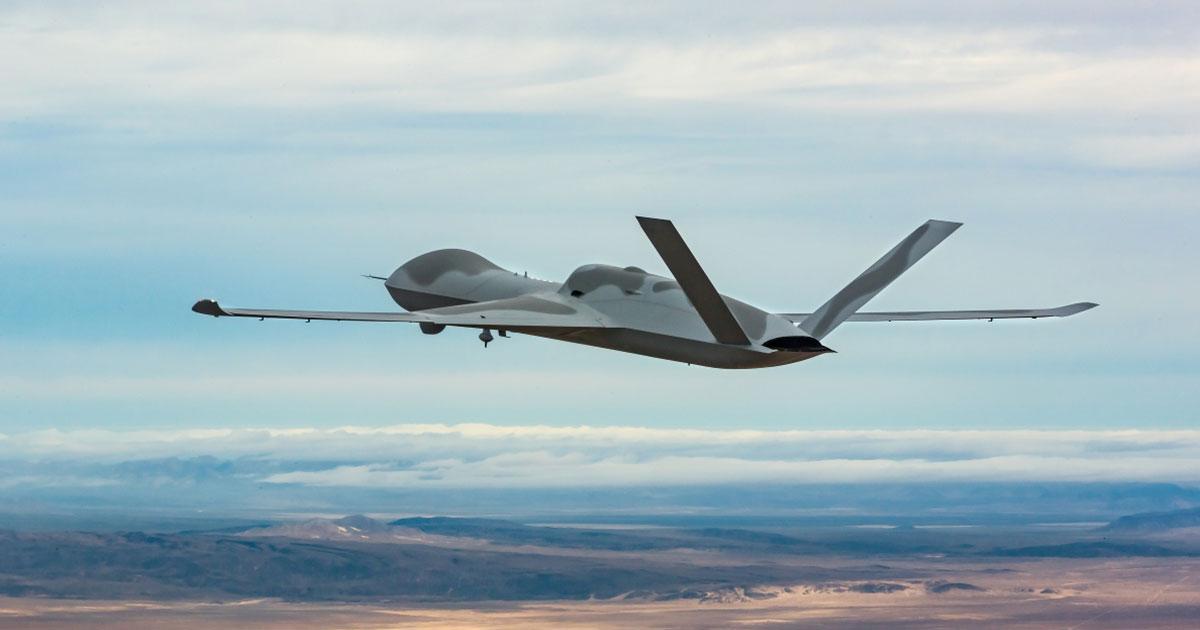
The U.S. Navy has conducted a collaborative teaming demonstration of the MQ-20 Avenger drone during its annual Gray Flag exercise. The flights, reported by manufacturer General Atomics’ Aeronautical Systems (GA-ASI) this week, were conducted in California on September 10 and were intended to show how a human commander’s intentions can translate into actions undertaken by autonomous elements.
During the exercise, which GA-ASI termed a “demonstration of collaborative autonomous mission planning,” the MQ-20 employed General Atomics’ Tactical Autonomy Ecosystem (TacACE) software to enable co-ordination and decision-making. GA-ASI said this software “provided an environment for integrated human-machine mission planning, command and control, autonomy configuration, simulation, and post-mission analysis.”
In practical terms, GA-ASI explained how TacACE was used to “reason over” a baseline mission plan and adapt it in real time as the scenario evolved. The company hailed the trial as a success, confirming that “the system proved it could understand its human boss’ instructions and carry them out within the team” of other crewed and uncrewed aircraft.
The jet-powered MQ-20 has featured in numerous U.S. armed forces demonstrations to date. In October 2025, it collaborated on a flight test with a Lockheed Martin F-22 Raptor fighter using L3Harris-provided datalinks: enabling the F-22 to command and control the drone in flight. In January, a company-funded demo also saw the platform make a live engagement with a human-piloted aggressor aircraft.
At the time, GA-ASI noted the MQ-20 has “served as a surrogate for collaborative combat aircraft (CCAs) for more than five years”. In February, the U.S. Air Force performed another F-22 teaming mission with the MQ-20. GA-ASI stated that this demonstration “highlighted the potential of CCAs to act as force multipliers for manned platforms, enabling collaboration between autonomous systems and human pilots.”
More In Unmanned Aerial Vehicles