Remember at the end of every episode of “The Jetsons” cartoon when George Jetson gets stuck on the treadmill with his dog Astro and cries out, “Help! Jane, stop this crazy thing!”? OK…Millennials and Gen Z out there who have no idea what I am talking about, check your eye roll at the door.
For those of you not old enough to remember it, “The Jetsons” was a cartoon about life 100 years in the future. At the end of every episode, as the credits rolled, George gets stuck on the futuristic dogwalker treadmill at full speed after Astro sees a space cat, and it sucks him under and sends him around and around on the treadmill until the next rerun is on the following day and it happens all over again.
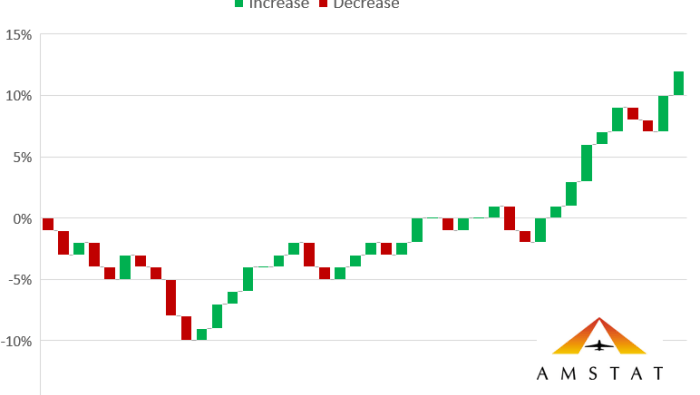
Those of us in the aircraft resale market are currently experiencing what George Jetson did every episode. Each morning we get up, we have customers who want aircraft that we struggle to procure, and we climb over each other to make deals and pay higher prices. Faster, harder, quicker, more. Oh, and throw in the end of the year with bonus depreciation at stake. The market is moving at a pace that seems to defy conventional logic. Prices continue to go up in the face of very short supply of aircraft and demand that just keeps coming. Seven-year-old aircraft are trading for the same price they did when new. Jane, stop this crazy thing!
At NBAA-BACE last week, it was of course the topic of conversation everywhere and was pervasive at the International Aircraft Dealers Association (IADA) meeting. See the IADA third-quarter market report: Market Report Shows Rising IADA Dealer Confidence as Demand for Preowned Aircraft Remains Strong. I heard the comment more than once from some industry associates that it feels like 2007 and early 2008 all over again. Yes, it does, and that sounds precarious to those of us who remember 2008. However, it is quite different this time in 2026, and in some of those conversations I found consensus on what is indeed different. That consensus is quite reassuring.
Studying the past gives us crystal-clear hindsight, of course, and is far easier than predicting the future. This is why people pay money to a fortune teller, but history professors don’t have storefronts advertising “I will study your past for $50.” There’s my disclaimer.
What the consensus seemed to be about this being different is that the demand is different. It is less artificial and backed by more real wealth than it was back in 2008. The circumstances are different too—to the positive.
In 2007 and 2008, much of what was driving the OEMs backlogs into three- and even four-year territory were orders that were coming from places in the world that they hadn’t come from before and in big numbers: China and Russia, primarily, with India thrown in the mix. Those parts of the world were exploding with growth at that time. Second, although we did not realize the magnitude of it until afterwards, many orders were held with relatively small deposits, no matter where they were from. Small enough that even if the buyer had the money to stick out the downturn, it was easier to walk away and default than to stay in line, take delivery, and overpay significantly. There’s one more element that was the elephant in the room at the time, however, and that was how leveraged many buyers were, with banks lending 100% or more of an aircraft’s value and taking pretty big credit risks that relied on the value of the aircraft a little more than the financial strength of the borrower. We all know how that turned out; 2008 had much to do with the banks and their behavior. See fortune teller versus the history professor.
Additionally, we cannot forget about the fact that bonus depreciation is now permanent and does not sunset. This fact alone makes every fourth quarter go gangbusters. The joke here in the office at Leading Edge Aviation is that it feels like we are running a resort, and our busy season is October through December; take your time off in January and February, we won’t need you then. Although there were tax benefits in 2008 for capital expenditure, today is a very different taxation landscape than what existed in 2008.
Let’s compare the 2008 scenario to what’s going on in 2026 topic by topic: OEM backlogs, demand, leverage, and tax benefits.
OEM Backlogs
The OEMs all learned from 2008 that having defaulted on, unsold whitetails (Millennials and Gen Zers, look up “whitetails” in the aviation lingo handbook) is not good, so there is no more speculation on positions; purchasing an aircraft requires far more of a real cash downstroke than it did before, and the OEMs do a lot of due diligence on people they contract to build airplanes for. OEMs are far more insulated from a sharp downturn than they were in 2008; as a result, a glut of whitetail aircraft flooding the market and really hurting the OEMs is extremely unlikely in comparison to how easily it was created then. Advantage 2026.
Demand
There are a zillion articles to read about the wealth that has been created over the last 10 to 15 years, and our industry is seeing it now. There are simply more ultra-high-net-worth people out there who want to fly in private jet airplanes than there are private jet airplanes, setting aside any corporate demand, which isn’t so bad on its own either. Additionally, the demand is coming from more predictable places than it did in 2008, especially here in the U.S. Summed up, the demand is more real, tangible, and sustained. Advantage 2026.
Leverage
Back in 2008, many more aircraft buyers leveraged their purchases with financing. Not so this time around. Yes, financing is still pervasive, but as a percentage, far fewer aircraft are financed during this market upswing versus then. This real, tangible, and sustained (see “demand” above) desire to fly privately is paid for in cash more often than it was back in 2008 and prior. Again, advantage 2026.
Tax Benefit
Permanent can be a four-letter word when it comes to making predictions because nothing is permanent, but bonus depreciation has been made permanent. This benefit is here for the foreseeable future. Advantage 2026.
All of this makes this writer think we may indeed be rethinking residual values for the foreseeable future and airplanes may no longer experience real market depreciation at a rate of about 8% per year again any time soon. The demand just will not allow it.
I have said in previous articles written for AIN about the current hot market that fuel prices have not slowed this down, and a war hasn’t slowed it down either. These two elements on their own have not (yet) created enough fear. Fear slows a market more sharply than anything, and these two recent developments have not provoked enough fear. I heard one person say at NBAA, “I don’t think jet-A at $14.00 a gallon would slow this down.” I do not disagree. A black swan event nobody is expecting could certainly do it. However, this time the fallout will not be, in this writer’s opinion, nearly what it was in 2008, because we have all learned from it and created means by which the industry can avoid it.
It is harder to purchase a brand-new airplane; it is harder to finance a new or used airplane, and the demand base is way bigger than it was. Even if the demand base shrinks, it is still very big. All of this in my mind, at least as far as the private jet airplane market goes, is back to an advantage for 2026.
I haven’t watched The Jetsons in a long time, but I sure remember how it ends every time. George Jetson just can’t keep up. Those of us in the aircraft resale business can relate, George.
Their “cars” sure looked like eVTOLs, didn’t they?

More In Finance, Taxes, Insurance