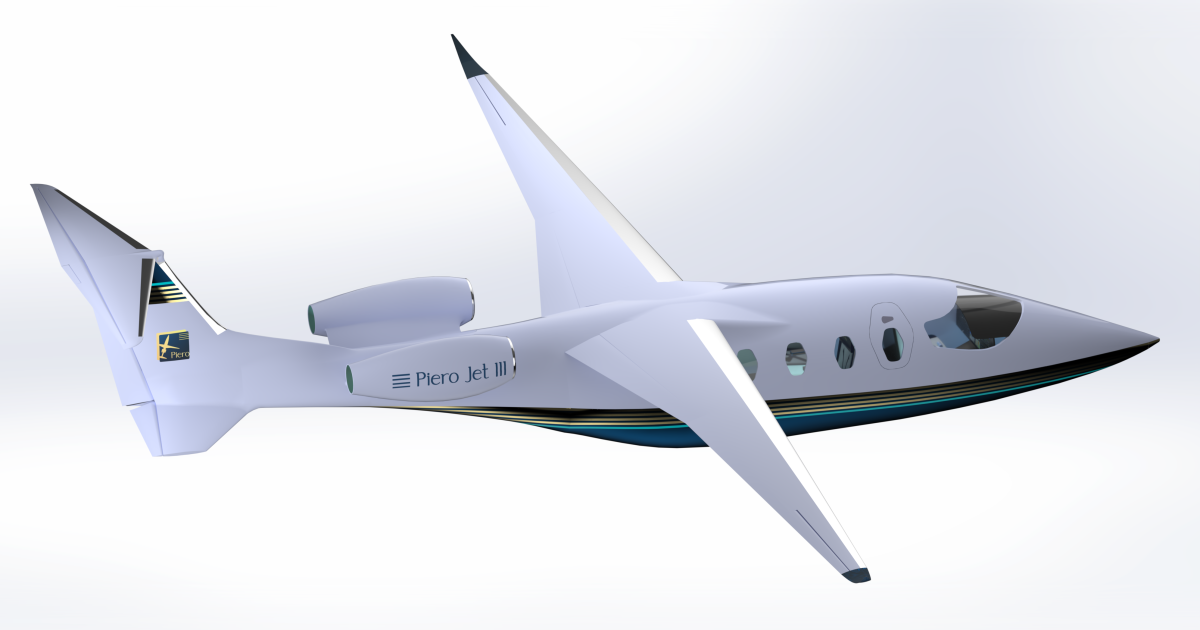
European aerospace technology company Moving Terrain is seeking manufacturing partners for what it believes could be a step-change in performance for very light jets (VLJs). The company has released plans for the Piero Jet III and wants to sell the patented design for a twinjet it claims would have a range up to 3,050 nm, be able to take off from about a 2,600-foot runway, and cruise at 440 knots.
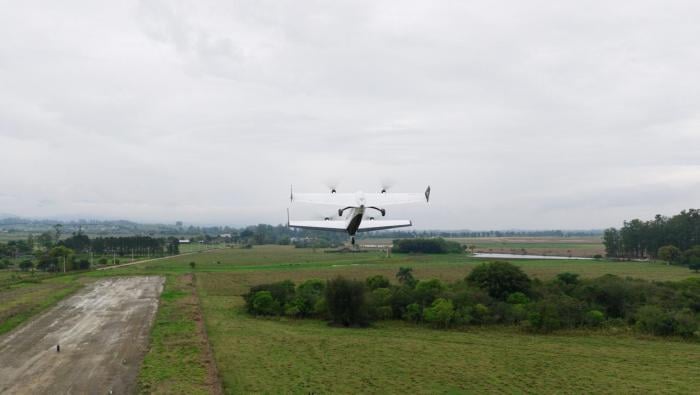
Design drawings show a slender wing mounted at the top of the airframe with an above-average aspect ratio of 18 that Germany-based Moving Terrain said will minimize drag. Fuel tanks would be located in the rear of the tapered fuselage of a six-seat aircraft with an mtow of 9,240 pounds.
According to Moving Terrain CEO Stefan Unzicker, a pilot with experience operating business jets, his engineering team reduced the jet’s drag by avoiding the conventional tube-shaped airframe in favor of “more of a dolphin shape with a slender wing that is more like a glider.” He told AIN that the Piero Jet III will achieve its optimal range with four passengers aboard cruising at around 50,000 feet.
Moving Terrain said the Piero Jet III, with short-field performance comparable to that of the Pilatus PC-12 turboprop single, would offer twice the range of similar-size aircraft such as the Cessna Citation Mustang and M2; Embraer Phenom 100; HondaJet; Eclipse 500/550; and Piaggio Avanti. It claims that range will match that of midsize jets such as the Citation Sovereign and Embraer Legacy 500, as well as the super-midsize Bombardier Challenger 300, but with around one-quarter of the fuel burn.
According to Unzicker, the new model could give access to around one-third more airports than midsize jets that have an average takeoff requirement of around 4,140 feet. He added that the Piero Jet III would have a 17% shorter takeoff distance than current VLJs.
Moving Terrain has suspended development work while it approaches potential manufacturing partners and is not seeking to raise capital for its own purposes. “The outer shape is defined, as well as the handling qualities, but nothing has yet been done to produce structures,” Unzicker explained. “At least the first year that a manufacturer would spend to get to this point in the design is already done.”
Prospective buyers for the Piero Jet III patents could include existing aircraft manufacturers. Moving Terrain also sees companies in the Middle East and India as potential collaborators for an aircraft it envisions being powered by either a pair of Pratt & Whitney Canada PW600-series or Williams FJ44 turbofans.
More In Aircraft