Gogo has unveiled a roadmap for improving service for its Galileo low-Earth-orbit (LEO) satcom systems, which run on Eutelsat’s OneWeb LEO satellite network. The roadmap targets five times faster download speeds and 10 times faster upload speeds for the compact HDX antenna by 2032, with interim performance upgrades every two years.
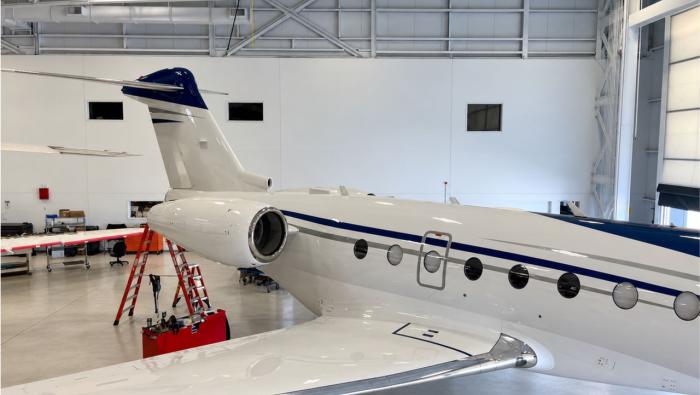
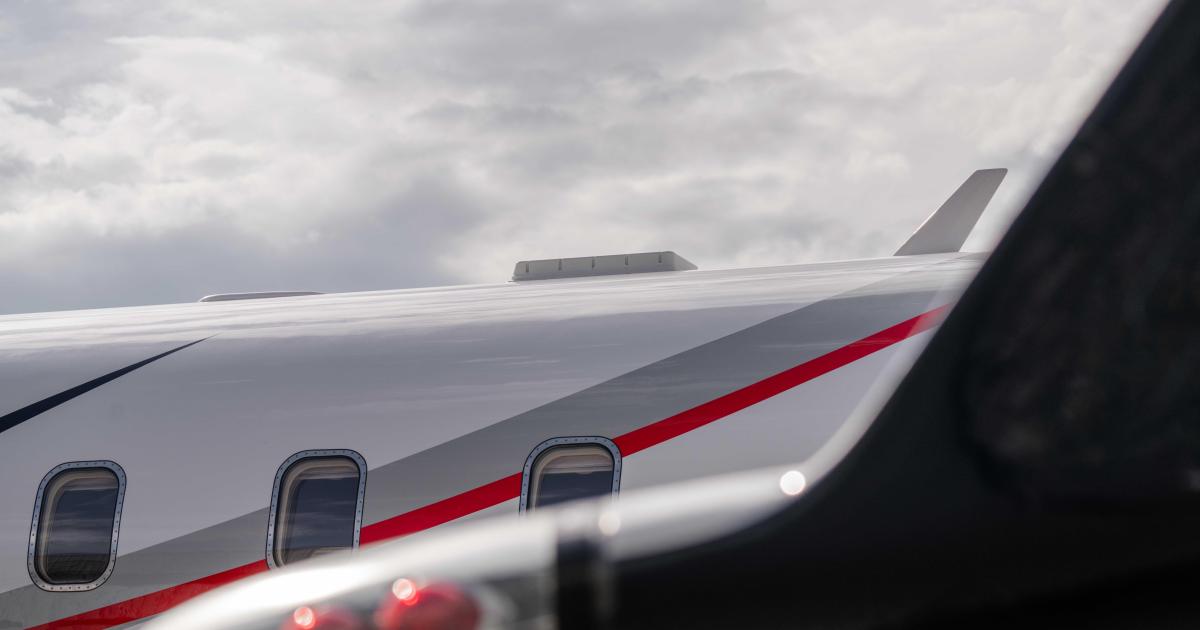
For aircraft owners and operators who select Gogo Galileo systems, the improvements will be simple upgrades that don’t require a new supplemental type certificate, according to Gogo CEO Chris Moore. Wiring will remain the same, and the upgraded hardware will be form, fit, and function compatible. “The way [the antenna] fits on the fuselage is exactly the same,” he said.
The Gogo Galileo roadmap speed projections start with today’s compact HDX antenna at 60 Mbps download and 10 Mbps upload, climbing to 100/20 in 2028, 200/50 in 2030, and 300/100 in 2032. For the larger FDX antenna, these speeds climb from 195/32 today to 600/90 in 2030 and 1,500/350 in 2032 (with no change in 2028).
To help customers manage connectivity budgets, Gogo offers guaranteed prices for three years. “The ongoing cost with us is substantially more cost-effective because they just doubled their pricing on their customers with only 30 days’ notification,” Moore said, referring to recent price increases for rival SpaceX’s Starlink LEO service.
HDX global service plans start at $3,500 per month for 25 GB (and $215 per GB overage) and go up to $10,500 per month for unlimited service, with a three-year price lock. One-year locked prices are higher.
“We don’t change prices on a whim,” he said, “and we care about customers and customer satisfaction. With the roadmap, that’s evident. We’re trying to make it friendly to install and upgrade, and then we're not giving any big price shocks. If you sign with us on October 13, that pricing is now guaranteed until October 13, 2029, which at that point, if you look at our roadmap, we would have taken the…HDX from 60 meg to 100 meg, and you'll be very close to getting 200 meg on the same product set.”
Galileo customers will get not only faster speeds but also cost predictability, according to Moore. “This is huge for charter operators,” he said.
Supporting the Gogo Galileo roadmap are continued improvements to the OneWeb network and the European Union’s Infrastructure for Resilience, Interconnectivity, and Security by Satellite (IRIS²) constellation, which is expected to enter service in the early 2030s and will add capacity. IRIS² will combine LEO, medium-Earth-orbit, and very-low-Earth-orbit satellites in a multi-orbit network.
“What it means for business aviation is the satellites become more enhanced,” he said. “This is a sustainable network. The money is behind it, and also the investment to improve it is there as well.”
“Installing connectivity is a long-term investment in an aircraft’s capability, productivity, and appeal,” Moore said. “Connectivity technology is evolving more rapidly now than ever before, and our customers deserve to know their investment will serve them years from now. With Galileo, they are buying into a platform with a clear development plan, designed to deliver increasing value over the next decade, helping keep their multimillion-dollar aircraft productive and competitive as connectivity expectations evolve.”
In this article
More In Cabin Interior and Electronics