Business aircraft operators can sample new Airflow-powered agents and consolidated capabilities at the Jeppesen ForeFlight NBAA-BACE exhibit. The AI-powered Airflow agents work in the company’s Dispatch platform, and updated ForeFlight Mobile features are also available, bringing together safety management, flight tracking, paperless cockpit operations, runway performance, fuel, and aircraft privacy tools.
The move to consolidate these functions is intended to help business aircraft operators simplify operations by using one platform instead of multiple products from different companies.
“Business aviation operators are expected to run like airlines, often with a fraction of the staff,” said Jeppesen ForeFlight CEO Brad Surak. “To do that effectively, their tools need to work together. We’re bringing the entire operation into one connected ecosystem, from the initial trip request through the final safety report.”
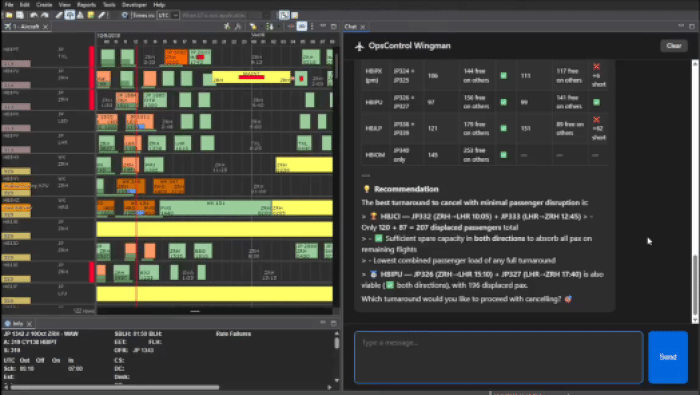
The Airflow AI agents, now part of ForeFlight Dispatch, include Trip Feasibility and Ops Briefing. Before an operator launches a mission, Trip Feasibility checks for potential issues such as sanctions, permits, notams, weather, and airport restrictions. The Ops Briefing agent helps ensure a shared operational picture by consolidating notams and current and forecast weather.
Jeppesen ForeFlight has added privacy ICAO address support so eligible operators can file flight plans using an alternate temporary ICAO address. This helps mask ownership information that is usually available via public flight tracking to ensure privacy for the aircraft’s owner.
A safety management system (SMS) and flight risk assessment tool (FRAT) are two recent additions to Jeppesen ForeFlight’s business aviation tools. The benefit of incorporating the FRAT is that it is tied to a particular flight instead of being a separate form. The operator can configure the risk factors, weighting, and thresholds. The SMS also sits inside the ForeFlight system so that users can report hazards from any device, and it includes a risk register, investigation and corrective action tracking, and reporting to safety leadership. The SMS and FRAT are designed for small- to medium-sized Part 91 flight operations.
Jeppesen ForeFlight has added flight-event alerts to Dispatch’s tracking, so operators receive notifications of weather events, critical notam-related events, holding-pattern entries, and go-arounds. This eliminates the need to constantly monitor a moving-map tracking system to see if any company aircraft are experiencing one of those events. Dispatch lets users claim events using an “acknowledge flight events” tool, ensuring everyone knows someone has taken responsibility for the event.
Other improvements include traffic layer filtering to reduce clutter; auto zoom for TV view, which keeps an operations center display framed on active flights; and geofencing, to generate an alert when an aircraft crosses a defined boundary.
New features in the ForeFlight Mobile app help move “business aviation crews closer to a genuinely paperless operation, where the record of the flight is created in the cockpit rather than reconstructed afterward,” according to the company.
Electronic signatures stay attached to a record once the flight crew signs it.
In the active navlog, planned alternates and their filed routes stay available for the whole flight, according to Jeppesen ForeFlight, “so you can divert along the filed route after a missed approach or go direct from wherever you are.”
Using the cockpit sharing feature, two pilots can work on the same flight on their own mobile devices in ForeFlight, with changes automatically reflected on both.
Weight-and-balance tools allow crews to apply curtailments during flight and to define “custom curtailment rules that match how their operator actually flies the aircraft.”
Enhanced airport diagrams show clearer taxiway, hot spot, and surface detail and are designed to provide better readability on the flight deck.
Mobile clearance delivery will be available from a growing list of airports, allowing pilots to request and receive a clearance on their devices. They can also use mobile clearance to cancel an IFR flight plan once on the ground.
Another useful feature is GPS alerting and cross-check, which “monitors GPS integrity and cross-checks position against independent sources, alerting crews to interference or degradation rather than leaving it to be inferred.”
ClearNotams, which Jeppesen ForeFlight introduced in July, presents notams in easy-to-read plain language, but users can always click on a link to see the original notam if concerned about the accuracy of the AI transcription.
ForeFlight Mobile’s runway analysis now includes the Hawker 800 and Cessna Citation 560 Ultra. Runway analysis provides alternative one-engine-out flight paths at certain airports, enabling takeoffs at higher weights.
Finally, ForeFlight’s fuel feature has added fuel release confirmations, retail pricing comparisons alongside contract pricing, home-base fuel-farm accounting, fuel tankering scenarios for up to 50 legs, and uploading of minimum-to-waive-fees files “for simpler, more effective fueling strategies.”
In this article
More In Operations