Safety
Changing the Gotta-land-it Mindset
Runway overruns cut across aircraft types and crews
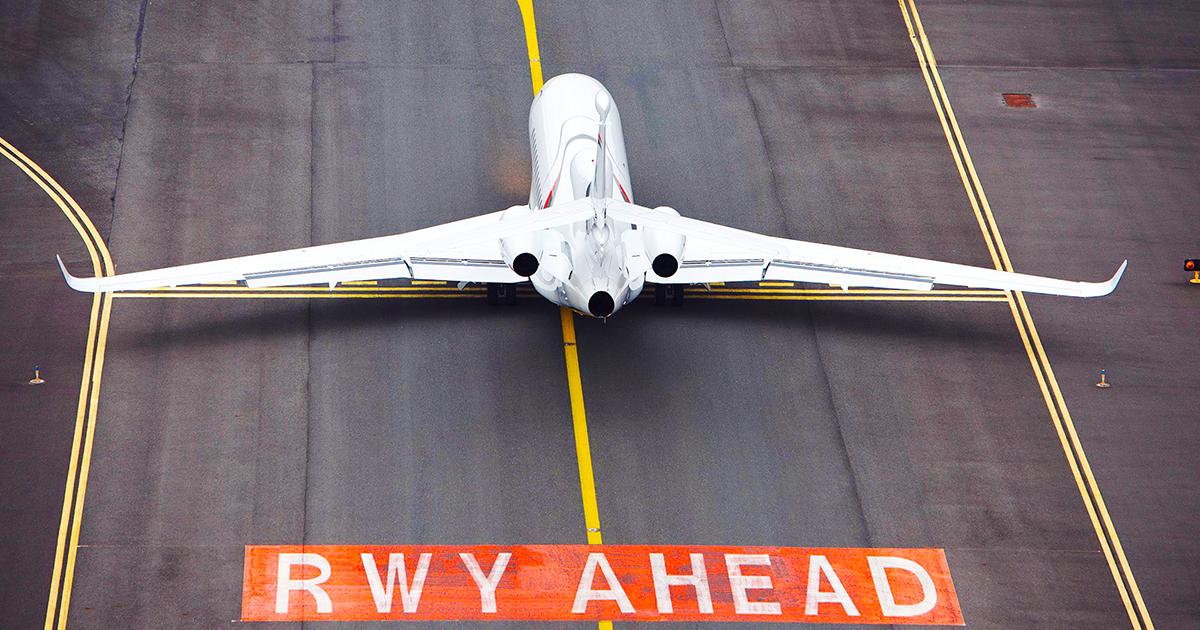
Falcon on runway
Understanding actual runway conditions and how they will affect the flight, preferably well before takeoff and landing, is critically important. © Dassault

It’s a standard pilot nightmare: You touch down after a long but satisfying flight, and when you go to bring the airplane to a stop, the equipment fails you: brakes go soft, reversers don’t actuate, or beta mode won’t engage. While many factors can lead to an airplane running off the end of a runway during landing, it’s more likely that human error on the part of the flight crew causes an aircraft to overrun. Instead of simply making all runways longer or installing arresting devices or materials, we can examine these situations to inoculate ourselves periodically against these lapses.

An exploration of recent landing accidents among multiple classes of business jets—and a couple of instructive regional airline accidents—finds the hazards cut across the lines between single-pilot and multi-crew. Professionally piloted aircraft do not have any special protection from these events. It boils down to this: the failure to fully consider actual runway conditions and understand their knock-on effects, combined with fatigue and that siren-song desire to complete the mission.

Stick to the Plan

A CommutAir (United Express) Embraer ERJ 145 overran the runway at Roanoke, Virginia (KROA), on Sept. 24, 2025, at 9:17 p.m. local time, nearly two hours past the end of civil twilight. The flight had been delayed about two and a half hours before its departure from Washington Dulles (KIAD) while resolving maintenance issues, and the crew briefed the thunderstorm potential approaching Roanoke, according to the NTSB preliminary report.

When storms materialized as predicted, the crew switched from the planned approach to Runway 6 to 34, based on reports from previous flight crews of precip on the approach to 6. The captain asked for updated landing numbers with reduced braking action for the wet runway (at level 5 RCC, indicating “good” braking action), which showed a slim margin but was deemed adequate (200 feet without reversers). The captain also briefed a go-around and departure to Greensboro’s Piedmont Triad Airport (KGSO) if conditions warranted.

Per the NTSB report, he didn’t choose that alternate option: “On short final, the rain intensity increased, and the captain requested windshield wipers at high. As the airplane descended below 500 feet, the FO [first officer] observed that they were high on the precision approach path indicator (PAPI) and then observed the captain correcting the flight path, but recalled they were still high as the airplane crossed the threshold. After crossing the runway markings, the FO called for a go-around, but the captain continued. About halfway down the runway, the FO called for a go-around a second time, but the captain continued.”

After touchdown, maximum braking and reverser deployment weren’t enough to keep the ERJ 145 from overrunning the pavement into the EMAS material at the end under the yellow chevrons. No one was injured in the stop or subsequent evacuation, and the aircraft itself only sustained minor damage.

The plan had been to make an attempt to land at Roanoke, but when the stabilized approach didn’t happen, the decision to continue rather than go around as briefed meant that the slim margin deteriorated into nothing. While the information wasn’t provided on the crew’s specific experience, they were professionally trained and acting according to operational procedures until that system broke down.

Don’t Relax Because You’re Home

Another recent accident involving a Cessna Citation CJ4 shows how returning to the aircraft’s home base on a routine positioning flight in clear, calm conditions can also end up in major damage to both the airplane and structures on the ground.

The pilot was the sole occupant of the CJ4, flying back from maintenance at St. Louis Regional Airport (KALN) near Alton, Illinois, to Mayfield, Kentucky (M25). He set up for a straight-in visual approach to Runway 19, which was just over 5,000 feet in length. He noted that he was a bit late in setting up the approach but maintained it was still stabilized, according to the NTSB preliminary report. 

The airplane touched down on the runway centerline, and the pilot noted “that he deployed the ground spoilers and pressed firmly on the brakes; however, he observed no braking action as the airplane continued to roll down the runway,” according to the report. “The pilot applied greater force to the brakes; however, the airplane began to veer to the right, and there was still no observed slowing of the airplane. The pilot determined there was insufficient runway for a go-around and decided to continue to roll down the runway with the engines at idle, continuing to press firmly on the brakes, correcting the airplane back toward the runway centerline, and applying downward force to the yoke. The airplane rolled off the end of the runway, went through the airport’s perimeter fence, crossed a road, and impacted a house.”

Standard landing distance at sea level on a dry runway in calm conditions for a CJ4 runs less than 3,000 feet at maximum landing weight—and it was not noted, but unlikely, that the CJ4 in question was close to that. Even with reduced braking power—and in a post-maintenance flight that is possible—that should leave adequate margin in normal circumstances.


HondaJet damaged left wing and spar
An exceedance of the published crosswind component was a likely factor in a runway excursion at Orlando International Airport that damaged this HondaJet’s left wing and spar. © NTSB

Crosswind Problems

Noting the limitations of the aircraft, as well as the company’s ops specs, should be part of a crew’s safety plan and should serve to head off an incident before it begins. However, when a crew bypasses those parameters in order to accomplish the mission, trouble can occur, as it did in this Honda Aircraft HondaJet crosswind excursion from January 2024.

The Part 135 flight approached Orlando International Airport after briefing winds there that exceeded the published crosswind component of the HA-420, which is 20 knots. While sustained winds were reported at that value, gusts to 23 and 24 knots had been present in most of the reports prior to the jet’s touchdown at KMCO.

“The PF [pilot flying] continued the approach and just about when the airplane was at touchdown the controller broadcast on the frequency for another airplane that was on approach that the wind was from 290° at 20 knots, gusting to 24 knots,” according to the NTSB’s final report. “After the airplane touched down, it began drifting to the left side of the runway. The PF applied left aileron control input, deployed the speedbrake, and applied right rudder; however, the airplane departed the runway and impacted a frangible runway distance-remaining sign. The PF then corrected the airplane to the right, returned it to the runway, and taxied off onto a taxiway, where the pilot stopped the airplane and evacuated.”

While the crew and two passengers were not injured, the airplane sustained substantial damage to the left wing’s forward spar where it had hit the airport sign. The original HondaJet allowed for a maximum crosswind component of 20 knots, placing the conditions at Orlando that day into the danger zone. A pilot’s skill in mitigating the effects of a stiff gust plays a role—but no amount of physical prowess can offset an airplane’s own limitations.

Citation X runway overrun
This Citation X landed at Telluride, Colorado, after encountering gusty, variable winds during the approach and touchdown, leading to a runway overrun. © NTSB

Mountain Flying

Gusty winds also played a part in another accident at Telluride, Colorado, earlier this year. Mountain operations intensify the threat under normal conditions, but unforeseen gusts can also take a pilot by surprise—as witnessed by the crew of a Citation X flying into KTEX this past winter.

On Jan. 13, 2026, just after noon on a sunny Tuesday, the pilot flying encountered a crosswind gust unexpected in its strength after touchdown. The crew had noted turbulent conditions resulting in five- to 10-knot airspeed fluctuations during the descent, the result of a northwesterly wind. The landing setup for Runway 9 was based on normal operational procedures for the airport, with the reported wind on the ground from the north (020 at 4 knots) at the time of landing. A previous metar at 11:55 a.m. local time showed 270 at four knots gusting to 17 knots, demonstrating the changeable nature of the winds there—not uncommon for Telluride, given its location on a mesa shelf in the valley.

Turboprop Protection?

Turboprop aircraft—whether owner-flown or professionally crewed—offer one (or two) insurance policies against a runway overrun: the big fan(s) used to propel the aircraft that can switch to beta mode. However, they too are not immune from these incidents, as indicated by the February 2026 accident that caused substantial damage to a Fokker 50 landing at Aden Adde International Airport in Mogadishu, Somalia.

In fact, the International Civil Aviation Organization (ICAO) has published data showing that turboprop aircraft are statistically more prone to runway overruns. Its Global Runway Safety Action Plan, released in February 2024 (www.icao.int/global-runway-safety-action-plan), offers the results from the Second Global Runway Safety Symposium, in which the association collated recommended actions for reducing the rate of these incidents and accidents around the world. Though the report is recent, the causes remain the same—and the good news is that many lie within the pilot’s control.

  • Using standard operating procedures, taking into account aircraft limitations, crew limitations, weather conditions, runway surface, and the airport environment
  • Ensuring adequate training for crews on stabilized approaches
  • Maintaining a safety culture on the flight deck that supports the decision to go around or choose another airport

The equipping of aircraft with Runway Overrun Awareness and Alerting Systems (ROAASs), in which the aircraft’s overall energy state is calculated against the runway available on an approach, is another way in which technology can assist the pilot in understanding the conditions. Such systems are already found on many new business jets, including (but not exclusively) the Embraer Phenom 100EX and 300E, Cessna Citation Latitude, Dassault Falcon 6X, and Gulfstream G700. These systems continuously calculate the aircraft’s stopping distance in real time, giving critical guidance to the pilot on the likely outcome of the approach in progress.

It’s still up to us pilots to make the right choice.