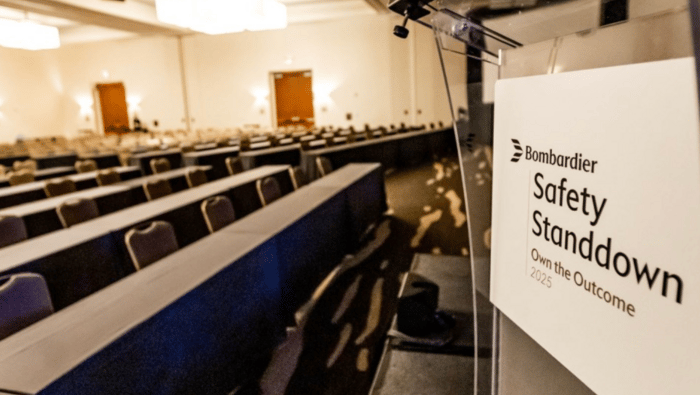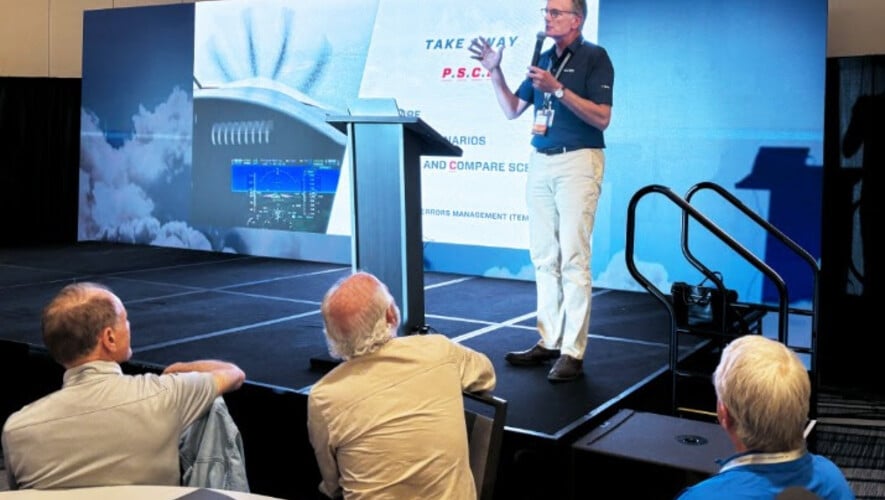
Alarm-saturated cockpits and an attention economy built to capture pilots’ focus have eroded the observation skills that keep crews ahead of trouble, Tony Kern told attendees today during the opening session of the 30th Bombardier Safety Standdown. Kern, the CEO of human performance consultancy Convergent Performance, focused on how pilots can be intentional about reclaiming attention to improve safety outcomes.
He opened the session with a look at the August 20 crash of a Security Aviation Cessna 441 Conquest II approaching Cape Newenham LRRS Airport (PAEH) in western Alaska, which killed all eight aboard, among them two U.S. Army Corps of Engineers employees. Kern flies out of Ted Stevens Anchorage International Airport (PANC), where the accident flight originated, and knew the crew. “This pilot had flown our people when we had to get supplemental air charters,” he said.
Kern pointed to the approach chart’s own warning that a missed approach beyond the missed approach point—some 2.5 miles offshore—is improbable. “They’re telling you ahead of time, this is scary,” he said.
He also offered a method for reading accident reports: replace the accident pilot with yourself. Instead of wondering why a pilot did something that resulted in an accident, ask, “Why would I do that?” Kern said. “What would ever lead me to make that bad decision?”
His takeaway is not about fault-finding but about understanding the threats that lurk in aviation: “Until this guy, or any accident pilot, has that accident, they could have been sitting right here, same confidence level, same belief in themselves.”
Kern framed the keynote around U.S. Air Force fighter pilot John Boyd’s observe, orient, decide, and act (OODA) loop and argued its first step has quietly collapsed. “We pay attention to the things that tell us to pay attention more than we actually pay attention to the things that it’s telling us to pay attention about,” he said, tracing a century of outsourced vigilance from fire lookouts to household smoke alarms.
His countermeasure came from the late Marine firearms instructor Jeff Cooper, whose color codes rank alertness. “The whole idea behind this is to stop relying on alarms to trigger us,” Kern said, pressing attendees to operate routinely in the yellow (alertness or vigilance) rather than waiting for a warning to summon their attention.
Deep familiarity with specific hazards, he argued, does more than another emergency procedure syllabus. Kern used bear behavior as the analogy, casting wind shear, icing, bird strikes, and mechanical failures as “bears of different colors.” He argued that black, brown, and polar bears have different behaviors and present different risk factors.
He also shared a thought exercise with attendees: his “perfect drive to work.” When he asked for examples of perfection, the crowd threw out things like “no red lights,” “no traffic,” and “not having to go.”
“You’re defining perfection as the world meeting your desires,” he told the audience, adding that if you do that, whether it’s driving to work or flying, you’re always going to be angry at reality, and “you’re never going to learn anything.” Instead, he suggested learning through experience to mitigate and react to circumstances in real time.
On complacency, he was blunter: “Living in ‘OK-ville’ is a dangerous place to live.”
In this article
More In Safety