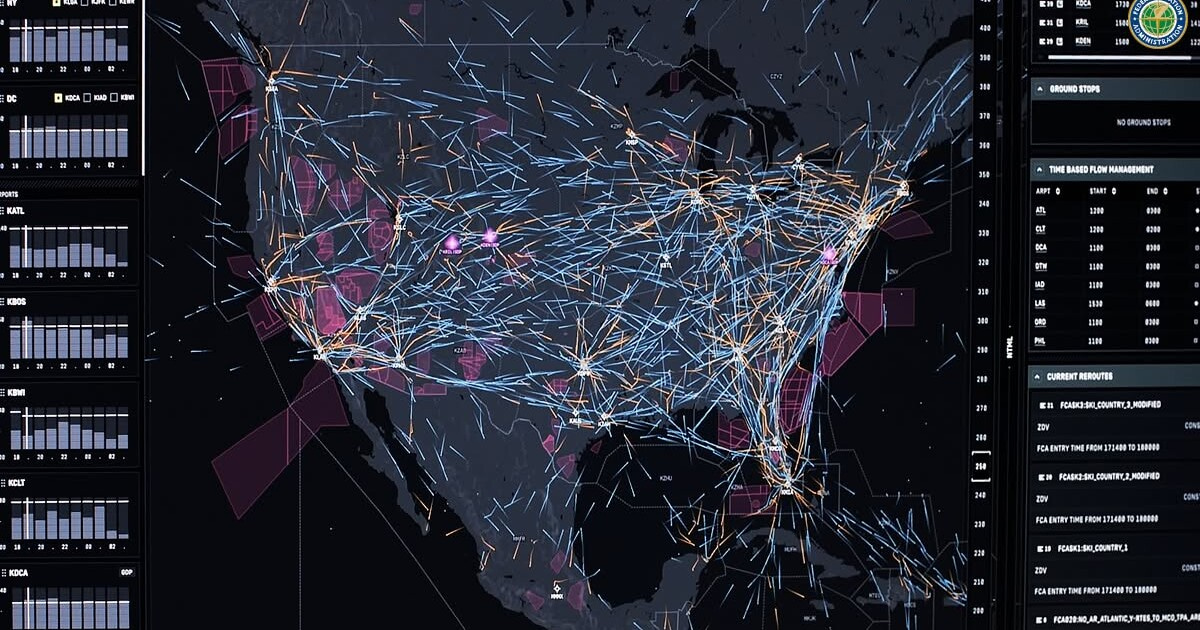
Two dozen U.S. House Democrats expressed “alarm” that the FAA rolled out its Strategic Management of Airspace Routes and Trajectories (SMART) AI-based system to the nation’s Air Route Traffic Control Centers (ARTCCs) without prior notification to Congress.
Tested at airports in the Washington, D.C., area beginning in September, the system was installed at the ARTCCs on November 10, just three days before the highly-disruptive nationwide ground stop. While initial questions surfaced surrounding a potential link to the ground stop, the FAA maintained that the issue was unrelated to SMART and that it stemmed from a router installation. SMART uses AI to project potential pinch points in the air traffic control (ATC) system and develop possible alternatives to alleviate those issues.
The lawmakers, including the ranking members of the House Transportation and Infrastructure Committee and aviation subcommittee Rick Larsen (D-Washington) and André Carson (D-Indiana), sent a letter to FAA Administrator Bryan Bedford on Tuesday. This detailed concerns that the rollout occurred before a planned 90-day validation period in the National Capital Region could be completed, and despite a lack of clear safety and performance metrics.
“This action raises concerns regarding the transparency of air traffic control modernization efforts and FAA leadership’s commitment to prioritizing aviation safety above all else,” they wrote. “This sudden expansion of a largely untested system to all air route traffic control centers across the country—a mere 50 days after SMART’s initial launch in the National Capital Region—contradicts what you told Congress would be a gradual, methodical 90-day validation period,” they added.
They added that “frontline safety workers” have been excluded from the development and deployment process. “Members of Congress have been clear in demanding proactive notification and transparent disclosure of data and performance metrics from the FAA as SMART is operationalized in the nation’s most congested airspace,” the lawmakers continued in the letter. “We have yet to receive any substantive information proving the system was properly validated before its nationwide expansion.”
The lawmakers directed the agency to furnish information on 13 questions they had by November 30, including on performance data completed before the deployment at the 22 ARTCCs, what its metrics are, whether SMART was reaching these metrics, what safety risk management activities the FAA engaged in ahead of time, how the FAA has engaged and coordinated with frontline safety workers, what feedback the agency has received on the system, what issues have been identified, and whether its scope has expanded or changed.
More In ATC