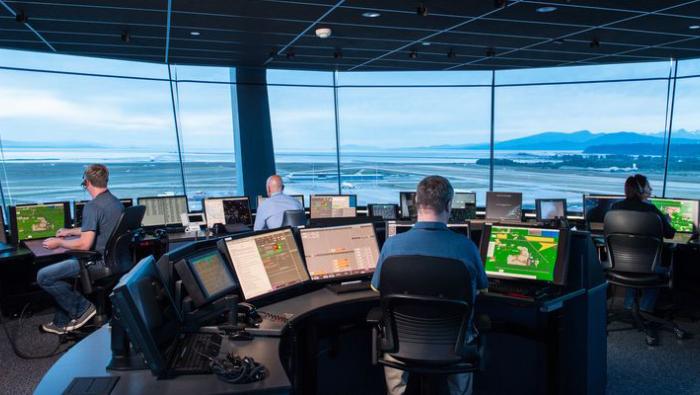
The investigation into the cause of Friday’s nationwide air traffic ground stop continues, as Congress and the public demand answers. At approximately 3:30 p.m. ET, the FAA reported a technical problem and issued the order halting departures at all airports in the U.S. This lasted until 8:15 p.m., throwing the nation’s air transport system into chaos and stranding hundreds of thousands of passengers for hours and, in some cases, days.
According to the agency, its legacy equipment became unstable when data began flooding the FAA telecommunications infrastructure (FTI) network at a rate of 1,000 connection attempts every 4 to 5 seconds. This disrupted the system and created instability with aircraft communications and radar feeds.
In an interview with CNBC, Transportation Secretary Sean Duffy said his team traced the problem back to a facility in El Dorado, Arkansas.
Industry flight operations clearinghouse OpsGroup is reporting that the most likely culprit appears to have been a newly installed router—part of ongoing copper-to-fiber-optic cable upgrades. “A large number of air route traffic control centers were affected, which then spread into several Tracons, prompting the precautionary ground stop,” the organization noted.
The Professional Aviation Safety Specialists (PASS) union added further analysis. “The issue was isolated to two contractor-owned and maintained routers that were being updated midday,” it explained in a statement. “Historically, contractors have followed a protocol where FAA employees conduct a risk assessment and coordinate the maintenance of the system or equipment. PASS-represented technicians were not involved in the upgrades that led to the ground stop [on Friday].”
“This ground stop left the flying public and aviation workforce in disarray and seeking answers that the Trump administration waited hours to share,” said Reps. Rick Larsen (D-Washington), ranking member of the House Committee on Transportation and Infrastructure, and André Carson (D-Indiana), ranking member of the subcommittee on aviation. “The safe travel of the flying public must always be our top priority. Our committee, on behalf of the flying public, will hold the administration accountable for what happened to make sure this chaos does not happen again.”
In response to the recent demands by Transportation Secretary Duffy for $30 billion—since raised to $50 billion in the aftermath of Friday’s ATC disruption—in additional funding for the FAA to continue its modernization of the nation’s air traffic control system, the legislators noted that Congress had approved $12.5 billion for the DOT to make necessary safety upgrades.
“Fifteen months later, the administration has obligated $4.3 billion but only spent $1 billion, leaving $8 billion unobligated and $11 billion unspent,” they stated. “Explain to Congress, again, why they need more money?”
More In ATC