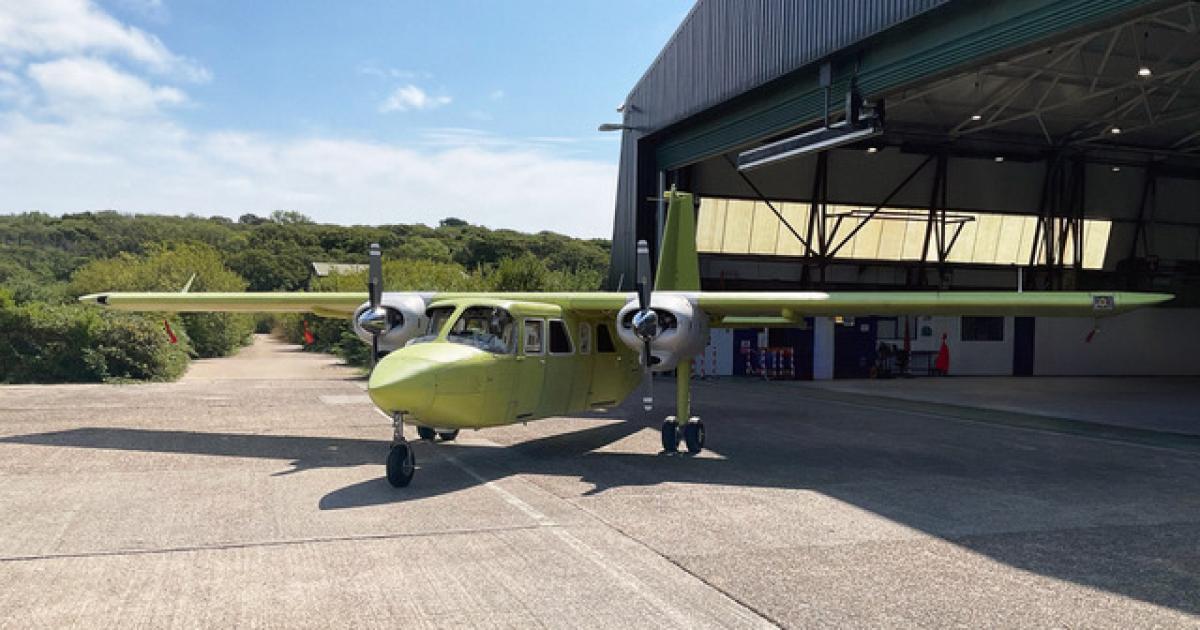
UK aircraft manufacturer Britten-Norman is back in the business of building domestically-manufactured regional aircraft. For the first time in almost 60 years, a complete Islander has rolled off the company’s newly-repatriated production line, marking what the privately-owned comapny hopes will be a new era of manufacturing—albeit at lower rates of production plans than initially announced.
Based at Bembridge on the Isle of Wight, Britten-Norman’s final assembly line is looking to ramp up annual output to eight twin-engine Islanders by 2029: comprising four B-N2 and four larger BN2T-4S models. This follows a significant period of change for the company, which despite repatriating its production line back home from Romania in 2023, has so far failed to reach the eight annual builds previous CEO William Hynett had initially targeted within 24 months.
Speaking to AIN in early September, Britten-Norman chief operating officer Richard Milne suggested that the team had underestimated specific challenges required to bring production back to the UK. “What we as a business underestimated was the scale of activity in updating all of the documentation to the standards that are required today to build an aircraft,” he acknowledged.
Although the Islander commenced production in the UK in the 1960s, this soon largely shifted to Romania. This arrangement was reversed with the re-inauguration of the Bembridge line in late 2023.
“Our documentation in the late 1960s was comparatively basic, and we needed to put a lot of effort in to bring it up to the required standards,” explained Milne. The company’s provision to meet modern regulatory compliance procedures—necessitating inspection and documentation of every build stage—has also changed ways of working.
This change process was further complicated by the some 2,000 modifications made to the original hand-drawn drawings over the decades: alterations that also require documentation. While modern modifications are now drawn digitally, around 80% to 90% of the Islander exists in its legacy hard-copy format.
Additionally, evolving production processes—including now-obsolescent ways of working—have also offered unique challenges. Treatments applied to certain components have changed over the years, with Milne stating that some of their suggested replacements “just aren’t good enough for what we need.” Other providers are inundated with work and, accordingly, prioritizing orders from larger companies. Parts that may once have been welded may also now be machined, while fiberglass fairings are also benefitting from updated materials and treatments.
Nevertheless, Milne said he is confident that UK manufacturing will prove to be cost competitive, especially since Romania has joined the Euro currency zone. Britten-Norman says it is in the process of converting letters into intent into firm orders for new builds, augmented by options to acquire pre-owned aircraft.
While Milne believes Britten-Norman has been fortunate to secure sufficient aerospace talent to re-open its production line, including inviting many experienced engineers to come back to work in Bembridge, he acknowledged the production rates are not sustainable at current levels of staffing. Five young apprentices have recently started a placement with the company, with Milne suggesting that “providing we make the sales, next year we’d be looking to grow that apprenticeship team again” with around 10 to 15 new students.
In the interim, the company is looking to reach four units a year by the end of 2027, with the next Islander “already well in build." Today, while Britten-Norman estimates there are around 350 active Islanders globally in 70 countries with 150 operators, the company believes there are good opportunities to refresh an ageing fleet.