Maintenance, repair and overhaul (MRO) providers will stay mired in supply chain bottlenecks unless they effectively tap data sources beyond those provided by manufacturers. Centrum AI says its new technology allows users to get a more complete assessment of the availability of parts and other hardware they need—avoiding the need to hold costly inventory to guard against delays.
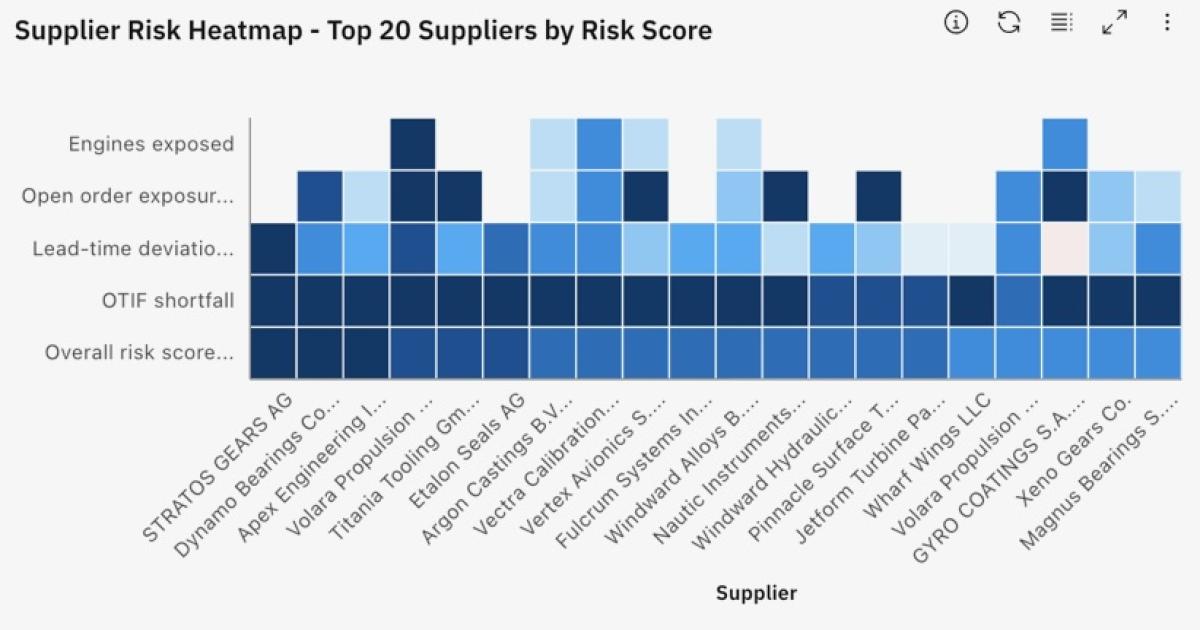
According to the U.S.-based start-up, the platform tracks around 20 billion global and corporate records, such as import/export records, shipping data, and statutory financial filings, to form a more complete picture of issues that could disrupt their supply chains. From this, Centrum generates what it calls “a probabilistic bill of material” providing “an inferred supplier graph” that incorporates OEM data and runs through the supply chain, accounting for issues such as raw-material availability.
Centrum co-founder and CEO Stefan Groschupf told AIN that MROs currently struggle to get a complete picture because their visibility is limited to what manufacturers share with them. “The OEM itself is often neither fully informed about its lower tiers, nor forthcoming about what it does not know,” he said.
In his view, MRO providers need to consider more than just the listed price of each part they need. “The number that actually matters is what its absence costs: the engine sitting idle in the shop, expedited freight on a heavy module, a leased spare, and the recurring conversation where an MRO has to tell its customer it needs another four weeks because one more part is missing,” he explained.
The company estimates that some MROs are spending heavily to hold three times the parts inventory they would have held before the Covid-19 pandemic. “Parts and repair lead times have gotten longer every year since the pandemic, and it compounds [because] a shop waits longer for hardware, [and then] the engine sits longer in the shop, and the operator waits longer for the asset,” Groschupf said. “MRO shops have spent the last five years absorbing a problem they can’t fix at the source.”
One example of items tracked by Centrum is the single-crystal nickel superalloy used to produce high-pressure turbine blades in engines. The company tracks the supply of cobalt and rhenium, which are critical alloying elements in this material, to identify anomalies that might flag problems with deliveries to MROs. The system prioritizes analysis of the most critical parts and hardware that will most impact delivery and work completion dates.
“We’re doing detective work, essentially,” Groschupf explained. “Nobody tells us a given shipment of metal is destined for a specific plant. We observe a flow, know what the alloy is used for, know who operates in that region, and assign a probability. Do that across millions of observations and you end up with something far better than the blank visibility most shops have today—even if it isn’t certainty.”
Before launching Centrum, Groschupf was involved in the development of Hadoop, an open-source framework supporting so-called “big data” applications. He has also helped develop AI-based systems used to assess payment fraud and insurance risk.
“Those are domains where you’re making decisions continuously, on incomplete information, and you get graded afterward on how accurate you turned out to be,” Goschupf said. “I think of what we’re doing at Centrum as algorithmic trading applied to supply chain—the same discipline: you never have complete information, so you assemble every observable signal you can, attach a probability to it, and act on expected value rather than waiting for a certainty that doesn’t exist.”
To assess the accuracy of its supply projections, Centrum compares its modeling with each customer’s enterprise resource planning data for the previous 12 months, assessing its forecasts against the decisions company planners made and the subsequent outcomes. On that basis, Centrum believes its technology achieves around 48% better accuracy in predicting when materials will arrive than its clients’ planners, and it also provides supporting data to explain and fully log issues to support accurate auditing.
According to Centrum, its approach can add significant value for business aviation clients. “Those fleets are more geographically dispersed, the operators typically have less commercial leverage with an OEM than a major airline does, and an AOG on a single aircraft is a bigger proportion of the fleet,” Groschupf said.
The company says it can free aircraft operators and their MRO providers from dependence on predictive maintenance based on OEMs’ sensor telemetry for engine data that only the manufacturer controls. It argues that tracking the airframe in isolation can provide actionable data.
“Registration and public tracking data tell us where a given aircraft has actually been flying, and therefore what its hardware has been exposed to,” Groschupf explained. “An aircraft that has spent its life on hot-and-harsh, high-dust routes accumulates hot-section deterioration that an aircraft on temperate routes does not.”
CFM International’s durability improvements to the high-pressure turbines of the LEAP 1A turbofans were based on research conducted with dust engineered by the engine maker to reproduce actual operating conditions in desert regions. According to Centrum, this approach reinforces the value in focusing on actual operating conditions rather than relying entirely on OEM-controlled data from individual engines.
In addition to avoiding costly over-stocking of parts, Centrum says its platform helps MROs provide aircraft operators with more transparent quotes for work. “The shop can commit to a [delivery] date based on parts risk it can actually see, rather than padding the quote with margin for risk it can’t,” it explained.