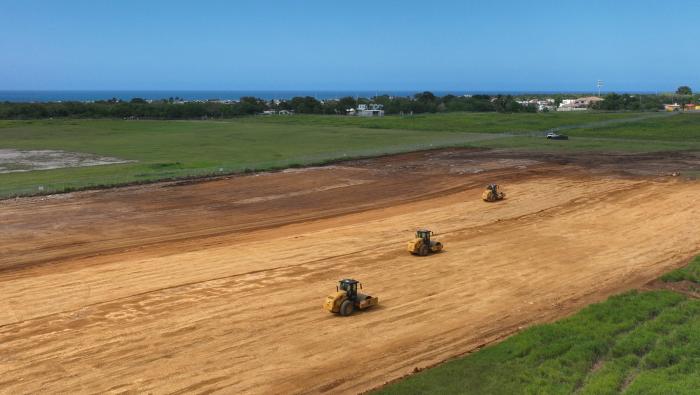

Purdue University civil engineering researchers have developed patent-pending “intelligent architected” materials that can dissipate energy caused by bending, compression, torque, and tensile stresses, avoiding permanent plastic deformation or damage. The materials might also exhibit shape memory properties that allow them to have actuation capacity, said the researchers. Aviation applications include aircraft runway mats for temporary or expeditionary flight operations using 3D printing materials.
Developed under a collaboration between Pablo Zavattieri, the Jerry M. and Lynda T. Engelhardt professor in civil engineering, and Indiana Technology and Manufacturing Companies (ITAMCO), the 3D printed panels consist of a carbon-fiber-reinforced metal composite, allowing for high stiffness while remaining lightweight. The panel system serves as an alternative to conventional AM-2 panels and offers improved longevity and mechanical properties. Applications for the technology include rapid deployment of structures or runways for defense, public health, and natural disaster response.
More In Airports