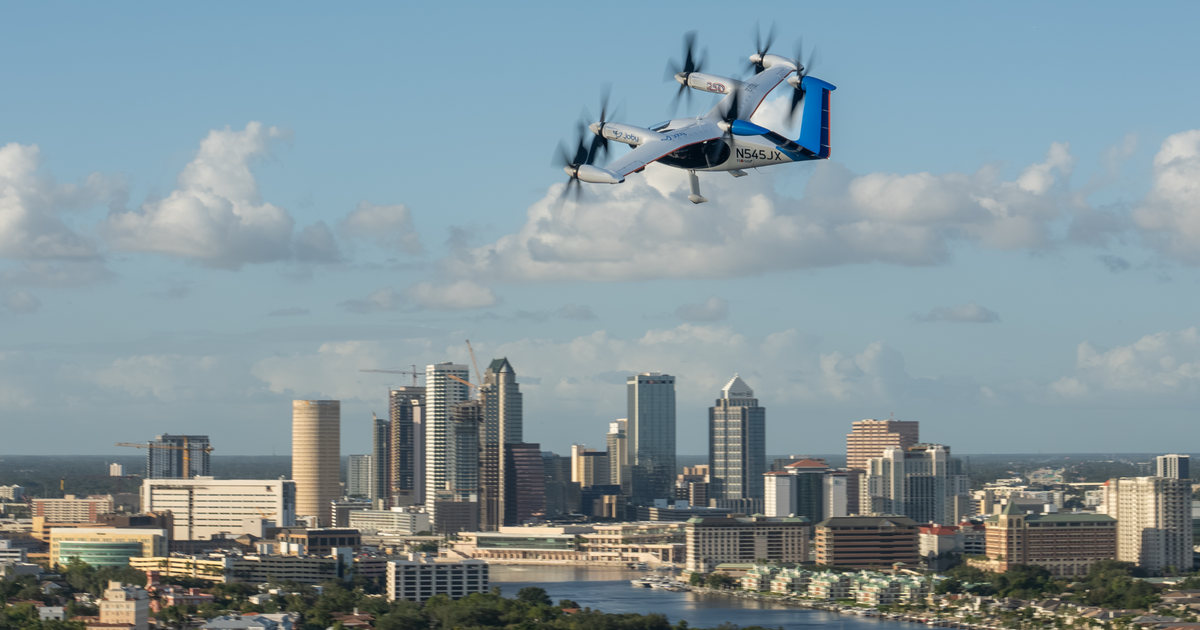
Joby Aviation and Archer Aviation now point to 2027 for early commercial passenger operations with their eVTOL air taxis in the U.S., the rival developers indicated in third-quarter earnings reports over the past week. Both companies have previously targeted the launch of commercial flights in 2025.
For Joby, the timing depends on FAA test pilots beginning certification flight tests. Archer still needs to achieve a first piloted transition ffrom hover to wingborne flight with its Midnight aircraft, a milestone Joby reached in April 2025.
Paying passengers on Joby’s aircraft would fly under the FAA’s eVTOL Integration Pilot Program (eIPP), which the company said allows such flights only once the agency's test pilots start flying its aircraft for type certification.
Meanwhile, Archer plans to fly passengers under a market survey certificate, an experimental airworthiness approval for demonstrating aircraft to prospective customers. The certificate the FAA issued for Archer’s Midnight aircraft this week covers only conventional takeoffs and landings on runways, and Archer must complete a piloted transition flight before seeking one for vertical takeoffs and landings.
Joby Awaits FAA Test Pilots
Joby’s latest quarterly filing with the Securities and Exchange Commission still lists a target of carrying its first passengers in 2026. The Santa Cruz, California-based company expects FAA pilots to begin training on its aircraft in the first half of 2027, when the company also plans to finish its own flight testing of the conforming aircraft built for type inspection authorization (TIA). FAA pilots would then begin the flight tests that count toward type certification, Joby chief policy officer Greg Bowles told investors in the company’s third quarter earnings call on November 4.
So far, the eIPP has hosted Joby’s demonstration flights in Texas and Florida. “Commercial flights under eIPP will be tied to substantial TIA flight testing,” Bowles said, noting that the FAA recently clarified that aircraft in the program can be used for commercial operations. CFO Rodrigo Brumana placed Joby’s “initial launch of commercial operations” under the eIPP in 2027. Joby founder and CEO JoeBen Bevirt said the company wants to add its eVTOL aircraft to its Blade helicopter service in New York that year.
Bevirt said he expects to ride as a passenger in a Joby aircraft designated for passenger testing “over the next few months,” and Joby plans piloted flight tests across its Dubai vertiport network before year-end. TIA flight testing typically takes six to 18 months, Bowles said, and Joby intends to fly several aircraft at once to shorten that span.
Archer’s Piloted Transition Still Pending
Archer, based in San Jose, has moved its Midnight eVTOL prototype to Hawthorne Municipal Airport (KHHR) near Los Angeles, where it plans to begin flying in the coming weeks. After the piloted transition, Midnight must also log 50 hours of flight testing before Archer can seek market survey approval for vertical flight, Archer president of aircraft OEM Benjamin Lyon said during the company’s November 9 earnings call.
In May, Lyon said Archer was on track to complete a piloted transition during the second half of 2026. He said Archer remains “on track for the end of this year,” with software verification finished and more than 100 of its 260-plus piloted test flights devoted to the transition campaign.
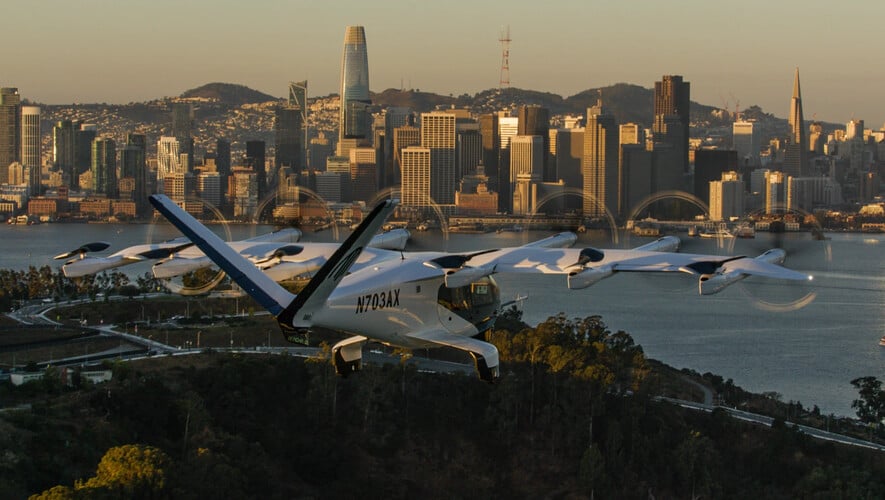
Midnight has yet to fly at the eIPP projects in Texas, Florida, and New York that named Archer as a partner, though the company said it continues to plan with the FAA to fly there. Archer co-founder and CEO Adam Goldstein told investors he intends to be the company’s first Midnight passenger in 2027, with further passenger flights to follow under market survey rules as Archer prepares for the 2028 Olympic Games in Los Angeles.
Beta Technologies, another rival electric aircraft developer, received a market survey certificate for the Alia 250 eVTOL in October. Joby has applied for market survey certificates for some of its aircraft, Bowles said, though he said the company remains focused on type certification and commercial passenger flights under the eIPP.
Archer is building nine Midnights for flight testing and eIPP flights, Lyon said, and Goldstein said three Midnights are in final assembly, preparing to move into flight testing. Joby has 17 aircraft in production, and Bevirt said its output rose 37% from the first quarter to the third.
Losses Continue as Defense Revenue Builds
Joby lost $211.8 million in the third quarter on revenue of $55.1 million, $53.2 million of which came from its Blade helicopter service. Archer lost $274.6 million on $5.1 million in revenue. Cash and short-term investments totaled $2.2 billion at Joby, which used $195 million during the quarter, and $1.35 billion at Archer, whose balance fell by $207 million. For comparison, Beta ended the quarter with $1.34 billion after a $119.1 million loss. Brazil’s Eve Air Mobility, which is targeting type certification in 2028, lost $58.1 million.
Joby and Archer are each buying defense businesses that already bring in revenue. Archer expects to close its all-stock purchase of Boeing’s Wisk, Insitu, and SkyGrid subsidiaries soon, and said drone maker Insitu generates more than $200 million in annual revenue. Joby expects its $500 million purchase of Resonant Sciences to close early in 2027 and said Resonant generated more than $100 million in revenue over the past 12 months.
Archer acting CFO Priya Gupta credited the first deliveries of electric engines to defense contractor Anduril for revenue that beat analyst expectations. The company supplies the engines and battery packs for Omen, an autonomous military aircraft Anduril is building with Abu Dhabi-based EDGE Group. In its quarterly filing, Archer also attributes its third-quarter revenue to airport services and leasing at KHHR, which it took over in December 2025.
Goldstein said deploying Archer’s technology early in defense “will deliver value across the whole business.” Archer and Anduril are also developing a hybrid-electric autonomous aircraft called Halo for commercial cargo and rescue flights, with a military version named Thunder, and plan to begin full-scale flight testing in 2027.
Ahead of its quarterly earnings release on the morning of November 4, Joby announced that the U.S. Air Force had raised its commitment to the company’s autonomous flight technology to nearly $37 million from nearly $20 million and lifted the ceiling on an operational testing contract to $50 million from $5 million. Awarded through the service’s Afwerx innovation unit, the funding covers software development and follow-on exercises in the Pacific. Joby’s Superpilot autonomy system flies on a Cessna Caravan turboprop, which operated in Hawaii under remote supervision from Guam—nearly 4,000 miles away—during a military exercise in August 2025.
In September, the Caravan completed what Joby believes was the first coast-to-coast autonomous flight by a civilian aircraft, with a safety pilot on board.
Joby’s revenue outside Blade, which includes flight services for the U.S. defense department, engineering work, and leasing, fell to $1.9 million in the third quarter from $8.9 million a year earlier. Its quarterly filing cites lower flight services revenue from those agencies.
In this article
More In Aircraft