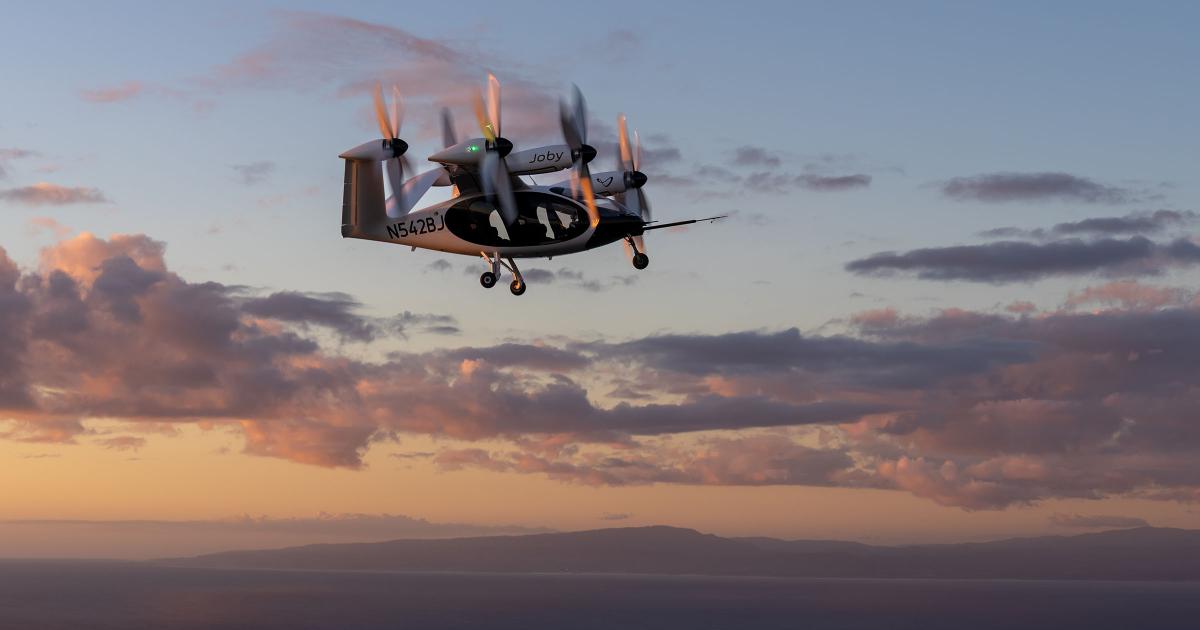
A federal jury in Tampa found on October 2 that eVTOL developer Joby Aviation breached a confidentiality agreement with avionics supplier Aerosonic and misappropriated trade secrets surrounding its air data probes. The jury awarded Aerosonic about $116.9 million, according to the verdict form filed in the U.S. District Court for the Middle District of Florida.
Clearwater, Florida-based Aerosonic, a TransDigm subsidiary, makes probes that measure air pressure around an aircraft so its flight computers can calculate airspeed, altitude, angle of attack, and sideslip. Aerosonic sued Santa Cruz, California-based Joby in March 2025, claiming Joby used Aerosonic’s proprietary designs and test data to develop its own probes in-house.
The jury awarded $68.6 million for breach of the 2021 nondisclosure agreement (NDA) between the two companies. It also found Joby liable under the federal Defend Trade Secrets Act and awarded $29.9 million to cover Aerosonic’s losses and Joby’s gains from the misappropriation. Because jurors found the misappropriation willful and malicious, they added $18.3 million in exemplary damages.
Aerosonic prevailed on each of the 39 items of proprietary information and 26 trade secrets presented to the jury. Meanwhile, the jury rejected all six of Joby’s affirmative defenses, including Joby’s argument that Aerosonic waived protection for information that Joby could obtain from probes it bought. The jury also rejected Joby’s counterclaims that Aerosonic breached the NDA and sold it defective probes.
According to Aerosonic’s complaint, the companies signed the NDA in September 2021, and Aerosonic began selling air data probes to Joby for its flight-test aircraft in April 2022. Days after the first delivery, Joby asked to buy the intellectual property rights to Aerosonic’s probes, and Aerosonic refused, the complaint states.
Aerosonic alleged that Joby then decided to design its own probes without telling Aerosonic, while continuing to ask the supplier for confidential engineering information. Joby developed its probe in about two years, according to the complaint, a task Aerosonic estimates would have taken a decade or more without its trade secrets.
The October 2 verdict is not yet finalized and remains subject to post-trial motions and potential appeal. A Joby spokesperson told AIN that the company has asked the court to overturn the verdict and intends to “vigorously pursue all available post-trial and appellate remedies.”
“We strongly disagree with the jury’s verdict, which we believe is unsupported by the evidence and inconsistent with the law,” the spokesperson said. “Joby independently developed its air data system through years of its own engineering and manufacturing work, and we stand firmly behind the integrity of that work and our conduct.”
Aerosonic also sold air data probes to rival eVTOL aircraft developer Archer Aviation. In February, the court allowed Archer to intervene in the Aerosonic v. Joby case so it could protect its own proprietary information after the judge allowed Joby to request records of Aerosonic’s sales to Archer, according to a court order.
Joby and Archer are also fighting each other directly. Joby sued Archer in November 2025, alleging that former Joby policy executive George Kivork downloaded confidential files before joining Archer and used them to undercut a real estate deal Joby had already secured. Archer denied that Kivork brought any confidential information with him. Archer countersued in March and accused Joby of hiding its ties to China when it sought U.S. government contracts.
On September 29, U.S. Magistrate Judge Susan van Keulen of the U.S. District Court for the Northern District of California dismissed Archer’s counterclaims for good. In her order, van Keulen wrote that Archer admitted it could not identify any specific false statement Joby made to the government and instead relied on what she called “inferences upon inferences.”
The same order allowed two of Joby’s trade secret claims against both defendants to move forward: one involving the developer agreement and one involving Hawthorne Municipal Airport (KHHR) in Los Angeles County. Joby alleges that Kivork took files naming the airport before he left, and that Archer leased the airport in November 2025 shortly after hiring him.
Van Keulen also dismissed Joby’s claims that Kivork’s files helped Archer pursue a Los Angeles Dodgers sponsorship, expand in Japan and South Korea, and explore hydrogen aircraft, giving Joby until October 6 to refile them with more supporting facts.
Archer’s separate patent infringement case against Joby at the U.S. International Trade Commission remains pending, with an evidentiary hearing scheduled for January and a final decision targeted for September 2027, according to the commission’s docket. Separately, Archer is also suing Vertical Aerospace for patent infringement.