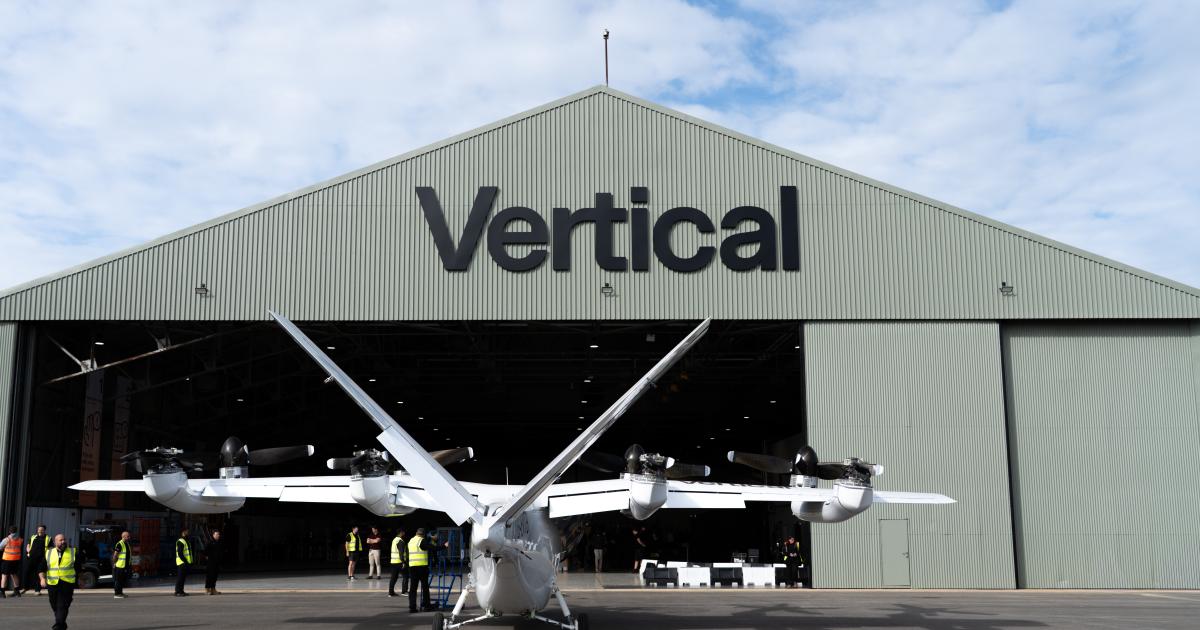
Vertical Aerospace has confirmed plans to start manufacturing its Valo eVTOL aircraft at its Cotswold Airport facility in the west of England. On Thursday, the start-up announced that a 60,000-sq-ft converted hangar will be used to assemble an initial 37 units each year, although in the longer term it aims to open a large factory with annual capacity for 1,000 aircraft at a yet-to-be-confirmed location in the UK.
Meanwhile, Vertical's engineering team is focused on the next stages of type certification work for the six-passenger all-electric Valo model. At the same time, it is also retrofitting one of its flying prototypes with an alternative hybrid-electric propulsion system that it intends to bring to market for applications such as military missions.
“Today marks the moment we pivot from prototyping to production,” Vertical Aerospace CEO Stuart Simpson said during an opening ceremony at Kemble on September 24. The company has spent around £1.5 million ($2 million) refurbishing its new building plus an additional World War Two-era hangar, more than doubling its space available at the site.
The first aircraft to be built in this facility will be Vertical’s pre-production, type-conforming Valo model, which is a redesigned variant of its VX4 prototype. According to Simpson, this design remains on track to achieve UK type certification in 2029
Simpson confirmed that the Valo - the production-conforming, redesigned variant of its VX4 prototype – remains on track for UK Civil Aviation Authority type certification in 2029. Following a critical design review due late this year, construction of the initial unit will commence onsite in the fourth quarter, with the first Valo intended to fly in 2028.
Once certified, Vertical anticipates production output to be around 26 aircraft a year split across two working shifts, although a third shift could boost numbers to up to 37. Batteries will be built at a separate ‘gigafactory’ in another as-yet undisclosed location, but it is also making a limited number of units at its Bristol headquarters.
According to Vertical, it is one of only two companies globally to have completed a full two-way piloted transition flight with a full-scale eVTOL, with the other being California’s Joby Aviation. Simpson said his company has spent little more than around $500 million to reach the current stage in the program, which he claimed is a fraction of the more than 42 billion spent by some U.S. rivals.
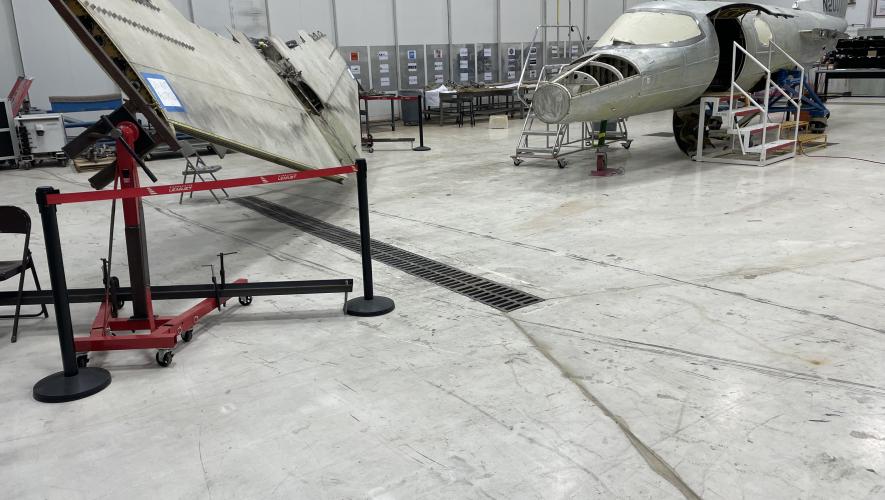
Vertical currently has two full-scale, piloted VX4 prototypes, which between them have accumulated nearly 120 flights in total. While G-VTLB is actively involved in flight testing, the other full-scale crewed prototype (G-VTLA) is currently disassembled at the back of the hangar, where the team are installing a hybrid-electric system. This airframe made its flying display debut at this summer’s Farnborough Airshow, from where it was disassembled and returned by road around a week ago.
Later this year, Vertical will announce a supplier for the hybrid version's thermal engine and chief commercial and technology officer Michael Cervenka said that the company has been studying numerous options. The introduction of hybrid-electric variant opens the market for three options: a full-electric, hybrid, and a militarized hybrid applicable for defense-related roles.
Although the latter is likely to start with logistics missions, Cervenka told AIN the platform is also applicable to transportation or intelligence, surveillance and reconnaissance roles. He confirmed that the hybrid Valo has sufficient power to run electrical equipment needed for omboard systems.
Cervenka explained that the hybrid-electric aircraft should achieve type certification about a year after its all-electric counterpart. He said Vertical’s methodical approach to flight testing—working closely with the UK regulator at all stages of the process to integrate the aircraft into controlled airspace—forms the basis of an assured path to certification. However, the inter-airport demonstration flights—such as the Bicester to Farnborough ‘hops’ announced a few years ago—are not a current priority for the company.
The type-conforming Valo will be around 15% smaller overall than Vertical’s existing white VX4 prototypes, with a slightly shorter fuselage: although the position of the propellers, pylons and wings will be almost identical. This, explained Vertical’s chief test pilot Simon Davies, relates to “the really critical learning about the aerodynamic interactions and structural loads” which are otherwise difficult to model.
According to Davies, it was important to have piloted flights “early” in the test campaign, with Vertical’s test pilots able to offer qualitative feedback on ride quality amongst other elements. Valo’s all-electric campaign will see seven conforming prototypes built: five airworthy aircraft and a further two for static testing.