Getting time in a U.S. supersonic wind tunnel can take over a year, and new aerospace technology developers typically pay for the whole facility by the week. Starfighters Space thinks it can sell those customers something better: several minutes at Mach 2 under the wing of a fighter designed in the 1950s, with less wait time.
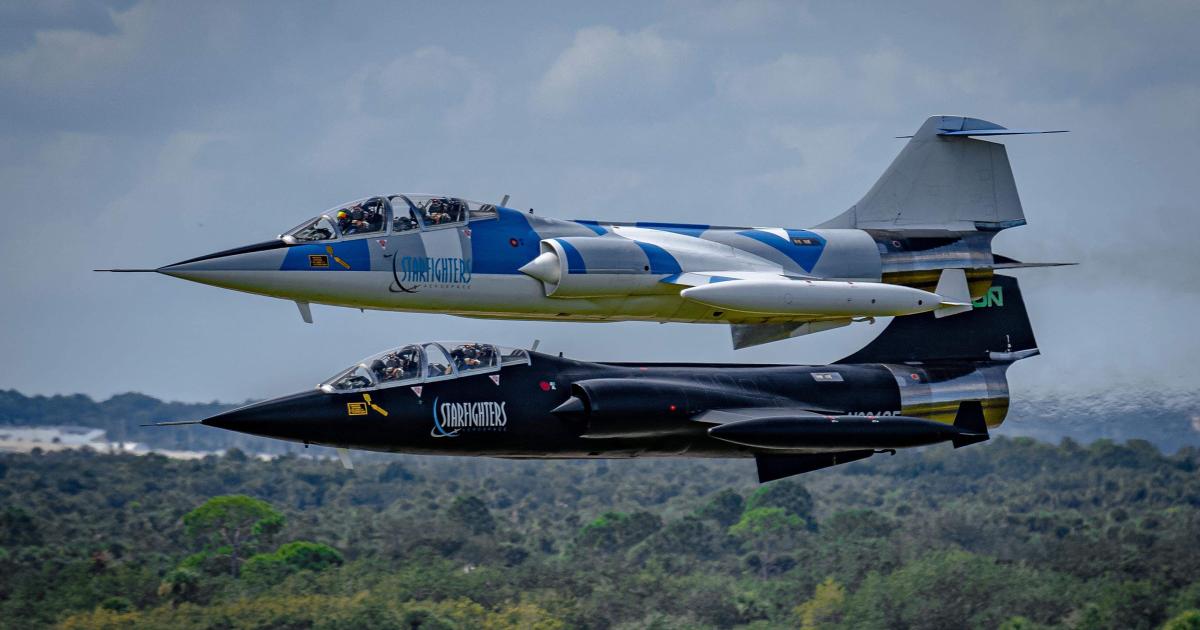
Based at NASA’s Kennedy Space Center in Florida with a second base at Midland International Air & Space Port in Texas, the company has a fleet of eight Lockheed F-104 Starfighters. It sells time on them to defense contractors, government laboratories, and universities that want to expose hardware to sustained flight at Mach 2, twice the speed of sound.
Asked why a customer would choose an airplane over a ground facility, Starfighters Space CEO Tim Franta pointed first to availability. Wind tunnel customers face a year to 18 months of waiting, he told AIN, and then have to rent the whole facility for a week regardless of how much time they actually need. A sortie on the F-104 yields about seven to 10 minutes of sustained flight at Mach 2, he said, against 30 seconds to a minute of sustained flight in a tunnel. Flying a fighter, Franta argued, also costs less.
Beyond cost and scheduling, Franta points to the real-world atmospheric conditions. Flying with Starfighters means flying in “dirty air,” as Franta put it—the industry’s term for the opposite of a wind tunnel’s controlled conditions. “When you fly in a wind tunnel, you’re flying extremely pristine air. When you fly with us, there’s humidity, there’s bugs, there’s thermal differences at various altitudes. You are flying in real conditions,” he said.
Starfighters calls the product “Wind Tunnel in the Sky.” The underwing carrier resembles an AIM-120 AMRAAM air-to-air missile, Franta said, and comes in three sections. A nose cone transparent to radio signals holds avionics. A body section carries control surfaces, engine inlets, and sensors. The tail section can fire igniters for ramjet or scramjet engines, the air-breathing propulsion used by hypersonic vehicles, which fly at Mach 5 or faster.
Hardware that needs speed but not airflow can ride in one of two internal avionics bays or in the nose. The F-104 was originally built to carry a nose radar. Franta said the radar sets were removed when the airplanes were demilitarized, before Starfighters acquired them, and each airplane now flies with roughly 245 pounds of ballast in that space to keep the nose-heavy design balanced. A customer can swap that ballast for a payload of about the same weight, sealed inside a radome that radio signals pass through, he said.
Customers include GE Aerospace, the Air Force Research Laboratory, the Defense Innovation Unit, NASA, and universities such as Florida A&M and the University of Florida. Demand, Franta said, is being driven by a change in how the Pentagon approaches testing. Where a program once staged a single expensive flight test each year and stood or fell on the outcome, the military now wants frequent, smaller-scale flights that build up data over time. “Now they want many, many more flight tests,” he said. “They want lots of data, lots of flight tests.”
The F-104 first flew in 1954 and entered service in 1958, powered by a General Electric J79 afterburning turbojet engine and sporting a pair of short, thin wings. Its ability to sustain Mach 2, rather than merely reach it, is a perk; Franta said the company is the only civil operator able to do so. Italy, the last military operator, retired the type in 2004.
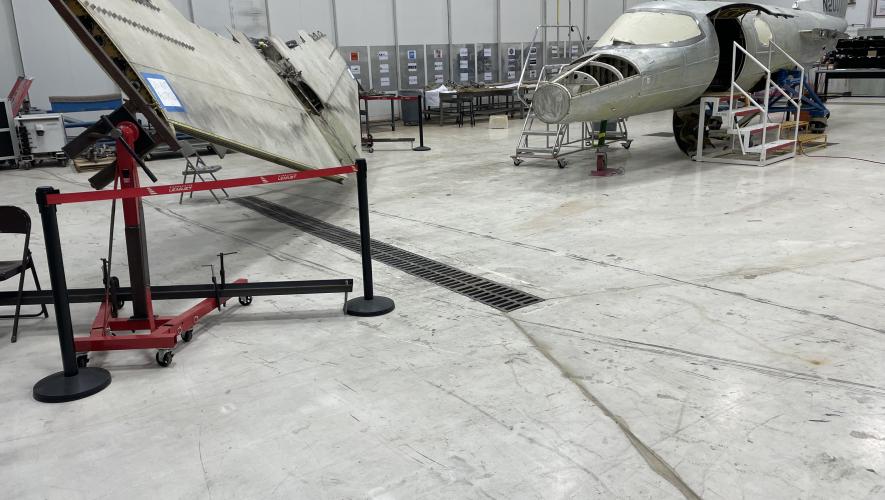
Five of Starfighters’ eight airplanes are former Italian jets, and three were built by Canadair, according to registry records. One serves as a permanent “hangar queen” (an industry term for an aircraft kept on the ground), Franta said; three are flight-ready at any time, and the fleet flies about 50 times a year.
Starfighters’ own crew handles almost all the maintenance. “We send the engines out to be overhauled, but we do everything else in house,” Franta said. Tires are the one commodity requiring outside sourcing, and they come from Dunlop in England using molds the company owns.
The company’s investor presentation in June stated that parts and expertise are available to maintain the airframes “through their design lifespan to 2035.” Franta’s own estimate runs a little longer. “We have every part we need for 10 to 12 years,” he said. “If for some reason—this will not happen—if we were to lose every single spare part, we can have them printed in titanium or something and replace them.”
Starfighters currently has “three and a half” pilots on staff, Franta said, without specifying what the fraction represented. Finding people willing to fly the airplane is not the constraint; with no F-104 in military service anywhere, no pipeline of current instructors or examiners exists, so the company trains its own pilots and the examiner who checks them. “Not only do we train our own pilot, we have to train our own FAA certifier, because no one’s proficient in the F-104 anymore.” Applicants are plentiful, he said. “Pilots are not an issue. I wish we could let more people fly.”

Civil aircraft may not exceed Mach 1 over U.S. land, a speed-based prohibition the FAA enacted in 1973, so Starfighters does its supersonic work offshore. Its airplanes fly under experimental airworthiness certificates, primarily in the research and development category, Franta said.
Those restrictions could soon change. In June, the FAA proposed replacing the ban with a noise limit, which would let operators fly faster than Mach 1 over the country without a special authorization as long as sonic boom overpressure at the surface stays no higher than 0.11 pounds per square foot. Executive Order 14304, signed in June 2025, set that rulemaking in motion.
Initial operations under the proposal would rely on Mach cutoff, a technique in which an airplane’s speed and altitude combine with atmospheric conditions to refract the sonic boom upward so it never reaches the ground. Franta’s expectations track that approach. Rather than a flat prohibition, he said, he anticipates rules tied to altitude, humidity, and temperature—clearance to fly supersonic above a given altitude when humidity is below a set level, for instance. “We’re looking forward to a data-driven rule,” he said.
Franta argued the F-104 is well suited to the coming standard because its frontal profile is less than a meter across, which he said produces a comparatively mild boom. He also described planned supersonic corridors over Texas and New Mexico—roughly linking Midland, Spaceport America, and the Waco area—that the company hopes to fly. Those flights would give the FAA real-world boom measurements to calibrate the eventual standard, he said.
The company coordinates with developers of supersonic jets on regulatory matters, Franta said without naming any specific companies. The FAA has granted special flight authorizations for supersonic testing to Boom Supersonic, which is developing the Overture airliner, and to Hermeus, which is developing the uncrewed Quarterhorse demonstrator for high-speed flight testing. “Someone has to be first to commercially fly supersonic overland,” Franta said. “There will be a supersonic business jet. I just don’t know who it’s going to be.”
The company’s name points to its other ambition: using the same F-104s to air-launch small rockets toward space. Under that plan, an F-104 would carry a rocket to high altitude and release it in flight, using the jet as a reusable first stage.
Starlaunch 1, a rocket sized to fit under the F-104’s wing, would be released at about 45,000 feet and flown on a shallow trajectory for an atmospheric hypersonic test or a steep one for a suborbital flight, Franta explained. He expects a drop-test flight within three to four months. The company does not yet hold an FAA launch license. A larger follow-on, Starlaunch 2, is intended to reach low Earth orbit.
A closer prospect is microgravity research. In March, Starfighters partnered with Mu-G Technologies to offer parabolic, simulated-microgravity flights for NASA and other customers. Franta expects the F-104 to deliver up to 45 seconds of weightlessness in one or two long parabolic arcs, against roughly 27 seconds per arc in a converted airliner. He hopes to begin those flights by the end of 2027.
Asked whether hypersonic testing or space is the bigger market, Franta did not hesitate. “I think hypersonics is going to pay the bills for the next 10 years,” he said.
Starfighters Space has been publicly traded since December 2025. It reported no revenue for the quarter ended June 30 and $1,918 in research and development spending, against about $23 million on hand and roughly $10 million spent running the business over the first six months of the year.
The quarterly financial report also carries going-concern language, meaning management has doubts about the company’s ability to keep operating without more funding. That disclosure is not unusual for early-stage companies working toward commercialization, a company spokesperson told AIN, explaining that the quarter’s research and development figure reflects the completion of an initial phase of Starlaunch testing. They declined to specify how the company classifies program expenses, or whether any of the customer work is under contract and generating revenue.