Aircraft
F-35 Buy Approved As Saudis Struggle to Counter Houthi Threat
Trump administration says $24.3 billion deal will bolster Saudi Arabia's self-defense capability
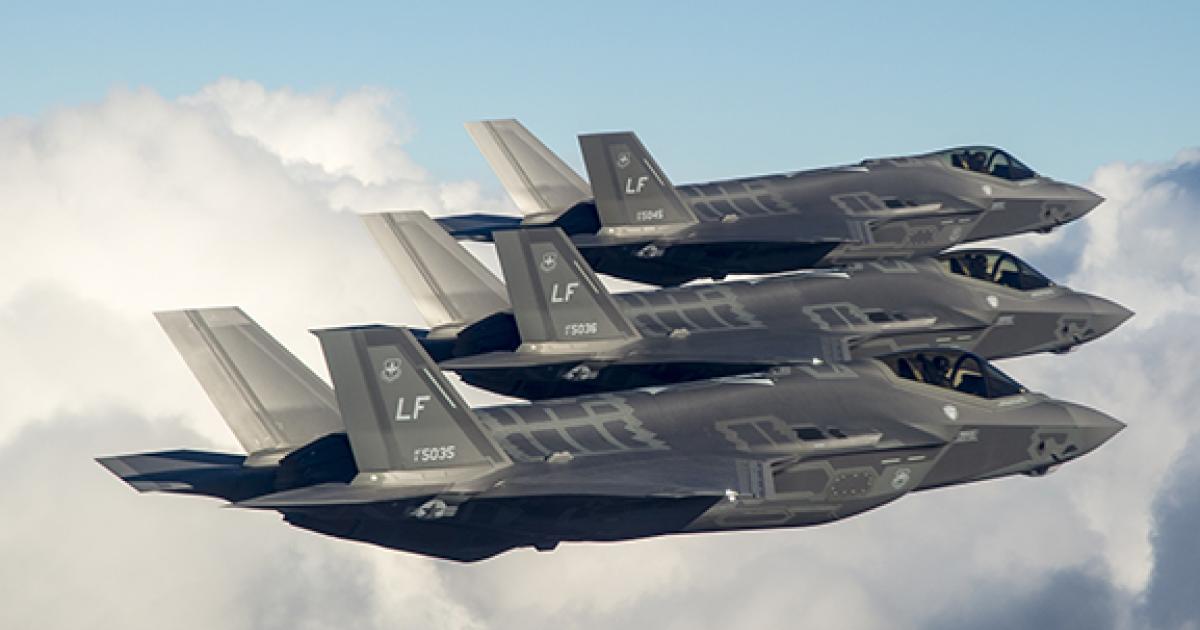
Formation of three F-35As against clouds
F-35As of the United States Air Force seen here over Luke Air Force Base. © Lockheed Martin

The U.S. Department of State's approval of the sale of 48 Lockheed Martin F-35A Lightning II fighter jets to Saudi Arabia last week coincided with President Trump's apparent refusal to join in counter-attacks against Houthi forces threatening the Kingdom and Red Sea shipping routes. Two days after the $24.3 billion deal was announced on September 17, Houthi missiles struck an Aramco fuel store at Riyadh International Airport (OERK) and several other energy industry sites.

The wider context for the sale, which also covers Pratt & Whitney F135 engines along with other hardware and services, is what it means to the U.S. government's 2008 commitment to ensuring that the Israel Defense Forces will maintain what the agreement defined as a "Qualitative Military Edge" over its Middle East neighbours. Israel is currently the only F-35 operator in the region and has a fleet of 48 of the combat jets.

The agreement will now be subject to scrutiny by the U.S. Congress over the next 30 days. Democratic lawmaker Raja Krishanamoorthi has already protested that it “could put the crown jewels of American military technology within reach of the Chinese Communist Party,” on the basis of Saudi Arabia's security pact with China. 

However, the Trump administration insisted that the F-35 deliveries anticipated in the 2030s “will not alter the military balance in the region” and will instead “improve the security of a major non-NATO ally that is a force for political stability and economic progress in the Gulf region.” The Pentagon characterized the strategic sale has strengthening the self defense capability of Saudi Arabia—a long-standing Lockheed Martin client for F-15 fighters, C-130 transports and Sikorsky Black Hawk helicopters—while also "improving interoperability with U.S. forces, and other regional and NATO forces.”

Under the previous Biden administration, the U.S. had considered supplying F-35s to Saudi Arabia as part of a wider move to normalize diplomatic relations between the Kingdom and Israel. However, this initiative collapsed after Hamas’ Oct 7, 2023, attack on Israel. The Royal Saudi Air Force warplane inventory currently includes variants of the F-15E Strike Eagle, the Eurofighter Typhoon, and the ageing Panavia Tornado. 


In this article