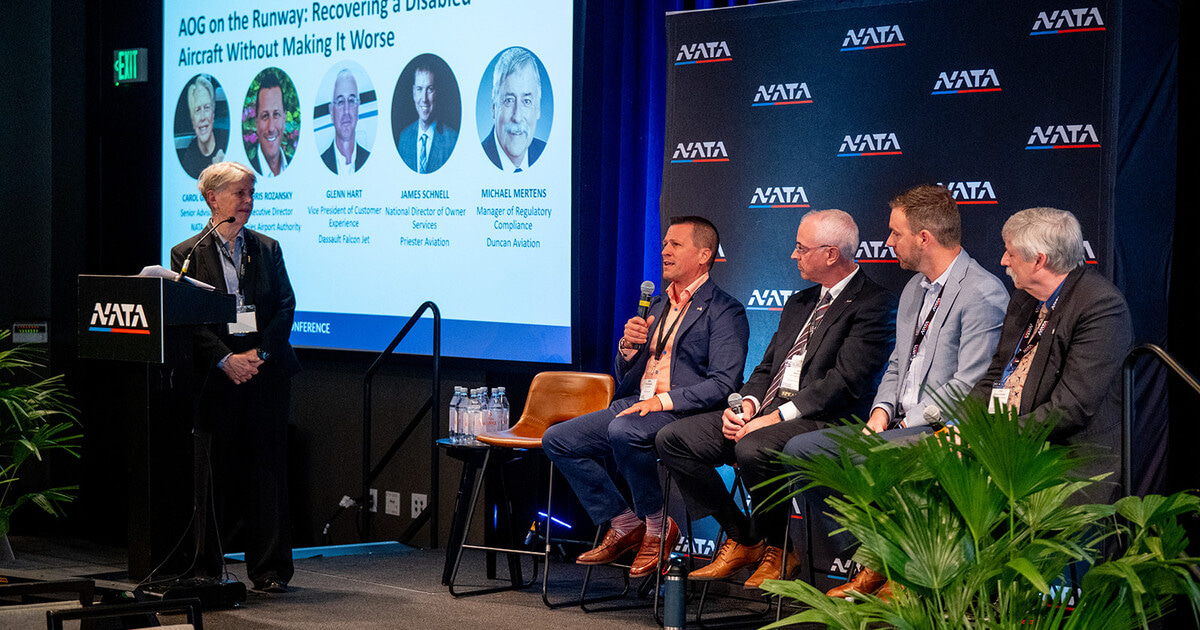
For aircraft operators and airport personnel alike, a disabled aircraft on or next to a runway is a serious concern, and one that could easily escalate into a worse situation if the proper procedures aren’t followed. At the recent NATA Aviation Business Conference in Denver, a panel of industry experts examined the dynamics of this situation and discussed how to deal with it in an efficient and safe manner, one in which no additional damage is done to the aircraft during the recovery.
Incidents such as blown tires or runway departures will not only put an airplane out of service, but will also render the runway unusable as long as the aircraft is stuck, causing pressure to remove it as quickly as possible. That may not always be the best idea for pilots who are responsible for protecting the value of their aircraft. While the aircraft manual is a good place to start, one of the first points of contact should be the aircraft manufacturer.
“We hope to be one of the first people to be called, after things settle,” said Glenn Hart, Dassault Falcon Jet’s v-p of customer experience. “But a lot of times we end up finding out about it on social media or other places, so we’re not always right in the front of it, but we certainly hope that we are.”
He noted that all the OEMs have technical call centers to help those on the ground with the specifications of the aircraft, as well as guide them through what needs to be done in terms of whether it will need to be defueled, or how to prepare it to be moved. “We have people that will be able to walk anybody through that instantaneously over the phone with technology these days,” added Hart. “You can have video conferences and see what’s going on. You don’t necessarily need to have boots on the ground, but we’ll also send field technical representatives that can go out there and help out.” Operators should also take photos of the aircraft starting from the time of the incident and throughout its recovery, to document any damage done through the process.
If the aircraft is in mud, those responders on the scene may wish to use a crane to hoist it, but it is imperative that they understand where to support it from, because the wrong location could cause serious damage to the fuselage. Likewise, knowing where to attach cables to tow a stuck aircraft could mean the difference between moving it and shearing off its nose gear.
Hart recalled one example posted online where that very outcome happened. “Really, what it comes down to is that aircraft could have been moved much more efficiently without any kind of damage,” he told the audience. “Now, when that happens, you’ve just exponentially increased the complexity of getting that aircraft out of there.”
“Sometimes everybody wants [the aircraft] off the runway in a hurry,” said Michael Mertens, Duncan Aviation’s manager of regulatory compliance. “You understand that, but you’ve got to make sure that you know what you’re doing before you start doing it; otherwise, you do more damage. It’s a bad day for everybody already, but then you compound that by continuing to break the airplane or making it worse.”
Mertens explained that whoever is in charge of the recovery should make sure they have the proper tools present to do the job. “The first thing is, don’t be a redneck engineer,” he stated. “We’ve learned to get the right tools, tools that can take the weight of the aircraft.” While in consultation with the OEM response team, they should carefully explain the situation, inform them what equipment is present, and ask whether they believe it is adequate for the task or if additional or specialized tools are required.
From an aircraft operator’s perspective, having an up-to-date and practiced emergency response plan (ERP) is crucial, according to James Schnell, Priester Aviation’s national director of owner services. “If the first time you’re working through your ERP is when you have an incident, then you’re way too late.” His company runs quarterly drills through its ERP, knowing that others are relying upon it.
“As an operator, when you’re working through this issue, your clients are looking to you to be the expert, so know your insurance policy,” Schnell stated, adding that a single point of contact should be designated. “One of our biggest check marks in our process is who is our point of contact going to be at the airplane?” Typically, that person is the aircraft pilot; their first responsibility is ensuring the safety of the passengers and crew, and then they should assume control of the aircraft’s situation until a maintenance provider arrives on scene. “Then a thorough rundown is passed down to the maintenance vendor or our maintenance personnel, and then that person kind of runs the incident thereafter.”
It is a delicate balancing act, weighing the needs of the aircraft operator with those of the airport in situations like this, said Schnell. “The longer we have an aircraft AOG on the end of their runway, it’s eating into their margins, it’s eating into their fuel sales, their landing fees, and so forth.”
“We make certain we are coordinating with the authorized person of accountability or responsibility for that recovery operation, and we want to be certain we’re doing the best we can to honor their wishes while trying to balance that with the needs of the overall airport activity,” explained Chris Rozansky, executive director for the Naples (Florida) Airport Authority, adding that all Part 139-certificated airports with air carrier service have a regulatory requirement to practice this on an annual basis.
“If the airport’s doing it properly, as they should, they put the safety aspect first of do no further harm, and then they want to, as efficiently as possible, try and recover that aircraft to get back to normal operations,” Rozansky said. “It can be challenging, but in my opinion, it all comes down to that advance preparation and having the people and the equipment ready to go.”
At Naples Airport (KAPF), the airport authority runs an FBO as well, and Rozansky explained that while his staff has a series of procedures for aircraft recovery, every circumstance is unique. “We have a host of equipment and tools, but our staff trains and prepares in part through some of our own training, supplemented with NATA Safety 1st.”
Another managing factor lies in communication. “It’s important that, as the operator, you’re coordinating with the airport and the FBO as well because you don’t know who the media is going to to find the information. You want to make sure that the right, consistent message is getting out there across all those different parties that are involved,” Rozansky said.
“We have very invested people outside of our industry trying to find out who manage, who own, and who fly in our airplanes, and those logos with the companies look great on the side of the airplanes until it’s off the end of the runway,” Schnell added. “Then they’re like, ‘How can I get that thing off the airplane?’”
More In Maintenance and Modifications