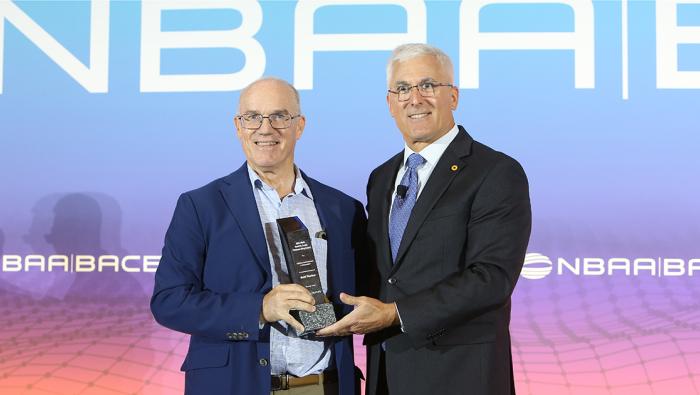
As Aviation Personnel International (API) celebrates its 55th anniversary at NBAA-BACE this year, the staffing firm is seeing an evolving industry trying to keep on top of compensation and recruitment pressures within business aviation. Releasing results of its latest survey of 200 Part 91 flight department leaders, API reported that compensation and benefits led the list of top concerns.
While 45% of flight department leaders pointed to those issues, 39% cited the ability to recruit qualified aviation professionals. Additionally, 39% listed work-life balance. Developing future leaders and retention followed at 38% and 36%, respectively.
On the factors having the greatest impact on retention, 74% selected compensation and benefits, 54% said schedule predictability and time off, and 44% identified department culture.
“Compensation is clearly top of mind, but a raise isn’t always the answer,” said API CEO Sheryl Barden. “Aviation leaders want to know what the market is paying and whether their people are being paid fairly. If not, they need help making the case to HR. And sometimes the job has changed so much that the title and salary haven’t kept up.”
Beyond staffing services, API has found that flight department leaders have increasingly turned to the company for guidance on workforce issues. “Sometimes a leader calls and says, ‘Can I run something by you?’” said API president Jennifer Pickerel. “They might be worried about upcoming retirements, wondering what their employees really think, or dealing with a situation they haven’t faced before. They just want someone they trust to talk it through with.”
This represents the continued broadening reach for the firm that Sheryl Barden’s mother, Janice Barden, founded 55 years ago. Janice, an aviation psychologist and recruiter, established API in 1971 with the view that technical qualifications alone don’t determine whether someone will succeed in a flight department. Instead, she developed an approach that considered the whole person and the match between that person and the organization.
Sheryl Barden joined the firm in 2001 and has since expanded the scope beyond recruitment to assisting with other workforce challenges, including adding aviation outplacement and compensation consulting, and custom benchmarking. More recently, it rolled out an organizational health and wellness program, API WorkWell, focusing on culture and employee engagement.
“It's been really fun to watch a company evolve and also stick to our core values,” Barden told AIN. “We haven’t gone a huge way out of what we started with: We started with trying to raise the bar of professionalism in Part 91 flight departments and doing that by finding the right people and curating the right teams of people and the right leaders to lead those people. When I think about what we do and what we've done for 55 years, I think we’ve really had a very good effect on professionalism in this industry and raising the bar.”
Along the way, the challenges confronting flight departments have shifted. “The industry has continued to evolve. The leadership of our flight departments have continued to evolve from being pilots to truly being business unit leaders,” Barden said.
In the beginning, she continued, business aviation “was all about a group of pilots flying the CEO. Now, while it's not a profit center, they’ve certainly got budgets and bottom lines that they need to adhere to. They’ve got to make the right strategic decisions for the corporation or the entity. Do they have the right equipment? With all of the things that are going on, are they delivering safely and securely in this global world?”
She noted her stepfather had started IBM’s flight department nearly 75 years ago. “He had carte blanche. He had no budget. He had a checkbook. He didn’t have any corporate oversight. He made the decisions. He wrote the checks. He hired and fired. And he grew that flight department, not just in the United States, but he grew it over in Europe as well.”
That has changed significantly, Barden said. “In today’s world, nobody has a checkbook. Everybody's got a budget. There’s all kinds of oversight, and there’s so much compliance—not just aviation compliance, but corporate compliance and HR compliance. HR is a huge factor in these flight departments today. And you add family offices to that, which are very different than corporations.”
API works with many family offices, Barden said. “That’s an entirely different spectrum with their own challenges.”
Another aspect that has changed the workforce dynamic is the Internet. “For years there was always reaching out to who you knew, your friends and family network—and friends and family networks still feed many of our flight departments,” she said. “But the internet has changed many things because there’s a wider reach. There’s a lot of vulnerability when you’re hiring that way to really know deep down who the authentic individual is. The hardest thing is to continue to find out who that person or professional is authentically.”
As for the survey results, Barden said she wasn’t surprised that compensation has been an issue for a decade. In the mid-2010s, business aviation became a prime choice for pilots.
Pilots came to business aviation for a couple of reasons. One of which was because they were either stuck in the regional carriers and couldn’t make enough or move up. “One regional carrier CEO said at a conference I was at, ‘We paid our pilots enough money to have a car or to have an apartment, but not enough to have both.’”
Pilots also came to business aviation through past furloughs. However, airlines began drawing those pilots back, and “since that time, compensation has continued to be probably one of the things that keeps a director of aviation up at night.”
Demand for higher compensation is increasing, but corporations have set salary bands. One director of aviation told Barden, “It feels like I’m going back every six months asking for more money for my pilots, more money for my pilot. But if we’re going to compete, we have to be able to compete.”
While competition may slow down, including recently, Barden believes it will pick back up based on airline growth projections. Flight departments already face pilot reluctance, viewing those jobs as a lateral move. “I won’t make any more money, and they’re behind the times.” These departments are limited by corporate flight structures.
“They’ve got compensation structures corporate wide that don’t necessarily jibe with where business aviation is going,” she said, with aviation department leaders and pilots making more than the structure above them. “Can you imagine asking your boss for a raise? Can I have more money than you?”
Not only is that a concern for experienced pilots, but the younger generations are expecting higher salaries, as well as more work-life balance. This makes unpredictable schedules a difficulty, especially in the recruitment of pilots used to the airline schedules. “In a recruiting situation, what a candidate wants to know is what will my work life look like? Will I have hard days off? Will I be on 24/7 call?”
That makes compensation even more important because “there are enough jobs out there that professionals don’t have to take [the flight department roles]. They can take other things,” Barden said.
More In Training and Workforce