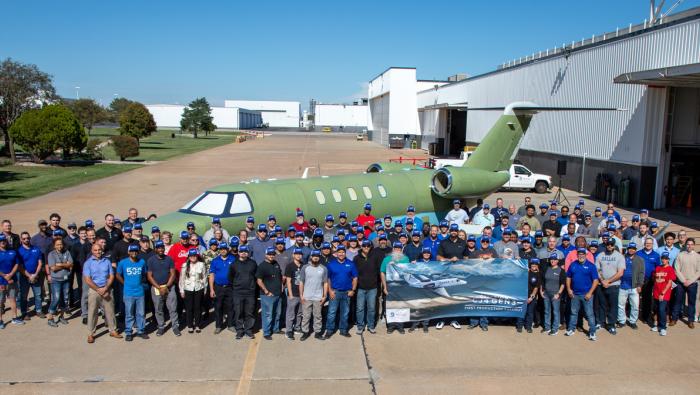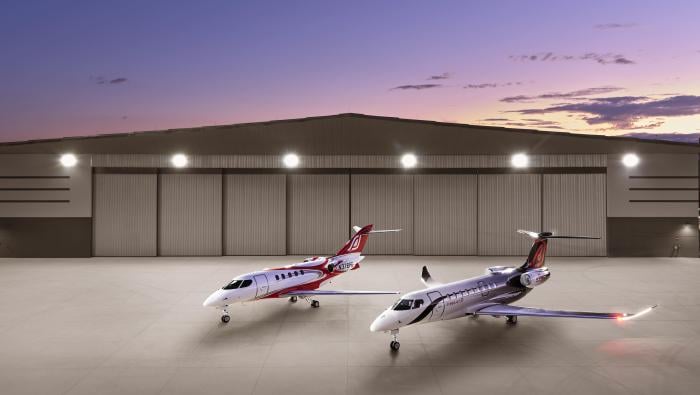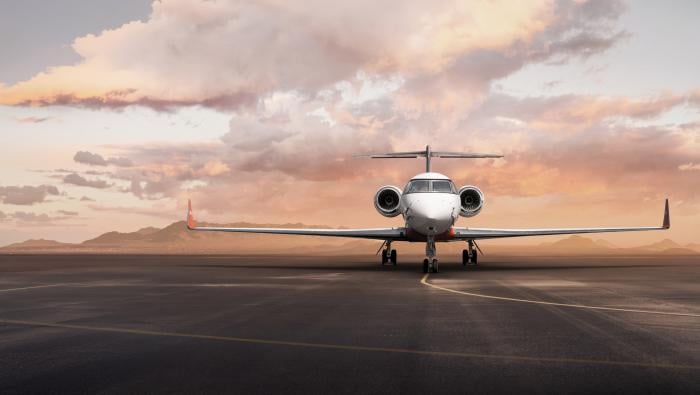
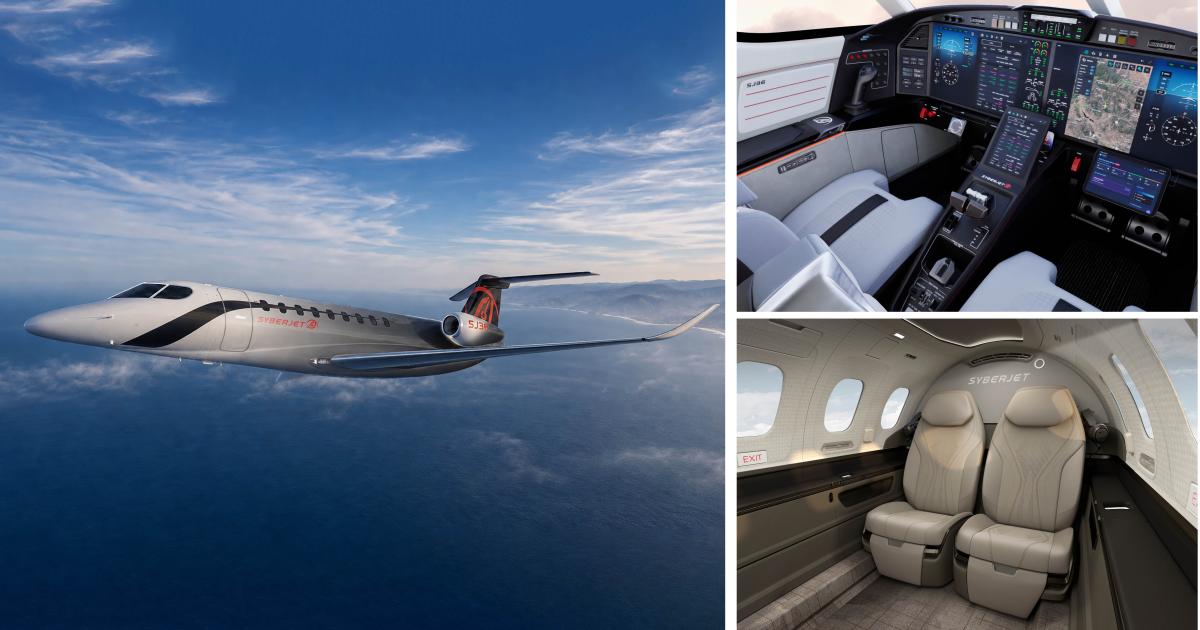
SyberJet Aircraft unveiled a full-scale mockup of the SJ36 light jet’s cabin and cockpit last night during the SyberJet World event at the Las Vegas Henderson Executive Airport. The company also brought a trailer to NBAA-BACE 2026 with an avionics mockup for show attendees to experience the airplane’s in-house-designed touchscreen suite.
The SJ36 is a redesigned and stretched upgrade of the SJ30-2, an FAA-certified light jet that was notable for its high-speed cruise of Mach 0.83, 2,500-nm range, 49,000-foot maximum altitude, and sea-level cabin altitude at 41,000 feet.
With only five SJ30-2s delivered by Sino Swearingen, the program then languished after it was acquired in 2011 by Metalcraft, one of the jet’s airframe component suppliers. Metalcraft had been working on an update to the SJ30-2’s avionics, to be called SyberVision, and renamed the jet as the SJ30i, but this variant never went into production.
The company was acquired by its current owners in 2024 and rebranded as SyberJet Aircraft. The following year, CEO Trevor Milton announced plans to stretch the jet’s fuselage by 2 feet and design—in-house—a new version of SyberVision and a fly-by-wire flight control system.
Milton was founder, executive chairman, and CEO of electric and hydrogen fuel-cell truck developer Nikola but resigned from the company in 2020. Nikola entered bankruptcy in 2025.
With the longer fuselage and powered by Williams International FJ44-4A turbofans, the SJ36 is expected to have a Mach 0.88 Mmo and 3,000-nm range, with the same 49,000-foot maximum altitude and sea-level cabin at 41,000 feet as the SJ30-2. The target for the SJ36’s first flight is as early as 2029, with FAA certification planned in 2032.
Milton told AIN he expects the costs of the program to be about $1 billion, including $250 million for design activities and $750 million to set up a factory.
SyberJet decided to design the SyberVision avionics in-house because traditional avionics companies weren’t interested in the program, according to Milton. Pilots will be able to connect to the avionics from their smartphones, including switching on a zero-emission auxiliary power unit that can cool or heat the aircraft parked inside a hangar.
The avionics feature six fully redundant large touchscreen displays, each of which can take over functions from the others. Pilots will be able to swap elements from one display to another with a swiping gesture.
A key design feature of the avionics will be over-the-air software updates, according to the company, to speed up and improve the customer service experience. Much of the avionics and airframe systems design work is being done with bench-test simulators to test controls in the cockpit and for other systems.
The 2-foot stretch makes the cabin—which Milton admits is somewhat narrow compared to other light jets—more comfortable. According to Milton, SyberJet engineers were able to extract more passenger space inside the cabin by redesigning the environmental system, systems attachments, and lighting.
With one pilot, the SJ36 will be able to accommodate eight passengers. Cabin height is 4.3 feet and width is 4.71 feet. While the SJ36’s designers aim to compete with midsize jets for performance, other manufacturers are targeting cabin space and comfort with different speed and range profiles.
For example, Honda Aircraft’s Echelon cabin measures 5.21 feet high by 5.08 feet wide, and the jet can carry up to 11 occupants. NBAA IFR range with four passengers will be 2,625 nm; its ceiling will be 47,000 feet. Meanwhile, the Otto Aerospace Phantom 3500 is expected to fly 3,200 nm with four passengers and have a 51,000-foot ceiling. Its flat-floor cabin is 6.4 feet tall and 7.5 feet wide.
All three competing twinjets will be powered by Williams International FJ44 engines. SyberJet officials believe the SJ36’s performance and passenger comfort—including lower fatigue thanks to the sea-level cabin at altitudes up to FL410—will set it apart from the competition.
In this article
More In Aircraft