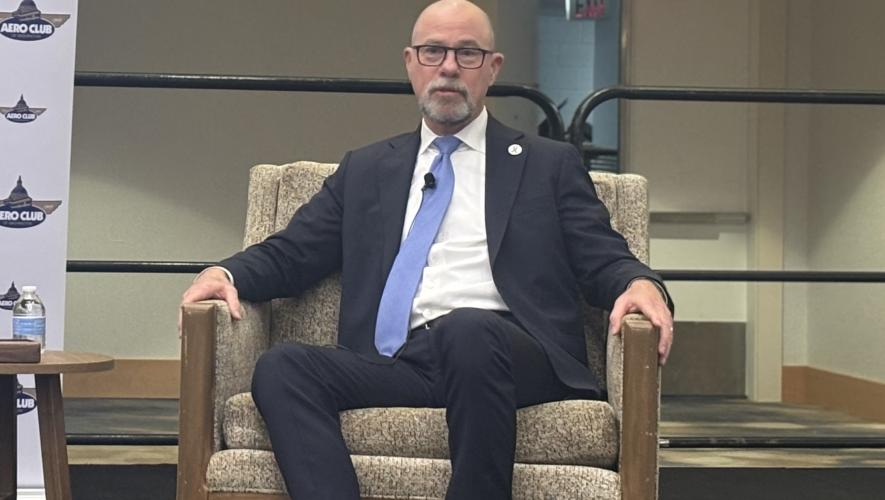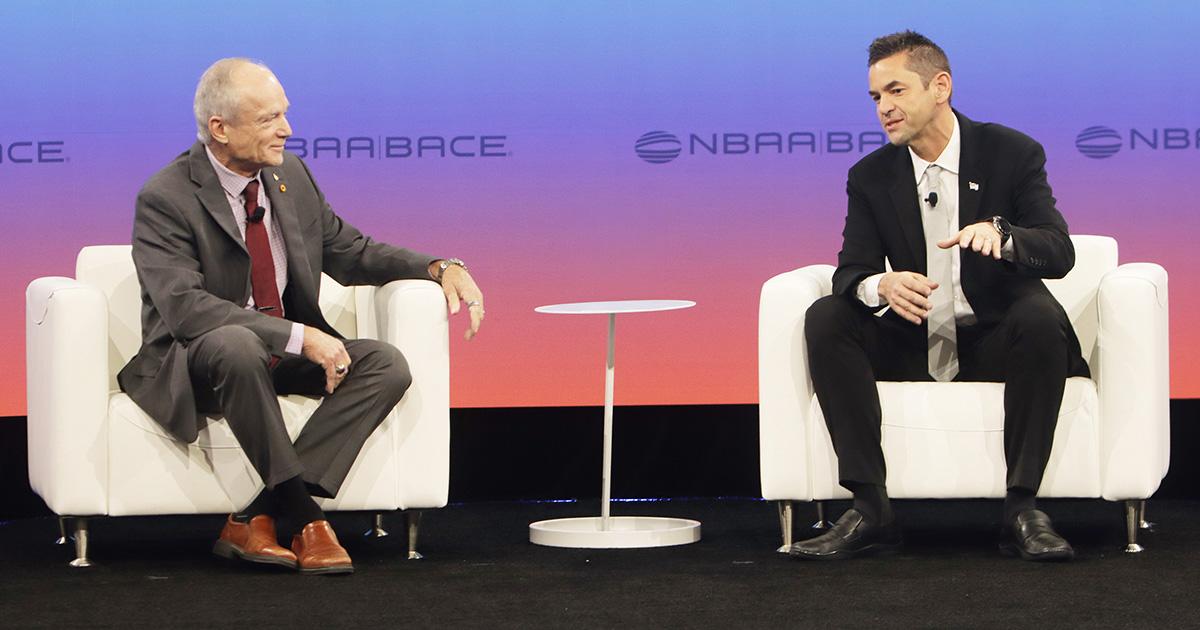
Quiet supersonic flight and a moon race with China took center stage on Tuesday morning at the NBAA-BACE opening session. In a fireside chat with former space shuttle commander Charlie Precourt, NASA Administrator Jared Isaacman said flight testing of the X-59 supersonic noise demonstrator is going better than expected.
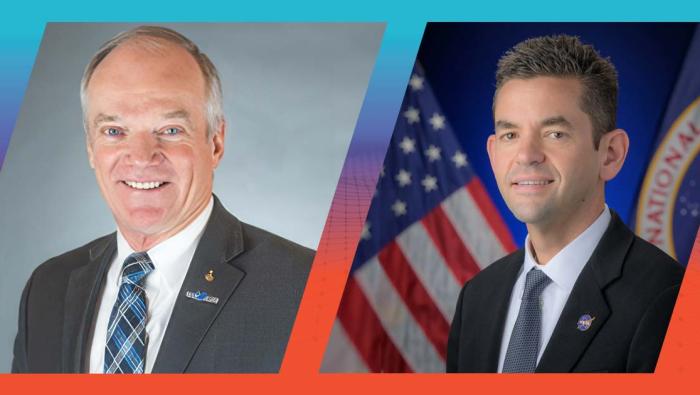
Both men are longtime business jet pilots. Isaacman, who has logged more than 8,000 flight hours, set a round-the-world speed record for light jets in a Cessna Citation CJ2 in 2009 and co-founded adversary air training company Draken International. Precourt, a four-time space shuttle astronaut and NBAA board member, has more than 11,000 hours in more than 90 aircraft types, holds type ratings in several Citations, and chairs the Citation Jet Pilots Association’s safety committee.
Precourt led the conversation on the Horizon Stage. The session, which NBAA dubbed “The Launch,” also featured the presentation of NBAA’s Meritorious Service Award to Air Lease founder Steven F. Udvar-Hazy. Stephanie Goetz, a speaker and pilot of The Pink Jet, served as emcee.
Drawing on his experience flying high-performance jets, Isaacman said he runs NASA the way pilots approach a good flight debrief: plan thoroughly, execute, and then focus on what went wrong. “Anyone who’s been in a good flight debrief knows that it’s the most confidence-inspiring thing possible to talk through what you got wrong,” he said, adding that projecting a “facade of perfection” is “probably one of the most unhealthy things you can do” as an organization.
“The test data so far is extremely encouraging,” Isaacman said of the X-59, the centerpiece of NASA’s Quesst mission to enable commercial supersonic flight over land. “We are doing a lot better than we thought we would so far.”
Meanwhile, the FAA in June proposed replacing its 1973 ban on civil supersonic flight over land with a noise limit. Under this proposal, operators could fly supersonically over the U.S. without special authorization as long as sonic boom overpressure at the surface stays at or below 0.11 pounds per square foot.
Initial operations would rely on a Mach cutoff in which speed, altitude, and atmospheric conditions refract the boom upward before it reaches the ground. The FAA aims to finalize the rule, along with separate takeoff and landing noise standards, by mid-2027.
Isaacman tied the X-59 program’s recent momentum to NASA’s push to rebuild in-house expertise. “We had no flight-test capabilities at all at NASA earlier this year. It was all entirely outsourced,” he said. When he was confirmed as NASA administrator, he added, the X-59 had flown only once before sitting in maintenance for five months.
NASA’s own test pilots have nonetheless flown the X-59 from the start. Nils Larson piloted its first flight on Oct. 28, 2025, and Jim “Clue” Less flew its first supersonic flight in June.
In late September, the X-59 flew a record six times in one week and reached a top speed of Mach 1.53, according to NASA. It has since reached its 50-hour maintenance checkpoint, Isaacman said, and NASA plans to bring the aircraft to its Max Power Air and Space Expo at Kennedy Space Center in Florida on November 7 and 8.
Looking beyond the X-59, Isaacman said he expects “a very healthy X-plane portfolio to emerge in the years ahead.” Taxpayer-funded aeronautics research should target radical airframe and propulsion designs at very low technology readiness levels, not work companies would fund anyway, he said.
A Close Race to the Moon
Isaacman warned that the U.S. and China could land astronauts on the moon within months of each other. “This one’s going to be close,” he said. China aims to put astronauts on the lunar surface before 2030, while NASA is targeting 2028, before President Donald Trump’s term ends.
Before astronauts land on the moon, the two countries are already racing to claim the best sites for a moon base at the lunar south pole, where there is water ice and where crater ridges get near-constant sunlight, Isaacman explained. “There’s only so many good parking spots there,” he said, adding that a few robotic landers and rovers could “quite literally deny access” to rivals.
Isaacman described the moon as the place to perfect habitats, surface power, communications, and spacesuits before attempting the six- to nine-month journey to Mars.
Isaacman said the U.S. must win this second space race as it did the first, then hold itself to the same candid review pilots expect after every flight. China sent its first astronaut into orbit in 2003 and could now beat the U.S. back to the moon, he noted. “We got to have that real fighter debrief on how we wound up in the situation where we could ever have allowed it to be that close.”
More In Regulations and Government