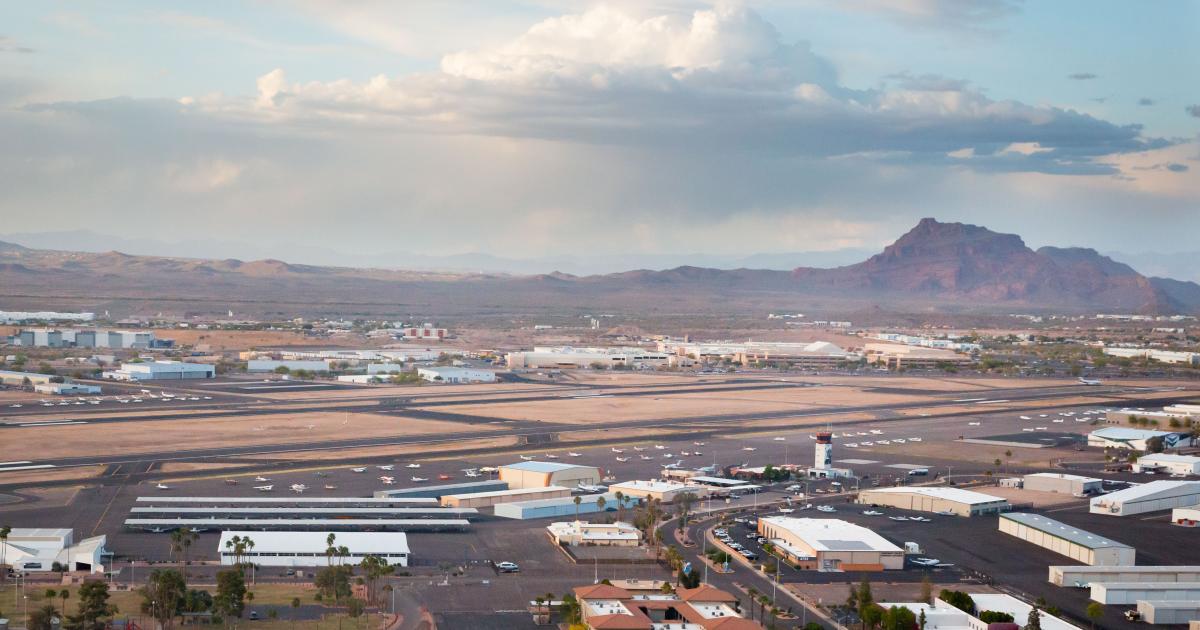
Aircraft Owners and Pilots Association (AOPA) continues to champion objections to the revised landing fee proposal from the city of Mesa, Arizona, for general aviation aircraft at Falcon Field (KFFZ), even after the issuance of a new fee schedule.
In March, the city council approved the imposition of landing fees—which it claims are necessary to bridge a funding gap at KFFZ—with a proposal that based aircraft weighing 6,000 pounds or less would pay $20.35 per landing after their first 10 landings each month, and transient aircraft of the same size would pay $24.35 per landing. Those fees, originally set to take effect May 1, were delayed several times, most recently to late October.
The FAA received at least four Part 13 complaints regarding the assessment of the landing fees, which some claim are a thinly veiled attempt to curb flight training activity and the noise that draws local community complaints. Two flight schools at Falcon Field filed one of those complaints, along with a federal lawsuit against the city. The agency notified the city that the landing fees may be inconsistent with federal obligations and could affect airport use and pose operational safety risks.
In a letter to the FAA, AOPA, the Arizona Pilots Association, and the Aviation Safety Advisory Group of Arizona asked that the agency find the city of Mesa in violation of its federal grant obligations, that the FAA ask the city for federally required financial documentation, and that, if the city does not rescind the fees, the FAA initiate a formal Part 16 enforcement action.
As a result, the city issued a new fee proposal late last week, under which owners would pay $4.14 per 1,000 pounds of their aircraft’s maximum landing weight—or $10.35 per landing for an aircraft the weight of a Cessna 172, an aircraft commonly used for initial flight training. According to AOPA, the new fee structure does not differentiate between based and transient aircraft and does not provide any free landings for based aircraft.
“We appreciate the city of Mesa recognizing that the original fee structure would not work and going back to the drawing board,” said AOPA general counsel Fernando Campoamor. “However, its new proposal does not address the concerns we previously raised and makes things worse by eliminating the exemption for based aircraft. The city also has yet to publish the claimed ‘detailed data’ that allegedly supports the fees.”
The revised landing fees are scheduled for consideration by the Mesa City Council on December 8, at the conclusion of the required 60-day public notice period.
More In Airports