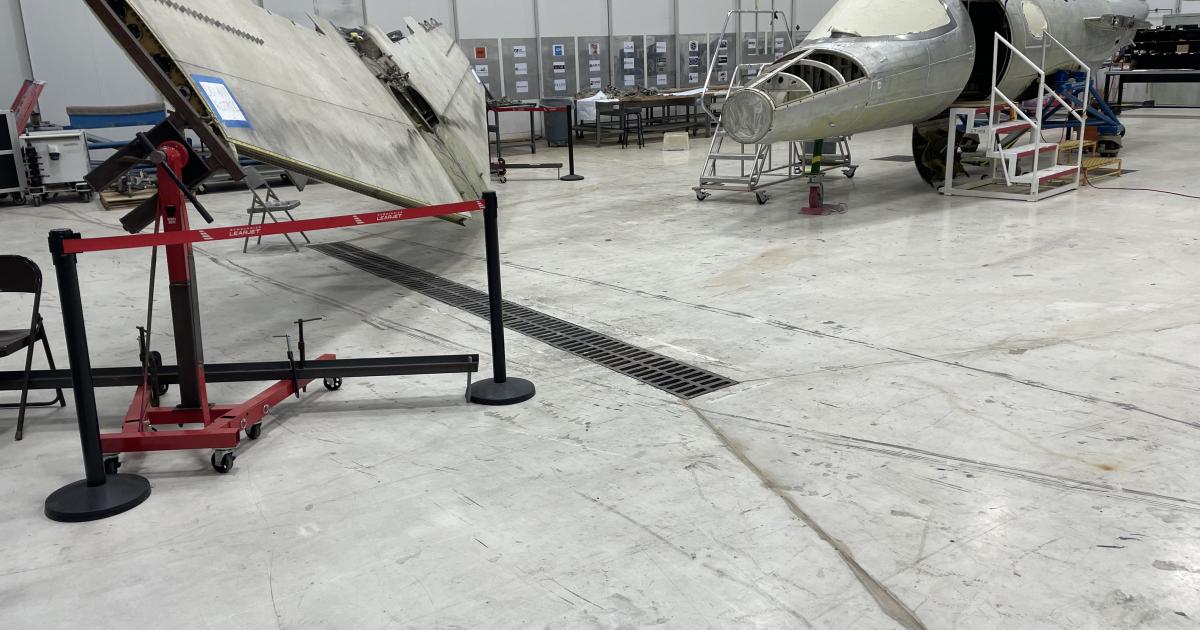
Classic Lear Jet Foundation (CLJF), the group working to restore Lear 23-003—the first production Learjet—is making progress toward its goal of returning the vintage aircraft to flight. This week, it is at NBAA-BACE for the first time with its own booth to highlight the effort taking place in the former Learjet delivery center at the Bombardier campus in Wichita.
“The restoration continues to be driven by dedicated volunteer labor and the generous support of our donors,” said foundation president Bill Kinkaid, adding that in the two years since the project began, it has surpassed 4,000 hours of volunteer labor. “During that time, we have made significant progress in wiring, inspections, and structural repairs, while numerous components have been sent off-site to donors and specialist partners for rebuilding and restoration.”
Work over the past year has focused on the dismantling and non-destructive testing of the vintage twinjet. To date, the forward half of the aircraft has been X-rayed. Once the baggage floor is removed and additional structure is exposed, X-raying will continue through the aft section.
One major recent decision involved the twinjet’s wing. When the aircraft was first inspected in Florida in 2022 ahead of its acquisition by CLJF, corrosion was identified on the lower wing skin. When the detailed evaluation of the wing began in Wichita in late 2024, it was determined that the corrosion was beyond allowable structural limits, making a major repair or replacement of the skin necessary.
In preparation for possibly re-skinning the wing, the group asked Bombardier to preserve the main wing jig, but further investigation proved that sourcing the appropriate-specification aluminum would have required a dedicated production run, resulting in an amount far in excess of what would be required.
The group had wanted to retain as much of the original aircraft as possible in the restoration, but faced with those economic realities, it then made the difficult decision to pivot to a replacement. Six wings of the same vintage were evaluated before the one from sibling 23-028 at BAS’ salvage yard in Bates City, Missouri, was acquired. While that assembly has minimal external and internal corrosion, Kinkaid said there are some differences in systems configuration, and the wing does not include the leading edges, so additional work will be required to bring it into the desired configuration.
Late last month, the aircraft’s horizontal stabilizer was returned from X-ray testing at nearby Paragon NDT, where it was thoroughly examined for structural cracks and corrosion. The unit will next be sent to DAS Aviation for necessary repairs, including the installation of two new spars.
CLJF will not predict a completion date for the project, as it continues to focus on the near-term work. “Looking ahead to 2027, we are actively recruiting additional volunteers and expanding our work schedule,” Kinkaid told AIN. “This increased capacity will allow us to continue building momentum and advancing the restoration toward completion.”
Today at 1:30 p.m., the foundation will have a special guest at its NBAA booth: legendary Learjet pilot and private aviation pioneer Clay Lacy. Lacy, who founded California-based Clay Lacy Aviation, was one of the major donors who enabled CLJF to acquire 23-003 in August 2023.
In this article
More In Aircraft