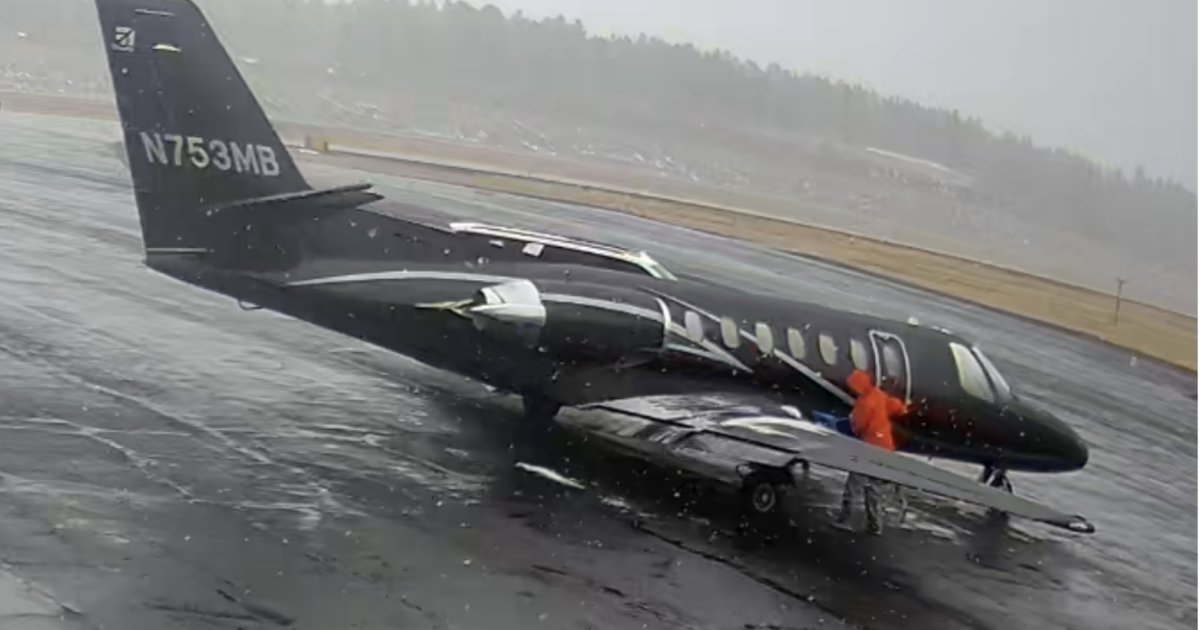
Inadequate preflight planning, poor preflight inspection, and an attempt to take off above a Cessna Citation V’s mtow with snow-contaminated wings led to a runway overrun on Dec. 27, 2024 at Stevens Field Airport (KPSO) in Pagosa Springs, Colorado, according to a newly released NTSB final report. The overweight, contaminated wings likely kept the airplane from rotating at the pilot's calculated speed, and by the time she rejected the takeoff, the airplane was already above decision speed.
The planned Part 91 flight was bound for Tulsa Riverside Airport (KRVS) in Oklahoma, but ended when the airplane ran off the end of Runway 1 at KPSO. The light jet ran into the grass, damaging both wings; the two pilots and eight passengers were not injured.
According to the NTSB, the pilot's type rating required a qualified second-in-command (SIC), but the copilot held no such rating and, by his own account, did not meet the requirements to act as SIC. The pilot told investigators that she was aware the copilot had no flight experience in type but assumed he was properly trained based on his job at a flight simulator training provider.
The airplane’s lease agreement required the lessee, a passenger aboard the flight, to hire “professionally trained and qualified” pilots. But according to the lessee, the management company that operated the airplane, Metroplex Flight Services, arranged the pilots itself and asked only for a passenger count, never for passenger or baggage weights.
Passengers told NTSB investigators that the flight crew filled every exterior luggage compartment, loaded a stroller into the lavatory and a child’s car seat into an empty passenger seat, and let each passenger keep a personal bag at their seat. The pilot calculated weight using ForeFlight’s standard average passenger weights—205, 184, and 87 pounds respectively for men, women, and children—for the five men, four women, and one child aboard, plus an estimated 130 pounds of baggage in the rear compartment and 110 pounds in the nose, arriving at a calculated payload of 1,285 pounds. Weights for each bag were determined by “heaviness,” not scales, the NTSB said.
The pilot told investigators the airplane’s takeoff weight was about 15,700 pounds, equal to mtow. After the accident, a passenger gave investigators additional figures, including about 100 pounds of luggage inside the cabin and roughly 240 pounds for three dogs aboard, bringing the total reported weight of people, animals, and baggage to 2,154 pounds.
Using that information, investigators calculated the airplane’s actual takeoff weight at about 16,502 pounds, some 600 pounds over the 15,900-pound mtow, with the center of gravity near its forward limit and likely outside the operating envelope.
The pilot said she performed a standard preflight inspection and noticed only liquid water on the wings, with no icing or other contamination. Airport surveillance video, however, showed snow already accumulating on the wings as the pilot and copilot walked out to the airplane, and continuing to fall as passengers boarded. One passenger said FBO personnel, working with a handheld brush because the airport had no deicing capability, cleared the wings three separate times over about 11 minutes.
According to the copilot, the pilot performed a tactile check of the wings after all passengers were loaded, but video showed no such check on the airplane’s right wing—the only wing visible on camera—after the final snow removal.
Contamination remained visible on the wings as the airplane began taxiing, the ramp pavement was wet, and the snowfall rate appeared to increase once the airplane left the ramp. About 20 minutes passed between the last time snow was brushed from the wings and the start of the takeoff roll. The report cited FAA Advisory Circular 135-17, which states that snow or frost can reduce wing lift by as much as 30% and increase drag by 40%.
The pilot gave conflicting accounts of what followed. She initially said the airplane accelerated normally through the 96-knot decision speed and 103-knot rotation speed, but did not rotate despite full aft deflection of the control yoke. Later, she told investigators that the airplane did not seem to accelerate at the expected rate.
Data downloaded by the NTSB from the airplane’s Garmin GTN 750 avionics units showed it reached 120 knots indicated airspeed and 138 knots ground speed before the pilot rejected the takeoff with maximum braking and full reverse thrust. That is above the speed that FAA guidance describes as “the maximum speed by which a rejected takeoff must be initiated to assure that a safe stop can be completed within the remaining runway.”
The airplane ran off the end of the runway, continued into the grass, and pivoted left before stopping. Passengers and crew exited and were met by airport emergency personnel. A post-accident examination found no evidence of pre-accident flight-control or engine anomalies that would have precluded normal operation.