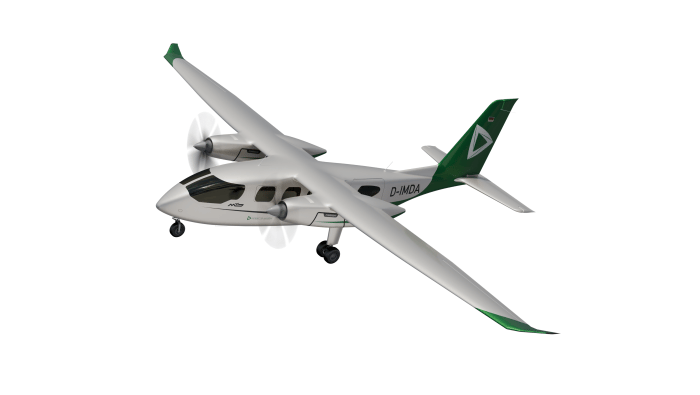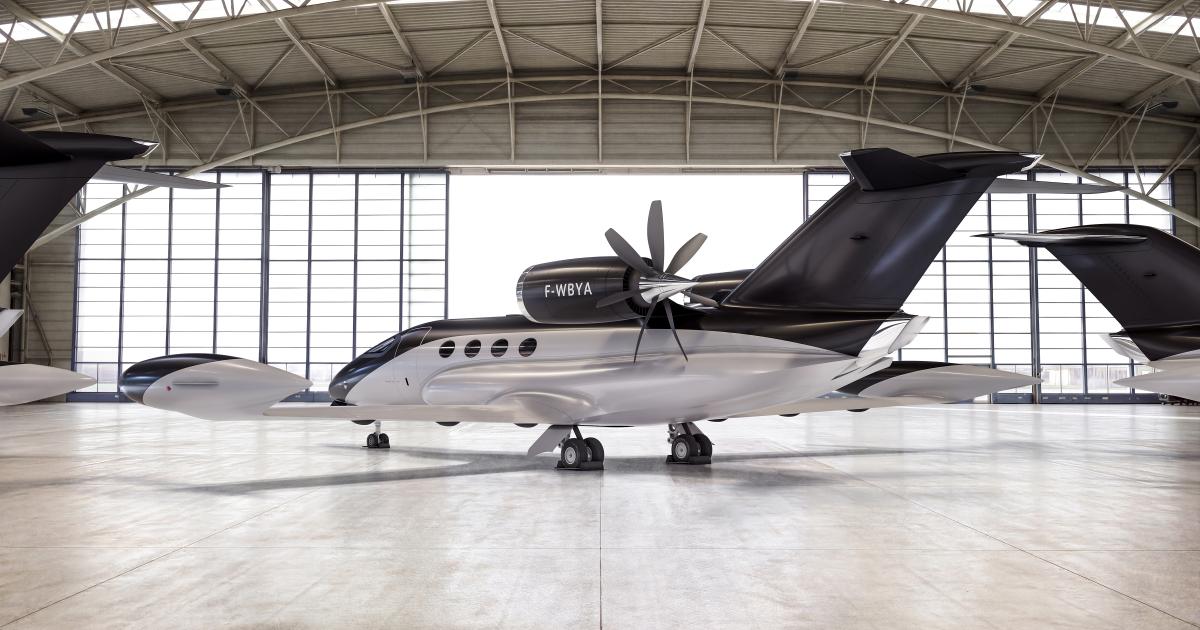
Beyond Aero has signed letters of intent for around 200 examples of its BYA-1 hydrogen-electric business airplane. As of mid-October, the French start-up reported agreements with 43 different prospective operators, which—if firmed up—would lead to sales worth more than $2 billion, implying a base price of around $10 million per airplane.
The Toulouse, France-based company is working toward EASA CS-25 type certification and aims to start deliveries of the eight-seat model in the early 2030s. Earlier this year, it switched from CS-23 rules to allow for an increased mtow to 9.6 tonnes (21,164 pounds), mainly on the basis that this would give operators improved one-engine-inoperative performance.
In March, Beyond Aero completed the preliminary design review, confirming a switch from ducted-fan engines to a pair of tail-mounted pusher propfans. According to chief engineer Luiz Oliveira, the switch in the fuel-cell-based engine architecture was due to the realization that the ducted-fan approach would take longer and be more costly to certify, although the company believes the technology could be deployed on future aircraft.
Beyond Aero co-founder and CEO Eloa Guillotin predicted that the emissions-free aircraft could attract younger clients deterred from private aviation on environmental grounds. However, the company is also pressing the case for reduced operating costs and believes the BYA-1 will be at least as economical to operate as turboprops such as the Pilatus PC-12 and Beechcraft King Airs.
Working with Airports
Earlier last month, Beyond Aero announced a partnership with airports in southern France that will help to develop gaseous hydrogen refueling facilities at locations they see as likely early adopters of the technology. Nice Côte d’Azur (LFMN), Cannes Mandelieu (LFMD), and Golfe de Saint-Tropez (LFTZ) airports are considering plans for a fixed dispenser in a dedicated parking area for hydrogen aircraft and a mobile refueling vehicle.
“We chose [to enter] this market because we see a strong need [to reduce carbon emissions] and we know that business aviation is willing to pay to finance innovation, as it has done in the past with advances such as winglets,” Guillotin told AIN. In her view, the sector is facing pressure not only in terms of environmental charges, such as the controversial solidarity tax in France, but also from rising jet fuel costs as seen since the start of the Iran war.
Beyond Aero believes that around half of its sales will go to aircraft charter and management fleets, with the rest being split between high-net-worth individuals and corporate flight departments. In Europe, Guillotin said business aviation hubs—including London, Paris, and Geneva—will be ideal for the BYA-1’s six-passenger range of 800 nm and cruise speed of 300 knots.
According to Guillotin, the question of who pays for the required hydrogen refueling infrastructure will vary by location, depending on the business model of each airport. Aboard the aircraft, hydrogen will be stored in tanks fitted in each wingtip.
Beyond Aero, which is a first-time exhibitor at NBAA-BACE, already has infrastructure partnerships in place with Aéroports de Paris and business aviation services group Luxaviation. The UK Civil Aviation Authority recently selected the company to participate in a “hydrogen sandbox” test initiative with London City Airport (EGLC) and the University of East London.
Beyond Aero’s 80-strong team of engineers is now working toward the critical design review and first flight of a full-scale prototype. The company, which is not publishing projected timelines for each of these milestones, plans to conduct further funding rounds to bring the BYA-1 to market.
More In Sustainability and Environment