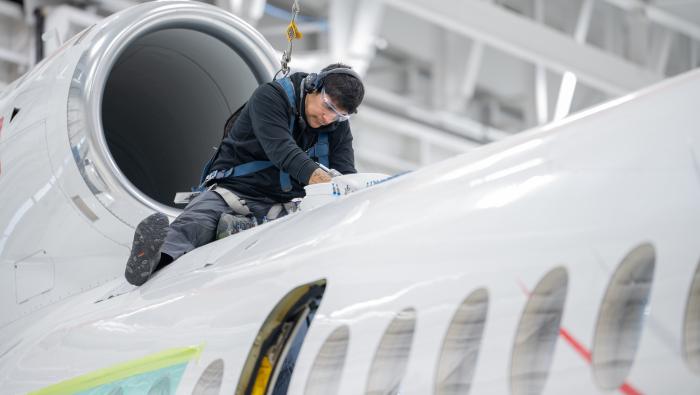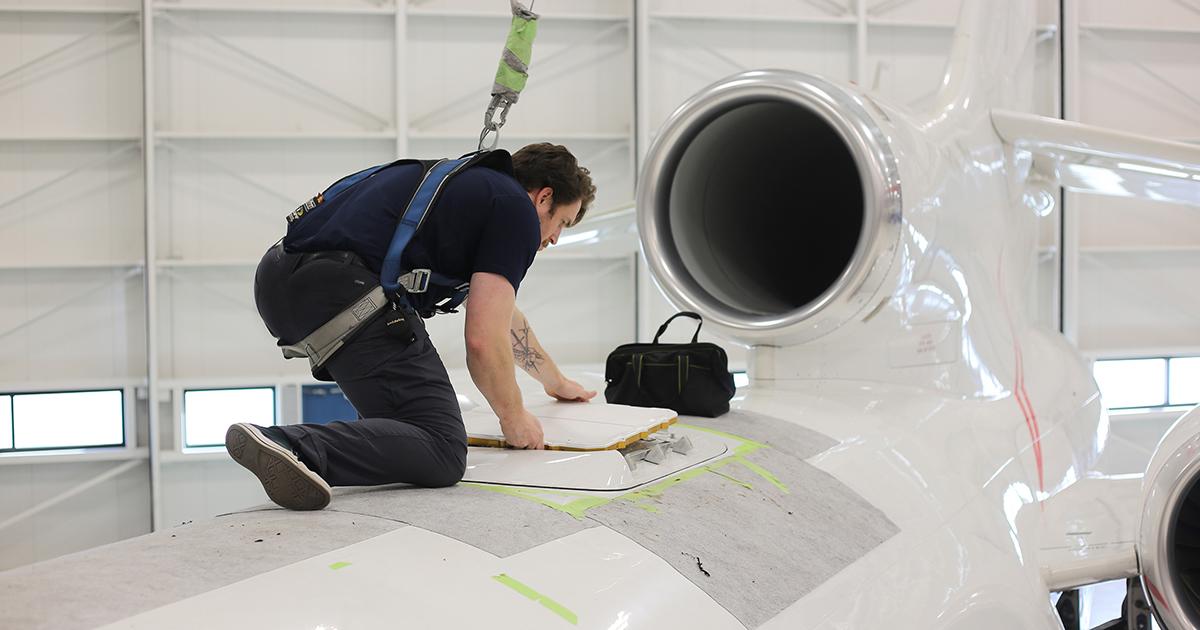
The Dassault Falcon that lands at Western Aircraft today shares a name with the one that landed 25 years ago and not a lot else. The airframes are more sophisticated, the cockpits unrecognizable, and connectivity that barely existed in 2001 is now something operators plan trips around. The more interesting question after 25 years isn’t how long Western has supported the Falcon. It’s what a shop learns about an aircraft family that never stops changing.
A manual spells out the work a Falcon needs. Knowing what to expect along the way is something a team earns over time.
Western earned its first designation as a Heavy Jet Service Center from Dassault Falcon Jet in 2001 and completed its first C-check in 2003, on a Falcon 50 that flew in from a Seattle operator. The Boise MRO has since completed more than 150 C-checks across Falcon 50, 900, 2000 and 7X, and this summer it added its first Falcon 8X 1C inspection. It has served more than 550 Falcon customers over that stretch. Today the shop has 26 factory-trained Falcon technicians, 24 of them licensed A&Ps, and some of the people who were here for that first C-check are still on the floor.
Doug Knehr, Western’s Falcon team lead, is one of them. He started in 2001 and worked that first Falcon 50.
"That 50 was the first Falcon I ever touched," Knehr said. "Back then these airplanes were cables and pushrods. Now it's fly-by-wire, and you're hooking up a computer to help diagnose it. The airframe hasn't changed much. Just about everything around it has."
“After 25 years, the value isn’t just that we’ve done the work before,” said Brody McKenna, director of MRO operations for Western Aircraft. “It’s that we’ve seen how these aircraft behave over time. That changes how you plan a project, how you read what you find and how you talk to an operator about it.”
Ask the people who have spent careers on the platform what 25 years of Falcon work teaches, and a few lessons come up again and again.
Experience is knowing what to look for
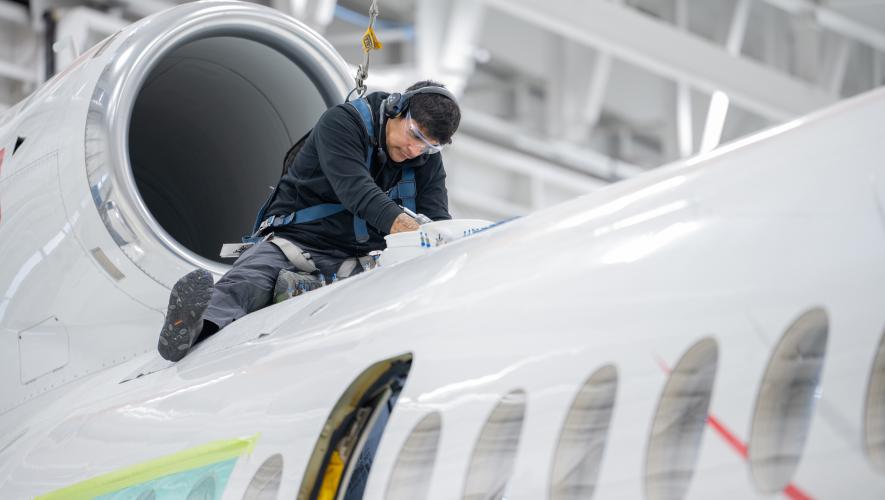
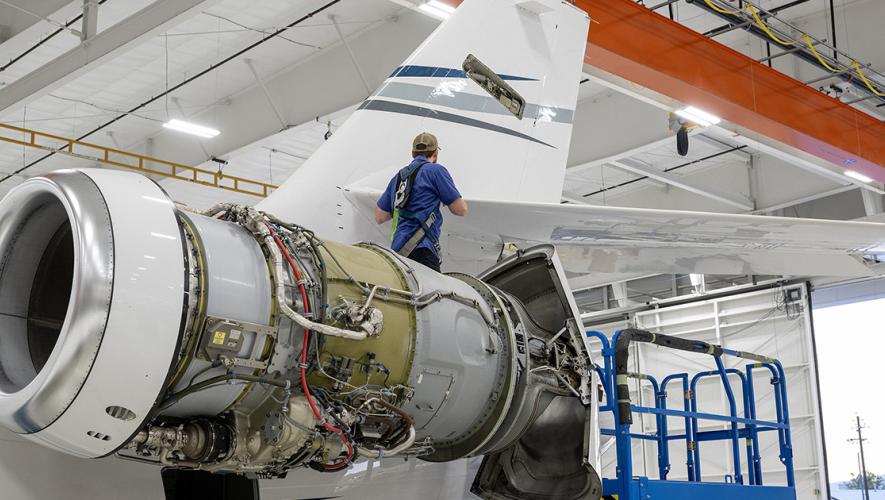
A maintenance inspection follows a defined procedure. What it turns up does not always follow a script, and that is where time on a platform matters most.
“The manual tells you what to inspect. It doesn’t tell you what you’re likely to find on a particular model at a particular point in its life,” said Jeff Watson, Falcon service manager. “After enough of these, you start to know where to look a little harder and what questions to ask before the aircraft even arrives.”
In the early years, much of that experience came from the field. As Western's reputation spread through the Northwest, operators began calling Boise when a Falcon was down somewhere else.
CJ Miller, who worked those early jobs and manages Western’s mobile response team, remembers how much there was. “Once our name got out there as a reputable service center, we were called on regularly to support off-site AOG events,” Miller said. “A lot of engine changes in the field early on, first for the Falcon 2000 and then the 2000EX fleet.”
That kind of work, on unfamiliar ramps and against the clock, teaches a team how an aircraft behaves in a way no checklist can. The same instinct shows up in the hangar.
“You do a couple hundred inspections and you know what a repair’s supposed to look like,” said Knehr, who has worked Falcons at Western since 2001. “The book doesn’t always tell you that. But you don’t lead with what’s in your head either. You check it against the manual. It’s a good reference, not the answer.”
For an operator, that is what experience buys: a team that knows what it’s looking at and still checks the book every time.
Planning is part of the technical work
Long before an aircraft reaches the hangar, the outcome of a heavy maintenance visit is already taking shape.
“Most of the work on a successful project happens before we ever open a panel,” McKenna said. “Parts, tooling, service bulletins, the modifications an operator wants done while the aircraft is already apart. Sort that out early and the visit typically goes smoothly. If you don’t, that’s where you lose time.”
That same experience has taught the team what to ask for and when. Before an aircraft arrives, Western works with its director of maintenance to set the scope, order long-lead parts and fold in projects the operator has been putting off. The ones who get the most out of a visit, McKenna said, start the conversation months ahead.
The aircraft changes, so the shop has to
Twenty-five years of experience does not mean doing the same thing for 25 years. The Falcon line has moved from the 50, 900 and 2000 generation into the fly-by-wire 7X and now the 8X, each step bringing systems earlier Falcons never had. Cockpits went from analog panels to integrated flight decks, connectivity from convenience to something operators build trips around. Keeping current has meant steady investment in training, tooling and factory-trained technicians.
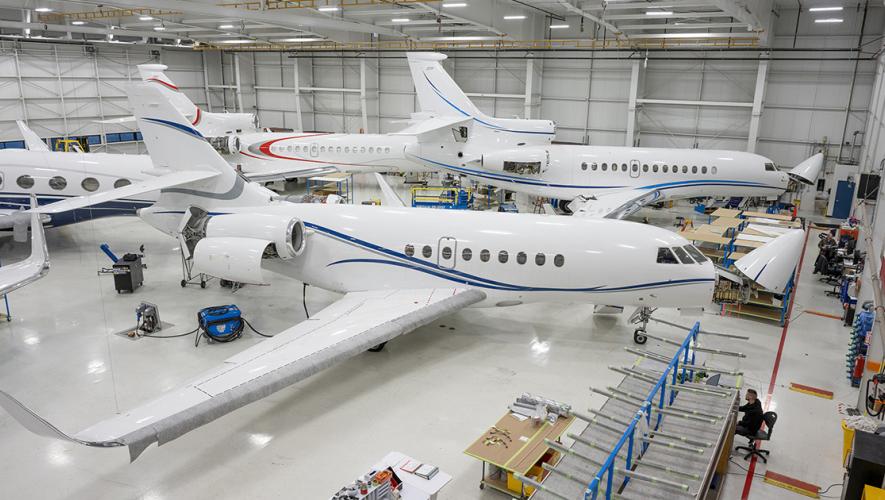
It has also changed what a single visit can accomplish. The recent 8X came in for its first 1C, the most comprehensive scheduled event in the Falcon program, required every 96 months or 4,000 flight cycles. It calls for removing all exterior panels and significant interior components. With the aircraft already that far apart, Western handled the 1C, service bulletin work, a Honeywell EASy IV cockpit upgrade and a dual Garmin GI 275 installation in one downtime event rather than three.
“If you froze your knowledge in 2005, you couldn’t do this job now,” McKenna added. “But completing our first 8X 1C matters because it shows the experience is still building. We carried what we learned on the 7X into the 8X, and we’ll carry what we learn on the 8X into whatever comes next.”
Knowing the operator, not just the aircraft
The last lesson has less to do with airframes than with people. Heavy maintenance means a long stretch of downtime, and how a shop handles the findings, the schedule and the daily contact can matter to an operator as much as the work.
“You can know the aircraft inside and out and still get the relationship wrong,” McKenna said. “A big part of what we’ve learned over 25 years is how to communicate. When to call, what an operator needs to hear when we find something unexpected and how to be straight with them about schedule.”
Western assigns a dedicated point of contact to each project, so an operator hears from a person rather than a portal. The clearest sign it works, McKenna said, is the operators who keep coming back, some through multiple aircraft.
“Western Aircraft has been our primary maintenance facility since we acquired the aircraft,” said Walt Chapman, aircraft manager and chief pilot for Mason Aviation LLC. “They provide the expertise of an authorized Falcon service center with the personal attention of a smaller shop. Their convenient Boise location and flexible, responsive team make them consistently easy to work with.”
Still learning
Western began its Falcon work in 2001 with a single service center designation. Twenty-five years and more than 150 C-checks later, its first 8X 1C shows the experience is still accumulating. The aircraft will keep changing. What 25 years has taught Western is how to keep up and which parts of the job never change no matter what rolls into the hangar.
“The day you think you’ve seen everything on these aircraft is the day you get in trouble,” McKenna said. “Twenty-five years in, we’re still learning. That’s the part that keeps it interesting.”
For more information on Falcon services, email [email protected].
In this article

More In Maintenance and Modifications