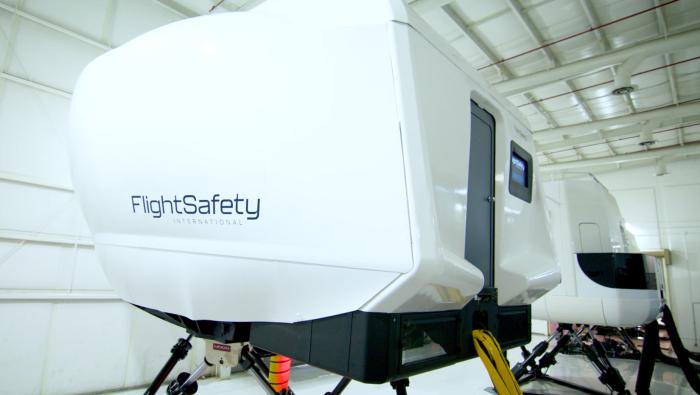

In 1951, corporate pilot Albert Lee Ueltschi rented a Link trainer to provide pilot training in the Marine Air Terminal at New York’s LaGuardia Airport under the name FlightSafety, Inc. Essentially an eight-foot-long by two-foot-wide wooden box in the shape of an airplane with a 10-foot wingspan (when wings were connected), the Link trainer ran on compressed air controlled by the pilot inside the box and an instructor at a desk. Outfitted with the same controls and instruments as an airplane, it mimicked flight and served as the world’s first flight training device (FTD). FlightSafety purchased four Link trainers in 1953, then a Link Translator (the company’s first flight simulator) in 1955.
Meanwhile, in 1949, an 18-year-old pilot from Chicago named Rudy Frasca joined the U.S. Navy and began serving as a flight instructor using Link trainers at nearby Glenview Naval Station. Frasca left the Navy after the Korean War to study aviation psychology at the University of Illinois, using Link and other early flight training devices in his research. Combining his experience from the Navy and university research, Frasca built his first flight simulator in 1958 and founded Frasca Aviation—later to become Urbana, Illinois-based Frasca International—in his garage
More In Training and Workforce